

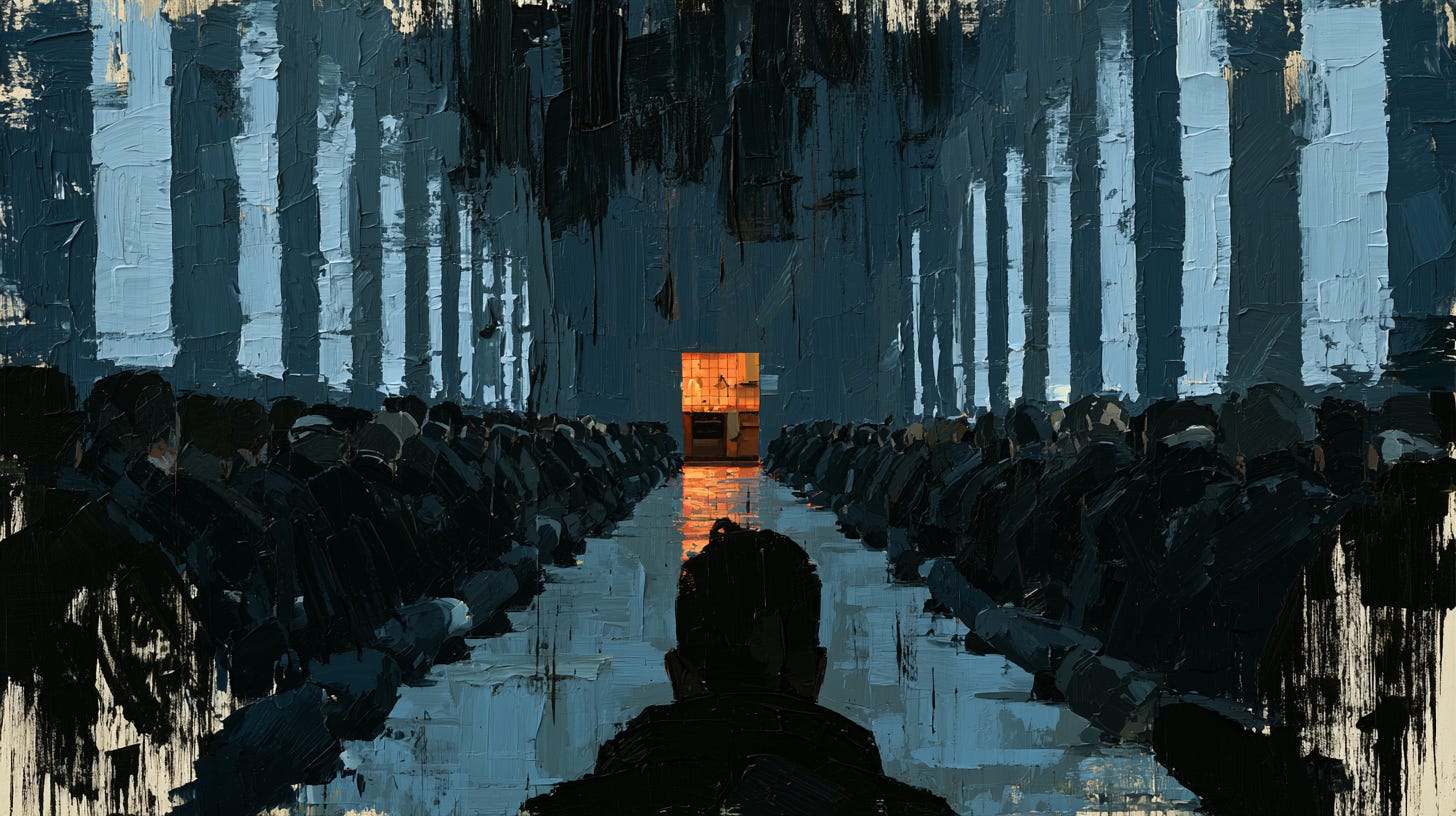
The gong goes at 4:30 in the morning. I am somewhere in the countryside beyond the reaches of the chaos of Mumbai. The mornings are my favorite, it is something about the air. A mix of charcoal smoke and florals. The kitchen staff has begun, and I put one foot in front of the other on the way to the meditation hall I was assigned on the day I arrived. I sit cross-legged in a dim concrete room full of strangers I would not speak to, look at, or gesture toward for ten days. No phone. No books, no notebook, no music, no run to burn the agitation off. The teachers call it Noble Silence, and it is nearly total: speech is reserved for the teacher, and only about the technique. The instruction that came with all this renunciation was almost insultingly small. Observe the breath where it crosses the upper lip. Don’t regulate it. Don’t count it. Just know it.
My mind took about four minutes to begin drafting the case for leaving. When I returned to my dorm, I read my travel size shampoo bottle eighteen times, most of it in Thai script.
It was a good case. What unsettled me was the form. The mind never said: this is uncomfortable and I want out. It said reasonable things, in my own voice, with supporting evidence and a plan of escape. Sometimes it screamed at me instead.
Any escape would require breaching the female section, Hollywood-style (the sexes were kept separate), and rescuing my wife. We would board a plane, back to civilization, and tell ourselves we did the right thing.
The body ran its own campaign. My back was already going, sharp shooting pains, and sitting still on hard pillows upon a concrete floor for over ten hours a day does something to a back and a pair of knees that I am not sure I can describe to anyone who hasn’t done it. By day two my spine had located a vertebra I could not have named on an anatomy chart, and made it the center of my universe. We had gotten in good shape running while traveling; sitting turned out to be my kryptonite. I was the one white guy in the hall, stared at by everyone, and also the one asking for the most little pillows to wedge the pain away. The cushion was unimpressed.
The escape arrived dressed as prudence, in my own voice, with supporting evidence.
The Oldest Map of the Exits
Somewhere around the third day, I noticed that my distractions had a structure. They were not infinite. The same five doors kept presenting themselves. Appetite: the meal I would eat when this was over, and other hungers besides. Irritation: at the man three cushions away whose proud farting I could smell, an offense he compounded by continuing to exist. Heaviness: a fog of sleep that arrived precisely when attention was asked of me, and at no other hour of the day. Agitation: the planning mind, the leaving mind, the mind forecasting me to the next country. And doubt, the quietest of the five: the voice asking whether any of this did anything at all.
Then people began tapping out. Leaving. They would give up, right in the middle. One man, who I was convinced was one of the stronger ones, didn’t make it to the end of day three.
A teaching catalogued these five doors about twenty-five centuries ago. The Satipatthana Sutta is a short discourse attributed to the Buddha and preserved in the Pali Canon, and it reads like a lab manual: observe the body, observe sensation, observe the mind, observe the mind’s recurring patterns, and for each, note what is present, what is absent, how it arises, how it passes away. It opens with an audacious claim — “This is the only way, monks, for the purification of beings” — and then drops all grandeur and gets to work. My five doors appear there by name: the five hindrances. Sense-desire, ill-will, sloth and torpor, restlessness and remorse, doubt. The instruction for meeting them runs like this:
“Herein, monks, when sense-desire is present, a monk knows, ‘There is sense-desire in me,’ or when sense-desire is not present, he knows, ‘There is no sense-desire in me.’ He knows how the arising of the non-arisen sense-desire comes to be; he knows how the abandoning of the arisen sense-desire comes to be; and he knows how the non-arising in the future of the abandoned sense-desire comes to be.”
— Satipatthana Sutta, Nyanasatta Thera translation
He knows. The text wants more than watching: it wants the meditator to know how a hindrance is abandoned, and how it is kept from coming back. In the tradition I sat in, the watching is nearly the whole instruction. Fighting a distraction feeds it; you have entered into a relationship with it. Observation starves it. The method repeats across body, feeling, mind, and mental pattern, with the patience of a text that expects to be ignored for several days before it lands.
The text’s sharpest tool is a word that does not translate cleanly: vedana, the feeling-tone riding on every moment of experience. Pleasant, unpleasant, neutral. It arrives before the thought, before the story, before the identity. Sit long enough and you can feel it operating: the itch registers as unpleasant and the hand is already moving to scratch, the whole transaction complete below the level of anything I would call a decision. The practice wedges attention into that gap. After enough hours, the space between the sensation and the story widens. Half a second, maybe. It does not sound like much.
From the fourth day the technique changes: attention sweeps the body part by part, observing whatever sensation is present without preference. That part is not in the sutta. The text catalogued the doors; the sweep is a twentieth-century reading of it. That was also the day my back did the thing the recorded discourses kept promising. Something came loose. Like a masseuse who finally got the knot, the pain stopped being the thing running the session.
Equanimity sounds like giving up control. It is how you get it. Whatever I cannot sit with gets a say in what I do next, and my back had been holding the floor for two days. What broke on the fourth day was its authority. The word the tradition uses is anicca, impermanence: the discovery, in your own tissue rather than in a book, that the sensation you are bracing against is already changing — and so is the one bracing.
The lineage that carried this technique out of Burma runs through, of all people, an accountant. Sayagyi U Ba Khin, teacher of the man whose recorded voice filled our evening discourses, ran a meditation center on the side of a government job auditing the national ledgers. The most useful account of the human mind I have encountered reached the modern world through a civil servant. I find this endlessly strange.
The Exits, Scaled Up
Erich Fromm, the psychoanalyst who spent his career asking why people hand their freedom away, catalogued the exits at the scale of civilizations: submission to authority, destructiveness, the quiet dissolve into conformity. Whole nations took those doors in his lifetime; he watched his native Germany take the first one. Fromm was describing the same shape at a bigger size. His three exits are social and my five doors were not; nobody submits to a vertebra. Something unpleasant arrives, and the mind reaches for whatever will make it stop. Sense-desire is the grasp at pleasure that dodges the present moment. Ill-will is destructiveness at the scale of one man’s audible farting. Sloth is the numbing that precedes every surrender. Restlessness is the anxiety Fromm said freedom always carries. And doubt is the open seam that someone else’s certainty slides into. I met all five before lunch on day two. All I wanted was my dahl and rice, please.
Every exit Fromm catalogued at the scale of nations runs first at the scale of a nervous system.
Fromm thought the answer had to include a practice. In the chapters published after his death as The Art of Being, he prescribed awareness and concentration: the daily, unglamorous work of seeing what is actually there. His own exercises are thin: sit still for ten minutes, follow the breath, concentrate on a coin until you can see it with your eyes closed. Then he does something better than defend them. He sends the reader to a commentary on the Satipatthana Sutta, quotes it at length, refuses the parts he cannot accept (he had no use for reincarnation and said so), and takes the awareness instruction anyway. And then he says the method is not enough by itself, and that what it needs added is the analysis of everything a person hides from himself.
Fromm found the text decades before I found the cushion, and he never thought sitting still was the whole of it. He was honest about the cost in a way the wellness industry never is:
“Without effort and willingness to experience pain and anxiety, nobody grows, in fact nobody achieves anything worth achieving.”
— Erich Fromm, The Art of Being
The line I carried home from those evening discourses collides with that head-on: there is no achieving; it is simply sitting with this practice. There is no done, no graduation, no destination. To the part of me that wanted to acquire the retreat (collect the insight, add the credential, return home upgraded), that sentence was the most unbearable thing said in ten days. Fromm had a name for that part: the having mode, the orientation that turns even experience into inventory. You can have a meditation streak, a retreat on your résumé, opinions about equanimity. You cannot have equanimity. The wanting is the obstacle. The course costs nothing, incidentally; old students fund the new ones. Somebody thought carefully about keeping this one thing off the shelf.
Civic Training Nobody Recognizes
Most people who do this come home unchanged. The mindfulness industry stripped the original practice for parts and sold the relaxing ones, and plenty of people have used those parts to sharpen their focus in service of entirely unchanged lives. Ten days of silence did not make me good. It gave me data: high-resolution footage of my own escape attempts, a field guide to my exits, half a second of warning before the reaction fires. What I do with the warning is still up to me, every single time.
That is a smaller claim than the brochure makes.
The five doors are still there when I get up off the cushion. Out here they get bigger offers. Certainty, for the doubt. A target, for the ill-will. A tribe, for the restlessness. Something to scroll, for the heaviness and the agitation both. Every demagogue in history has run that transaction: give me your discomfort and I will give you relief. The discomfort does not have to be dramatic. Boredom will do, or the low hum of an unresolved self. The phone runs a smaller version a hundred times a day. The offer comes in every political color; the relief is the product, and the ideology is just the packaging.
A republic of people who cannot sit with themselves will be governed by whoever promises they’ll never have to.
I have spent two essays on the informed spectator: the man who can describe every mechanism operating on him and still not move. Diagnosis is cheap, and I have been generous with it. This is the part of the answer I could not write until I had sat through it.
Which is why those ten days were civic training that nobody, including the people running it, would ever call civic training. The retreat does nothing but make you watch your own exits until you can recognize them mid-stride.
The recognition works slower than the half second does. Nobody joins a movement in the gap between an itch and a hand. What took three days to see on that cushion was the form of the argument my exits hide behind: leaving arrived pre-reasoned, in my own voice. The handwriting is familiar, and a man who has watched his mind draft the small brief is slower to sign the large one.
It has made me harder to sell relief to. Self-governance requires self-acquaintance, and self-acquaintance turns out to be a physical skill, built the way any physical skill is built: badly at first, in conditions someone else designed, with your own body as the curriculum.
The Technique Has a Country
The accountant is where this argument almost dies.
U Ba Khin was made the first Accountant General of the Union of Burma on January 4, 1948, the day the country became independent. He started a meditation association inside his own government office in 1950 and opened a center in Rangoon two years later. On March 2, 1962, the army took the country, and Burma has spent most of the six decades since under one military government or another. U Ba Khin kept teaching. He died in 1971, nine years into a dictatorship that outlasted him by forty. What came after was worse than indifference: monks led some of it, and Buddhist nationalism supplied the vocabulary for driving three-quarters of a million Rohingya over the border.
The country did get its opening. The generals stepped part of the way back in 2011, and in 2015 the vote was free and the opposition won it. I was there not long after, on a business school trip, in rooms with American executives and Dutch incubator hopefuls, people trying to bring commerce into a country that had just stopped being closed. In February 2021 the army took it back. Our old group thread, dormant for years, lit up.
The technique did not save the republic that produced it. It did not reliably keep its own tradition honest. Any claim that sitting quietly makes better citizens has to walk past that, and it cannot.
So the claim I am making is smaller and harder to get rid of. Nothing produces free societies; the ones we have were argued and fought into existence by people with entirely ordinary nervous systems, and most of the refusals that built them ran on interest, or faith, or stubbornness, or a union card. The half second is what is left when none of those are pointing the right way. It is the defense you need when the offer has been built for you, when your tribe and your interest and everything you already believe are all saying yes. Burma proves it is not sufficient. Nothing is.
On the morning of the tenth day, the silence breaks. It broke early for one man, a large Indian fellow who had lived in the States and had decided I was his kindred spirit. He was reprimanded, and I was glad. That was not the side I expected to be on.
That morning, most of us waiting on transport back to Mumbai, my wife and I sat with a young Jain man and his mother. He reeked of equanimity. Coming off ten days of silence I could have listened to him for hours, and I still cannot tell you what he was actually expressing. I can tell you what came next: a coach car to Mumbai, and then a stampede at the gate for the plane to Malaysia. Whatever he had, it was what I needed to walk into that.
Within a week I was back in the world of phones and feeds. I still reach for it. I reached for it while writing this. But sometimes, between the itch and the hand moving, there is a pause that was not there before.
Ten days of silence bought me half a second. Everything I believe about republics is that half second, scaled up.
Sources and Inspiration
The Heart of Buddhist Meditation: The Buddha’s Way of Mindfulness - Nyanaponika Thera