

The essay worked. For about a week.
I recognized myself in the paralysis of the over-aware: the person who sits at dinner cataloguing everyone’s escape mechanisms while saying nothing.
I promise, I don’t ruin dinner parties. Allow me to paint.
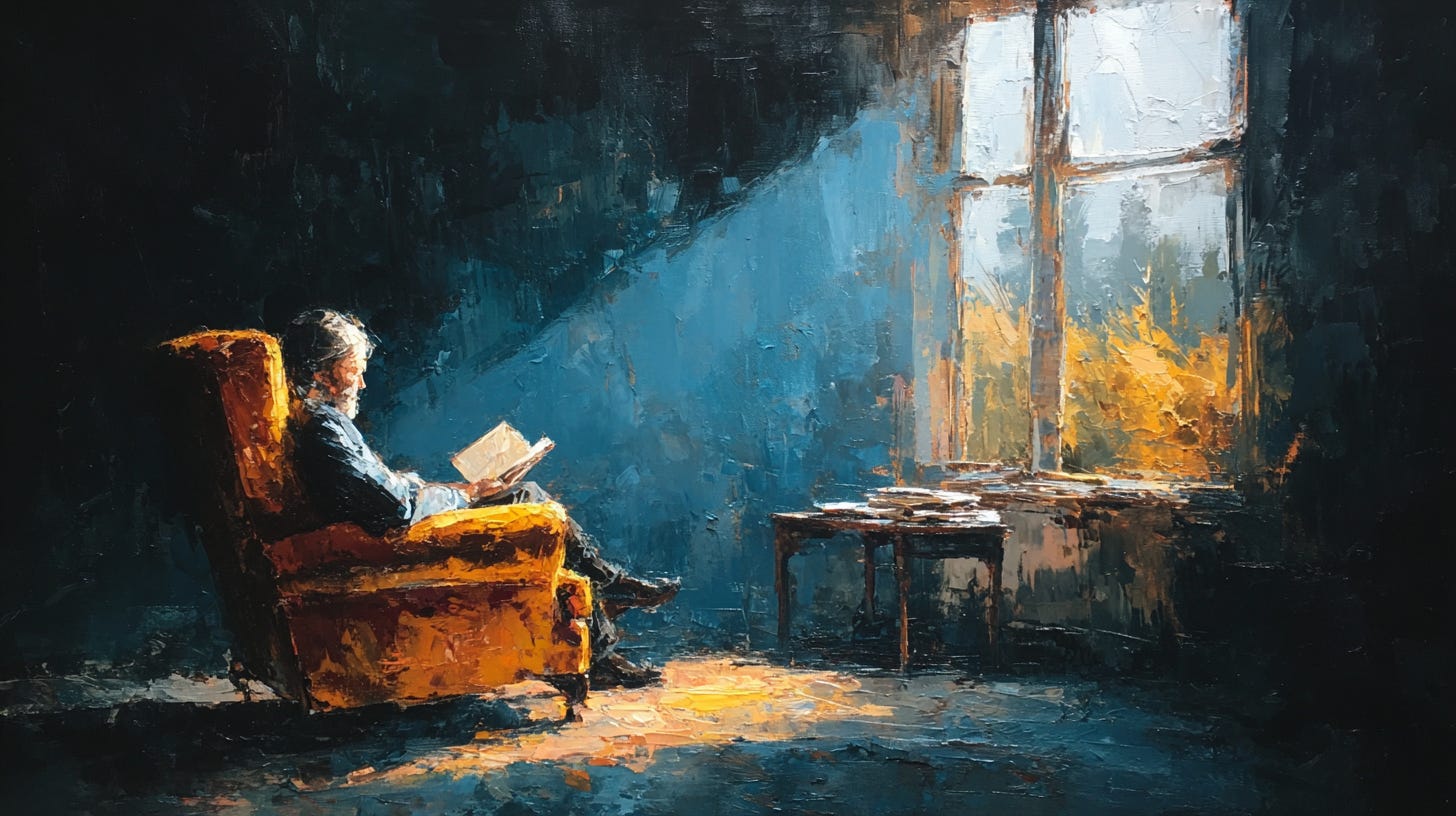
A week later I was back in the reading chair. Three channels open: a paper on democratic backsliding, a Canon source I’d been meaning to finish, a draft covering the 250th. Excellent reasons, all of them, for staying exactly where I was.
I know the name for this. I wrote the name for it. The naming changed nothing.
Anyone who has tried to change a deeply rooted pattern or habit knows the moment. The insight arrives. The behavior doesn’t follow. You see the mechanism with real clarity. You can explain it to others. And you keep doing the thing you just diagnosed. Something deeper than knowledge holds the gap open between seeing and doing.
Aristotle, twenty-three centuries ago, described people who “take refuge in talk” and “flatter themselves they are philosophising,” acting “very like those sick people who listen to the doctor with great attention but do nothing that he tells them.” The patient nodding at the doctor is the oldest portrait of the over-aware reader. Seven centuries later, a North African rhetorician sat in a garden in Milan and described why the nodding never stops.
The prayer of the educated
Augustine of Hippo (an excellent name) was a man who understood things beautifully and changed nothing for years. A professor of rhetoric in fourth-century Milan, he had spent his adult life collecting positions: Manichaeism, Neo-Platonism, the ambitious social climbing of a young academic on the make. He knew, by the time he sat in that garden in 386, what he should do. He had known for a long time. His prayer from this period is the most honest sentence written about the human will: “Grant me chastity and continence, but not yet.”
He explains in the Confessions that he feared God would hear him too soon and cure the disease before he was ready to let it go. He wanted transformation. He also wanted the familiar comforts a little longer. Both desires were genuine, living in the same person at the same moment.
His description of the divided will in Book VIII is the earliest clinical account of what it means to want to change and be unable to begin. “The mind commands the body, and it obeys instantly; the mind commands itself, and is resisted.” The will does not fail because it is weak. It fails because it is split. One part reaches toward the life you know is better. Another clings to what it knows. Augustine insists: this is the structure of human will itself.
“The consequence of a distorted will is passion. By servitude to passion, habit is formed, and habit to which there is no resistance becomes necessity.” Will hardens into habit. Habit hardens into identity. The person who has been observing rather than acting for long enough doesn’t just prefer observation. They have become an observer. The pattern has calcified into the self.
What makes Augustine cataclysmic for the over-aware is his diagnosis of the educated. He was a professional persuader, and he discovered that rhetorical skill works internally as well as externally. The same techniques he used to win arguments in the lecture hall, he used to construct plausible narratives of delay for himself. One more system to study. One more framework to master. One more season of preparation before the real work begins. At his breaking point he cried out: “The unlearned start up and take heaven by force, and we with our learning, and without heart, lo, where we wallow in flesh and blood!”
This is very high-status cope.
The educated are better at self-deception precisely because they have more tools for it. The sophisticated case for “not yet” comes with citations and frameworks explaining why the timing isn’t right, why the problem needs more study before anyone should act. The understanding becomes the delay.
Augustine’s garden conversion is well known. The years of knowing-without-changing that preceded it are the real lesson. The divided will wasn’t resolved by one more argument, one more insight, one more conversation. He heard a child’s voice chanting tolle lege: take up and read. He opened the scriptures at random. This moment was the end of postponement.
The question reversed
Viktor Frankl, a Viennese psychiatrist who survived Auschwitz, watched the divided will under conditions no soul should know. In the extermination camps, he observed a pattern: prisoners who maintained a reason to live (a manuscript to rewrite, a child waiting somewhere, a task left unfinished) survived at higher rates than those who lost their sense of purpose. The moment a prisoner’s meaning collapsed, the body followed. Sometimes within days.
Frankl arrived at Auschwitz with the manuscript of his life’s work sewn into the lining of his coat. The guards took the coat. He spent the rest of the war reconstructing the book on scraps of paper and in his head. The system he called logotherapy was built in the place that should have made meaning impossible.
Its central claim was that the primary human drive is neither pleasure nor power. It is meaning. And meaning arrives through engagement: through work, through love, through how you bear what cannot be changed.
This matters for the over-aware because the analytical loop they’re trapped in is a form of what Frankl called the existential vacuum: the condition of meaninglessness that emerges when traditions, instincts, and social roles no longer tell you what your life is for. The vacuum manifests as restlessness, as the “Sunday neurosis” that arrives when the week’s distractions stop and you’re left alone with the question of whether any of it matters. The vacuum fills itself. With consumption, with conformity, with ideology, with entertainment. Or, for the sophisticated, with analysis. Understanding becomes the content that fills the space where purpose should be. The reading chair, filled with excellent frameworks about human purpose, is the Sunday neurosis in its most vaunted form.
Frankl’s prescription was a reversal. Stop asking what you want from life. Ask what life wants from you. “It did not really matter what we expected from life,” he wrote, “but rather what life expected from us.” And then the line that is the essay’s whole thesis in his voice: “Our answer must consist, not in talk and meditation, but in right action and in right conduct.” Each person is questioned by life. You answer by answering for your own life, by being responsible for what is in front of you.
It challenges the therapeutic model that dominates contemporary self-improvement, where the self is the project and understanding the self is the method. Frankl argued that self-actualization pursued directly will always miss its target. “The more one forgets himself, by giving himself to a cause to serve or another person to love, the more human he is and the more he actualizes himself.” Self-transcendence, meaning found outside the self rather than through more introspection, is the way out of the loop.
What is asking for your response right now? A community that needs someone to show up. A conversation that needs radical honesty. A project that needs someone to begin it badly so it can eventually be done well. Seeing your own children more clearly. Publishing in your own voice, on your concerns, attempting to illuminate. You must listen to know what is calling.
Frankl made this argument as a man who had lost his wife, his parents, his brother, his manuscript, and his freedom. He spent the war reconstructing the destroyed manuscript on scraps of paper. After liberation, he wrote Man’s Search for Meaning in nine days: response to what life was asking of him.
Two brothers, one question
Augustine described the divided will. Frankl prescribed the reversal. Fyodor Dostoevsky, writing in 1880, dramatized both the failure and the alternative in two characters who share a surname but inhabit different worlds.
Ivan Karamazov is the over-aware figure rendered in literature. He is brilliant. He has read everything. He constructs the case against cosmic justice: the Grand Inquisitor, who explains to a returned Christ why the Church was right to take away the freedom Christ offered, because people never wanted it and cannot use it. Ivan sees through every mechanism, every institution, every comfortable lie.
And he goes mad.
His trajectory is analysis without response, understanding without responsibility. He formulates the argument that makes his father’s murder philosophically possible, and his half-brother Smerdyakov, less sophisticated and more literal, carries it out. Smerdyakov tells him it was following his words that he did it. Ivan expected nothing from his own arguments, because expecting would have required choosing, and choosing was what the analysis was designed to avoid.
Yet even Ivan cannot extinguish the irrational fact of his own aliveness. “I love the sticky little leaves as they open in spring,” he confesses to his brother Alyosha. “I love the blue sky. I love some people, whom one loves sometimes without knowing why.” The experience of being alive exceeds the categories available to explain it. This is the crack in every purely rationalist framework. Ivan loves life and cannot figure out what to do with that love.
Alyosha can. He is less intellectually sophisticated than his brother. He cannot construct the Grand Inquisitor’s argument or return God’s entrance ticket with philosophical panache. What he can do is show up. He practices what Father Zosima called “active love,” distinguished sharply from love in dreams: “Love in action is a harsh and dreadful thing compared with love in dreams.” Active love is specific, inconvenient, directed at the person in front of you rather than at humanity in the abstract.
There is a scene near the middle of the novel when Zosima dies and Alyosha, shattered by grief and doubt, walks outside into the night. He falls to the earth and kisses it, weeping. He does not understand what is happening to him. He has no framework for the experience. Something moves through him that his categories cannot hold, and he responds to it with his body before his mind catches up. Dostoevsky writes that Alyosha “did not know why he embraced it. He could not have told why he longed so irresistibly to kiss it, to kiss it all.” And then: “He had fallen on the earth a weak boy, but he rose up a resolute champion.” The moment is Ivan’s trajectory in reverse: surrender producing wholeness. Augustine’s will, finally undivided. Frankl’s self-transcendence before Frankl had the word for it.
And here the essay reaches the edge of its own usefulness. One more source. One more framework. One more essay. Building the Canon for this publication itself can become the sophisticated person’s version of “not yet.”
Augustine would see the pattern in his readers. By the time he wrote the Confessions, he had crossed the threshold. He was a rhetorician who finally stopped rehearsing.
The question that matters is what is asking for your response right now.
Frankl would say you already know. You’ve known since before you opened this essay. There is a conversation you’ve been avoiding, a friend you’ve been watching from a distance, a project you’ve been preparing for long enough that the preparation has become the thing. Seeing your family, your children, as work rather than calling and purpose.
Professor Wadhwa in grad school asked each of us, “What is your purpose?” We had answers ready — career titles, ambitions, the next milestone. None of them was what he meant.
We had no idea. We had been checking boxes, moving up ladders, rarely reflecting. He left us with “If you do not know your purpose, your purpose is to find your purpose.”
Wadhwa’s invitation was one of agency. We had been climbing through systems that required pleasing gatekeepers. We, a roomful of high-achievers, largely had not asked ourselves what we wanted and how we wanted to go get it. Our comfort was in the achieving. Stepping beyond the threshold asked much more of us than pleasing gatekeepers. We needed to listen and find the courage to go forth.
The divided will has been running the clock, and it will keep running as long as the understanding substitutes for the doing.
Augustine heard a child’s voice in the garden: tolle lege. Take up and read. He had been reading his entire life. What he finally did was begin.
Sources and Inspiration
Nicomachean Ethics - Aristotle
Confessions - Augustine of Hippo