

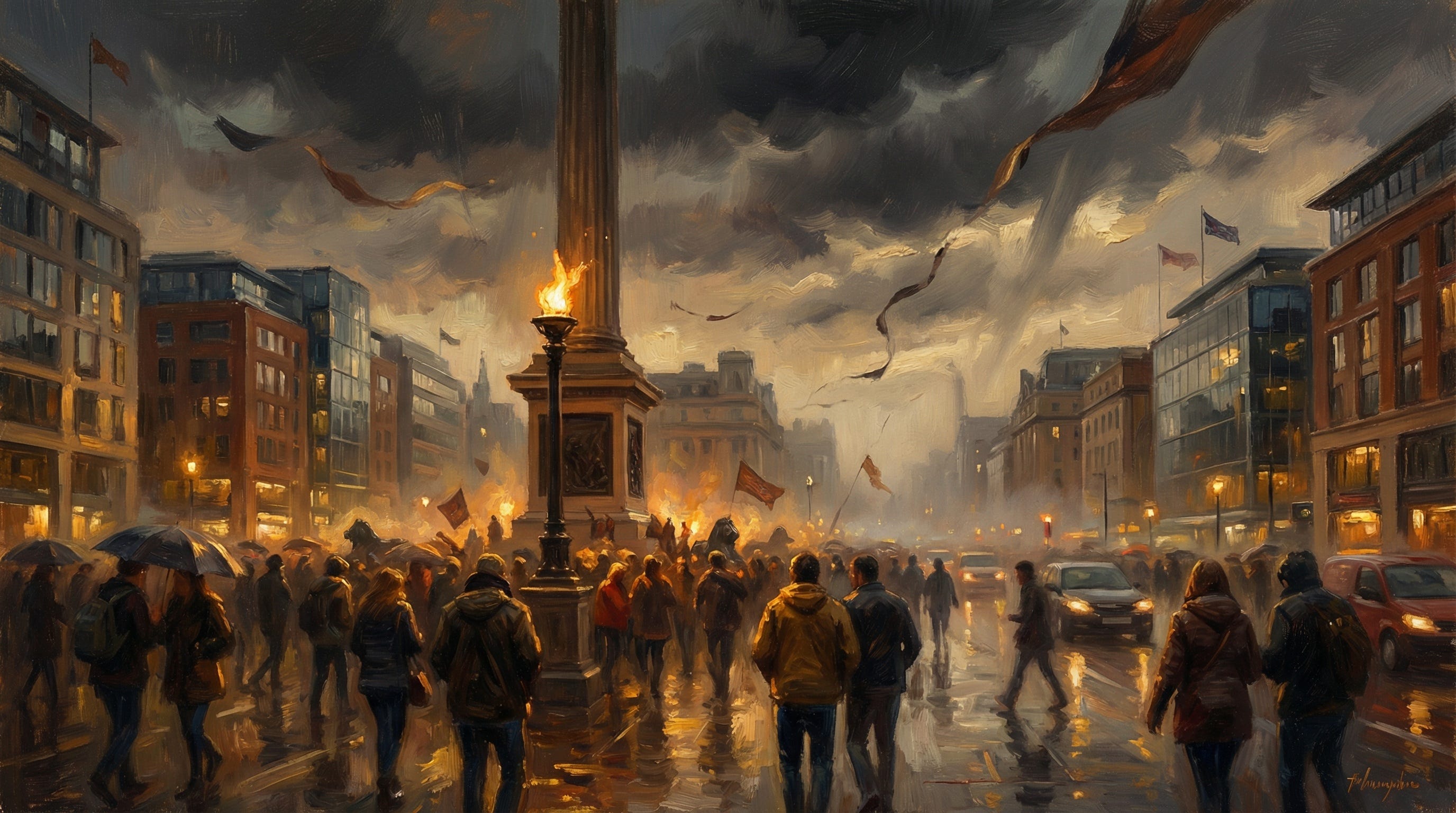
The culture war is now being fought in beer aisles, school libraries, weather agencies, medical journals, fast food drive-throughs, and morning talk shows. It started somewhere smaller. Nobody can remember where. But it keeps widening, absorbing new territory the way a wildfire jumps roads: the conditions are right, the fuel is everywhere, and nobody has an interest in putting it out.
Think about what a decade of this has actually produced. The right didn’t reverse progressive cultural change. The left didn’t neutralize populist backlash. Both sides are more entrenched than they were in 2016, more exhausted, more certain the other side is not just wrong but malevolent. The territory hasn’t shifted. The armies are just smaller and more tired.
Sun Tzu observed twenty-five centuries ago that there is no instance of a country having benefited from prolonged warfare. The insight has outlasted every empire since because the mechanism never changes. Prolonged campaigns drain the state that wages them. Not just the treasury: the morale, the cohesion, the institutional capacity, the willingness of citizens to cooperate on anything. The cost of a war that never ends always exceeds what either side was fighting for.
I’ve felt the pull. The urgency of engagement. The sense that stepping back means complicity. That feeling is the trap. The conviction that fighting is always courage and disengagement is always cowardice is, strategically speaking, how you guarantee your own defeat.
The left’s contribution to widening warfare is the expansion of what counts as political terrain.
Start with the workplace. Diversity, equity, and inclusion as a concept is defensible. As a bureaucratic apparatus of compelled statement, it became something else. The DEI loyalty oath (sign this commitment, attend this training, produce this public affirmation) turned a legitimate organizational goal into a political litmus test. Not because inclusion is wrong but because compelled speech always backfires. It doesn’t produce allies. It produces resentment, falsified compliance, and a new front in the war.
Then the battlefield widened further. “Silence is violence” eliminated neutral ground entirely. When non-participation becomes complicity, you’ve conscripted every citizen into a war they may not have chosen. The person who wants to sell insurance, coach Little League, and go home to their family is now a combatant whether they like it or not. Their silence has been redefined as a position. This is strategically catastrophic. You’ve maximized your enemies and guaranteed that the war encompasses all available territory.
The pattern kept expanding. Publishing houses policing backlists. Scientific journals appending social justice disclaimers to research papers. A Shakespearean theater company issuing land acknowledgments before Hamlet. Each expansion felt righteous from inside the movement. Each opened a new front. Each consumed resources (institutional goodwill, public trust, organizational energy) that could never be recovered.
This is siege warfare, the most expensive strategy in Sun Tzu’s hierarchy. His preferred order: disrupt the enemy’s plans first, then their alliances, then engage their forces. Siege cities only as a last resort, because sieges consume the attacker as much as the defender. The progressive project chose to siege every institution simultaneously: universities, corporations, newsrooms, nonprofits, medical associations, entertainment, sports. The cost has been extraordinary. The gains have been fragile.
And the expansion serves a psychological function beyond politics. The fight provides moral clarity: I know which side I’m on. I know who the enemy is. I know what justice requires. Resolution would reintroduce ambiguity. If the war ends, I have to sit with harder questions: who am I when I’m not fighting for something? The burden of freedom doesn’t go away just because your cause is righteous. It just hides behind the righteousness.
The underlying values are genuine. The mode of pursuit has become the problem.
The right’s contribution is the permanent emergency.
Every fundraising email is the last stand. Every news cycle is an existential threat. Every election is the final battle for the soul of America. The rhetoric of crisis has been so relentless for so long that it has produced numbness: a population that has heard “this is it” so many times that when a genuine crisis arrives, the alarm system is broken.
Conservative media built a business model on outrage supply chains. The cycle works like this: identify an offense (a transgender athlete, a campus protest, a corporate pride campaign), amplify it across platforms for 72 hours, extract maximum engagement, then discard it and move to the next one. By Friday, nobody remembers Monday’s apocalypse. The effect is a citizenry habituated to performing emergency. The resources consumed (attention, institutional trust, the capacity for sustained focus) are real. The strategic output is zero.
Then there is “fight” as governing metaphor. When the dominant language is combat (fight, war, battle, take back, last stand), compromise becomes surrender and moderation becomes treason. Trump’s “fight fight fight” wasn’t metaphor; it was instruction. The rhetoric locked both leaders and followers into escalation. Disengagement became structurally impossible because it would mean admitting the fight was never as existential as advertised.
And the provocation wing: the faction whose explicit goal is triggering emotional reactions from the other side. Owning the libs. The performative cruelty of policies designed not to solve problems but to generate outrage. When the goal shifts from winning to provoking, you’ve abandoned strategy for spectacle. You’ve guaranteed counter-escalation without advancing any objective. This is what it looks like to attack from anger rather than advantage.
Same mechanism as the left, different costume.
The fight provides belonging and purpose. I know what I’m against: the elites, the woke, the establishment. That clarity is addictive. Peace would mean sitting with the harder question both sides are avoiding: what am I actually for? What would I build if I stopped fighting long enough to draw blueprints? The black coffee problem applies here too: when identity is defined by opposition, you get whatever your enemy isn’t, which is rarely what you need.
Both sides are draining the same treasury. Both have structural incentives to prolong rather than resolve. Both are choosing the strategy Sun Tzu warned against above all others.
So why does the war keep widening instead of resolving?
Follow the power, not the ideology. The professional class that lives between the combatants has every incentive to keep the war going and no incentive to end it.
Cable news. Fox and MSNBC are not opposing armies. They are arms dealers supplying both sides. Outrage is the product. Resolution would collapse the business model. Sean Hannity and Rachel Maddow need each other the way Coke needs Pepsi: the competition is the business. Neither wants you to disengage.
Political fundraising. Open your inbox. “Democracy is at stake: donate $25 before midnight.” “They’re coming for your freedom: rush $50 now.” Every email is an emergency. The crisis never resolves because next quarter’s fundraising depends on a fresh one. The stated goal is winning. The operational goal is fighting, because winning would end the revenue stream.
Social media platforms. The engagement algorithms don’t care about truth, justice, or the American way. They optimize for conflict because conflict holds attention, and attention is the product. This isn’t conspiracy. It’s architecture. The information environment selects for prolongation the way a river selects for the path of least resistance. You are downstream.
Most people, on both sides, look at this and want to fix the platforms. Regulate the algorithms. Break up the companies. Some of this may be needed. But it won’t hold. Before algorithms, talk radio did this. Before talk radio, cable news. Before cable, yellow journalism and penny presses. The mechanism within us that craves the clarity of combat, that mistakes outrage for engagement and engagement for meaning, is older than any technology. Shut down one delivery system and another will find the same vulnerability. The terrain changes. The susceptibility doesn’t.
The durable answer is inoculation. The capacity to see the mechanism for what it is, to feel the pull and name it, to recognize the surge of righteous combat as a signal to pause rather than engage. This is Sun Tzu’s oldest counsel applied inward: know yourself. Know what in you can be exploited. Then it can’t be.
Pundits, influencers, commentators: their relevance is a function of the war’s continuation. The podcaster with a million followers built that audience on outrage. The columnist who pivoted to political commentary tripled their readership during the Trump years. The last thing any of them want, on either side, is for you to look away.
The stated motivations diverge from the actual behavior. The professional political class says it wants to win. Watch what it does. It wants to fight. Winning would be an extinction event for the industry that has grown up around the conflict.
And this matters now more than it did a decade ago. The generational cycle suggests the decisive period of this era hits by the early 2030s. That crisis (whatever form it takes) will demand exactly what prolonged culture war destroys: institutional coherence, social trust, the capacity for collective action, the willingness to cooperate with people you disagree with. Every year of widening warfare degrades those capacities further. We are burning our strategic reserves on a war that produces nothing, heading into a season that will demand everything.
The damage is cumulative. A decade of culture war hasn’t just failed to resolve anything. It has actively degraded our capacity to resolve anything in the future.
I don’t exempt myself from any of this. I’ve doomscrolled. I’ve argued with strangers. I’ve felt the righteous surge that comes with a perfectly crafted rebuttal to someone who is wrong on the internet, even if I never posted it. That surge is what Sun Tzu was talking about when he said never to act from anger. It feels like courage. It’s usually just adrenaline.
Here is what I think, stated plainly.
The culture war in its current form is a strategic trap. Both sides are inside it. The way out is not to care less about the issues but to refuse the terms of engagement. The widening is the mechanism of destruction: every new front opened is another resource consumed, another institution degraded, another relationship sacrificed on the altar of being right.
Choose your battles. This is Sun Tzu’s most basic counsel, and the one we’ve most thoroughly ignored. Not every hill is worth dying on. Not every outrage requires a response. Not every disagreement is existential. The person who fights everywhere fights nowhere effectively.
Withdraw from the fronts that don’t matter. Invest the reclaimed resources: attention, energy, good faith, the willingness to see your neighbor as something other than an enemy. Invest them in building. Families, communities, local institutions, your own inner capacity to bear complexity without retreating into tribe. The work of construction is slower, quieter, and less satisfying than the dopamine of combat. It is also the only work that has ever produced anything durable.
The general who knows when to fight and when not to fight will win. The general who fights everything, everywhere, all the time, will exhaust the state he swore to defend.
We are that state.
Sources and Inspiration