

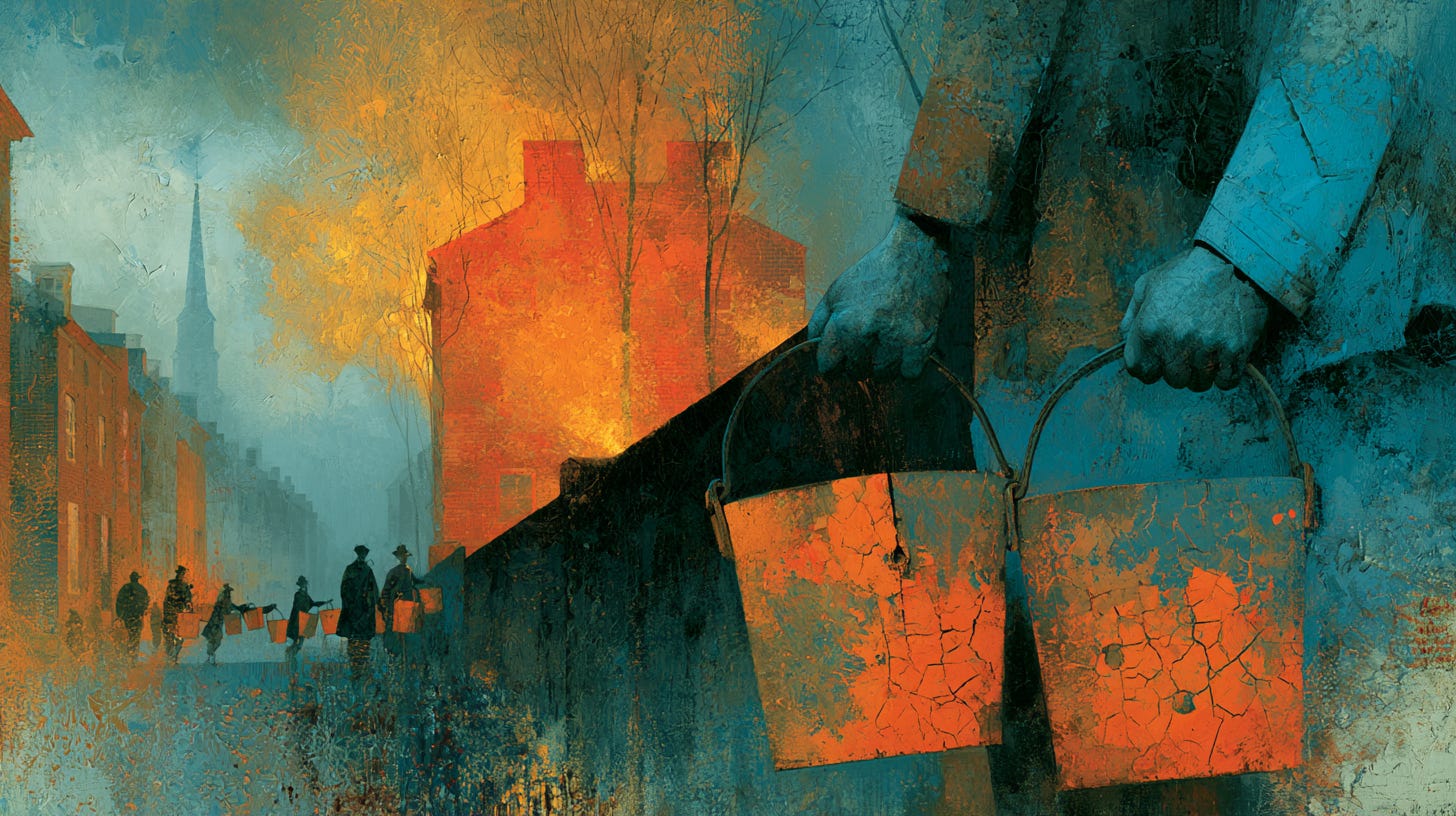
In 1743, a small notice ran in the Pennsylvania Gazette: "Lost at the late fire on Water Street, two leather buckets, marked B. Franklin & Co. Whoever brings them to the printer hereof shall be satisfied for their trouble."
The man who placed it was the most successful printer in colonial America. He published the paper the notice ran in. He wrote the almanac the colonies quoted at each other. Within a decade he would be the most famous scientist alive. And he spent part of his week hauling leather buckets to house fires, and when he lost two of them, he wanted them back.
He had buckets because he belonged to a fire company. There was a fire company because, seven years earlier, no such thing existed in Philadelphia, and he decided that was a problem he could fix.
Picture the city he walked into. Philadelphia in 1727 had no library. No fire department. No hospital, no college, no functioning night watch. Fires took whole blocks. Books belonged to gentlemen who could afford to import them. The watch consisted of constables who dunned their neighbors a fee, hired whoever showed up, and drank through the night.
Benjamin Franklin was twenty-one years old, a printer's tradesman with two years of formal schooling. That fall he gathered eleven other young workingmen (a glassworker, a scrivener, a couple of clerks, a surveyor) into a Friday evening club they called the Junto. Initiates stood, laid a hand on their breast, and answered four questions. The last one: Do you love and pursue truth for its own sake?
The club had rules that tell you everything about the man who wrote them. Discussions were to be conducted "without fondness for dispute or desire of victory." Expressing too much certainty was punished. "All expressions of positiveness in opinion or of direct contradiction were prohibited under small pecuniary penalties." Twelve tradesmen in leather aprons, fining each other for being too sure of themselves.
Then watch what comes out of those Friday evenings over the next twenty years.
The members pooled their books on a common shelf. The shelf worked, so Franklin scaled it: recruit subscribers, charge dues, import books from London. The Library Company of Philadelphia incorporated in 1731, fifty subscribers, "mostly young tradesmen." It is the oldest cultural institution in the United States. It is still operating.
Fires kept eating the city, so Franklin wrote a letter to his own newspaper under a pseudonym, posing as an old man with opinions about prevention, and proposed organized fire-fighting clubs with specific duties. The piece was "much spoken of," so he organized the Union Fire Company in 1736. So many people wanted in that it spawned sister companies across town.
The night watch was a racket, so he drafted a proposal to fund full-time watchmen through a property tax scaled to the value of each home, reasoning it was unfair that "a poor widow housekeeper" whose guarded property "did not perhaps exceed the value of fifty pounds, paid as much as the wealthiest merchant." That one needed the Assembly's signoff and took until 1752 to pass; the watch was a government function, and he knew which problems were. The rest he simply built.
The pattern repeated until the city was unrecognizable. The academy he proposed became the University of Pennsylvania. The hospital came the same way. Most of it required no ministry, no ideology, and no one's permission.
The library fundraising taught him a trick he kept for the rest of his life. Franklin discovered that people resented a "proposer of any useful project that might be supposed to raise one's reputation." So he put himself "as much as I could out of sight," credited the idea to friends, and watched the subscriptions come in. "The present little sacrifice of your vanity will afterwards be amply repaid." Abigail Adams ran the same calculation from a farm in Braintree: the work lands better when you stop demanding to be seen with it. Franklin systematized it. Visibility was a cost he paid down so the project could clear.
A problem, a proposal, a subscription list. Run the loop again.
The stove he gave away
In the early 1740s, Franklin applied his knowledge of convection to a problem every colonist lived with: fireplaces that sent the heat up the chimney and the smoke into the room. He designed a stove that promised more warmth from less wood, had a Junto friend manufacture it, and wrote the promotional pamphlet himself. Testimonials filled the papers. One letter writer declared the inventor "merits a statue."
The governor of Pennsylvania offered him a patent. Exclusive rights to a heating device, in a cold country, in a wood-scarce century. "But I declined it," Franklin wrote. "As we enjoy great advantages from the invention of others, we should be glad of an opportunity to serve others by any invention of ours, and this we should do freely and generously."
Here is the part the statue version leaves out: the stove mostly didn't work. Unless the channels were already hot, the smoke backed into the room. Sales tapered off. Manufacturing stopped within two decades, and most owners gutted the clever convection chamber out of the design. Franklin spent the rest of his life revising his theories of chimneys and drafts, the way you do when results come back and you let them count.
That failure is what makes the refusal interesting. He turned down the patent around 1744, barely four years before he could afford to retire, on a device whose commercial future he had every reason to believe in. The money was real to him and he declined it anyway, because he held a theory about where inventions belong: in circulation, compounding, available to the next tinkerer. He kept that policy his whole life. The lightning rod went to the world the same way, unpatented, along with everything else he invented.
He created more than he captured, and the remainder is what we walk around in.
When he did retire, at forty-two, exactly the midpoint of his life, it was so he could give more of it away. "Leisure to read, study, make experiments, and converse at large with such ingenious and worthy men as are pleased to honor me with their friendship." He had said it plainly years before, reporting an experiment: "What signifies philosophy that does not apply to some use?" He didn't entirely live by that, for the record. As clerk of the Assembly he passed dull sessions constructing magic squares of numbers, and cheerfully admitted they were "incapable of useful application." Even his utility kept a hobby.
Conviction without certainty
Jefferson had a philosophy. Adams had a temperament. Hamilton had a system. Franklin had a method: try the thing, measure the result, adjust. He held his convictions the way a scientist holds hypotheses, firmly enough to act on, loosely enough to revise. The Junto's fines against "positiveness" were the method applied to conversation. The stove revisions were the method applied to failure. The subscription library was the method applied to a city.
Two centuries later, Eric Hoffer would anatomize the opposite character: the true believer, who joins the cause to escape the burden of his own unfinished self, and for whom the doctrine grows more precious as the evidence runs against it. Hoffer's fanatic needs the certainty more than the outcome. Franklin is the cleanest counterexample the American record offers. He had convictions and causes in abundance; what he refused was the certainty. At eighty-one, the oldest man at a Convention that nearly failed, his great contribution was a speech asking every delegate to "doubt a little of his own infallibility" and sign anyway. Walter Isaacson, his biographer, rendered the verdict in one line: "Compromisers may not make great heroes, but they do make democracies."
The hardest proof of that temperament is the one least comfortable to tell. Franklin held slaves in his household and ran ads for slave sales in his paper, as his world did and mostly did without a second thought. A true believer holds the inherited conviction to the grave. Franklin, who held nothing as settled, eventually held this up to the light too. Late, he changed his mind, and then did what almost none of his peers did: he acted on it. President of Pennsylvania's abolition society at eighty-four. A petition to Congress that mankind was "all formed by the same Almighty Being," owed liberty "without distinction of color." And three weeks before he died, one last satire, an Algerian official defending the enslavement of Christians with every argument Congress had just used for the enslavement of Africans, the Junto printer's whole toolkit aimed at last where it should have aimed sooner. He got there late. Most never got there at all.
And when Alexis de Tocqueville toured America a century after the Junto's first Friday meeting, he found Americans "of all ages, all conditions, all minds" joined in associations "to raise churches, to distribute books," associations that "create hospitals, prisons, schools." It reads like an inventory of Franklin's Philadelphia. He was describing habits one printer had spent the 1730s teaching a city, the disposition that asks what can I do before it asks what tradition or ministry permits. Tocqueville found the township functioning as democracy's schoolhouse. Franklin had built the curriculum: the library, the fire company, the watch, each one a small rehearsal for self-governance, each one proof that the people who name the problem can be the people who fix it.
I want to be careful here, because I find this man easy to admire and his method easy to flatter myself with. I keep a running ledger of things that are broken around me: the compliance thicket that taxes my business before the tax itself, the institutions that don't work the way the label says. I can recite my ledger fluently. Franklin kept the same ledger. The difference is that every entry on his became a proposal with a subscription list attached, and most entries on mine are still grievances I'm nursing because the grievance is cheaper. The pie grows the way Philadelphia grew: somebody stops auditing the smallness of their slice and builds the next oven.
In 1785, a Massachusetts town named itself Franklin and wrote to ask the great man for a church bell. He sent crates of books instead, suggesting "sense being preferable to sound," and told them to build a library.
Around the same time, back from Paris, he gathered what remained of the Union Fire Company. He was the only person who signed all four founding documents: the Declaration, the treaty with France, the peace with Britain, the Constitution. Kings had received him. Four members of the original company were still alive, so the five of them met, as before, with their leather buckets.
He had measured his life in many currencies by then, and this was one he still counted. A republic, he told a woman outside the Convention, if you can keep it. The keeping has always looked less like the signing table and more like the bucket line: a few neighbors, organized on purpose, showing up for a city that would burn a little less because they did. There is always a next fire. The buckets still have our names on them.
Sources and Inspiration
Benjamin Franklin: An American Life - Walter Isaacson
The True Believer - Eric Hoffer
Democracy in America - Alexis de Tocqueville