

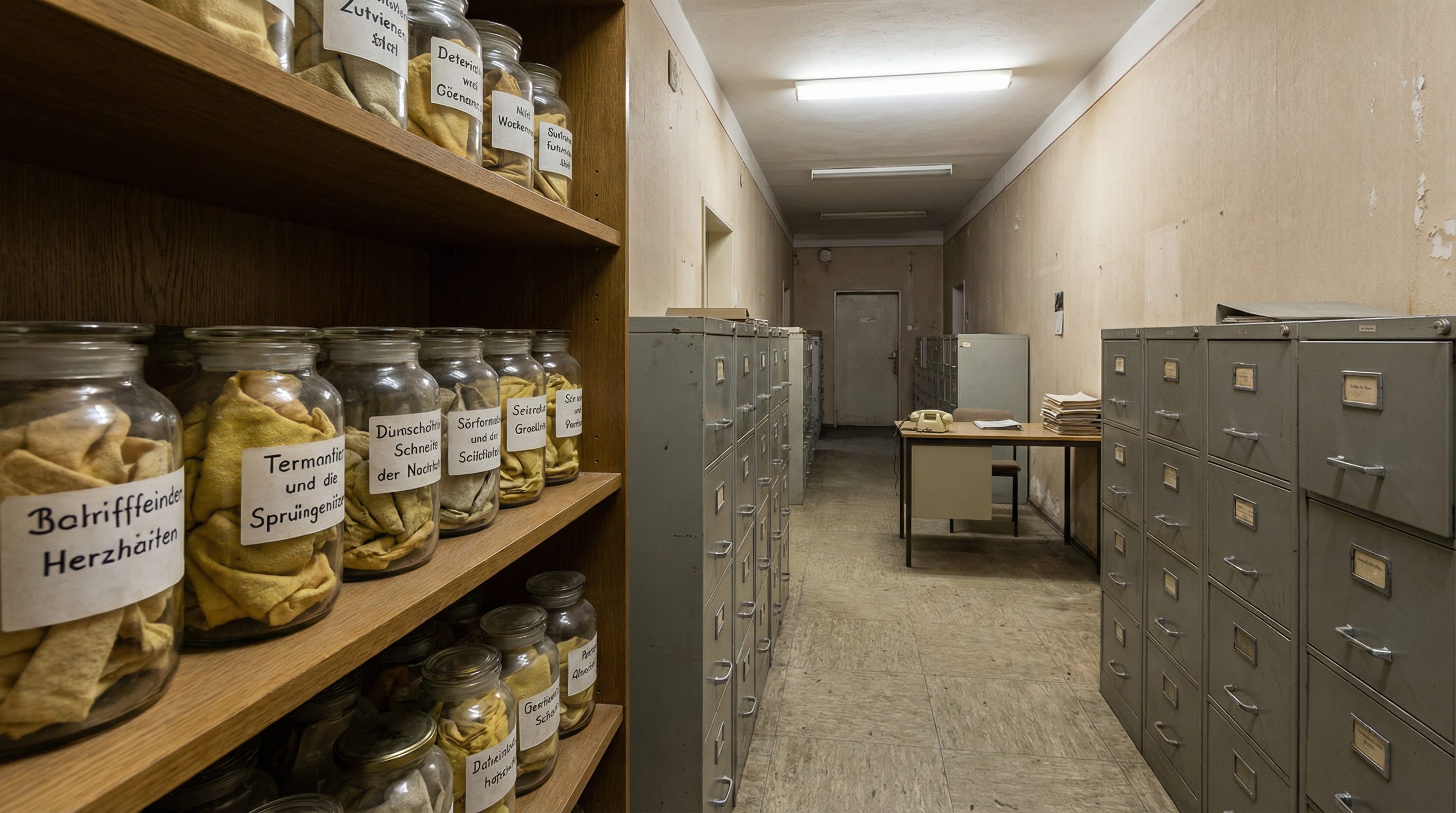
The hallways are narrow and the lighting is flat. Walking through the old Stasi headquarters at Normannenstraße in Berlin, I am struck by how ordinary it all feels. Linoleum floors. Filing cabinets. The particular institutional beige that governments everywhere seem to favor. It could be a tax office, a hospital records department, a claims processing center. The banality is the point.
In one room, rows of glass jars sit on shelves. Each jar contains a yellow cloth. These are the Geruchsproben: smell samples. During interrogations, subjects sat on chairs with cloth inserts. The cloths absorbed their scent. The jars were labeled, cataloged, filed. If the subject later needed to be tracked, dogs could be given the scent.
I stand there trying to process what I’m seeing. Somewhere in this building, clerks sealed jars and filled out forms while human beings sweated through interrogations in the next room. The paperwork was meticulous. The procedure was clinical. Someone had to requisition those jars. Someone had to label them. An entire bureaucracy organized itself around the collection and preservation of fear.
This is what comprehensive surveillance looks like when implemented with German efficiency. Something quieter than the camps, pedestrian in its horror: the reduction of human interiority to administrative data. Your secrets, your affairs, your complaints muttered over dinner, your doubts about the regime whispered to a friend. All of it documented, cross-referenced, filed. Leverage, organized alphabetically.
The German Democratic Republic had a population of roughly sixteen million. The Stasi employed ninety thousand full-time officers and, at its peak, nearly two hundred thousand informal collaborators. One in sixty-three citizens was reporting on the others.
These weren’t trained agents. They were neighbors, colleagues, friends. Sometimes family. The apparatus couldn’t staff enough professionals to monitor everyone, so it recruited the population to watch itself. The method was straightforward: find leverage, apply pressure, secure cooperation. A son who wanted to attend university. A husband with a drinking problem. A woman whose brother had fled West. Everyone had something. The Stasi found it, documented it, and made an offer that wasn’t really an offer.
The dynamic mirrors predation. A skilled predator doesn’t rely on force alone. He identifies vulnerability, cultivates access, accumulates leverage, creates complicity. The Stasi operated identically, just at scale. The clinical detachment was part of the mechanism. A predator who rages might lose control. A predator who files paperwork never does. Procedure disciplines power. Forms routinize violation. The bureaucratization of betrayal made it sustainable, reproducible, normal.
And this is the key: the informant doesn’t feel like a predator. He feels like a survivor. The state has leverage on him, too. He informs because the alternative is worse. His complicity is coerced, which makes it feel less like complicity. The system is designed to make everyone guilty, everyone compromised, everyone holding secrets about their own betrayals. A population of informants is a population that cannot revolt. Who would you trust to revolt with?
Ruta Sepetys’ novel I Must Betray You brings this dynamic to life in Ceaușescu’s Romania. The Securitate operated on the same principles as the Stasi, if with less Germanic precision. The protagonist, a seventeen-year-old named Cristian, is recruited through leverage against his family. The novel traces what happens to a person, to relationships, to the very possibility of authenticity when the state has inserted itself into every private space.
What Sepetys captures is the texture of life under informant culture. The daily experience of never knowing. Is this conversation safe? Is that friend genuine? When she asks about my opinions, is she curious or collecting? The surveillance state doesn’t just monitor behavior. It colonizes consciousness. You begin to monitor yourself, to pre-censor, to perform loyalty even in private because privacy has become theoretical.
The novel is fiction, but the dynamic was real across the Eastern Bloc. Romania, East Germany, Czechoslovakia, Poland: the names and acronyms differed (Securitate, Stasi, StB, SB), but the mechanism was identical. The socialist project, wherever it was implemented, produced surveillance states. This was structural.
After the Wall fell, Germans could request their Stasi files under the Stasi Records Act of 1991. People lined up to learn what had been collected about them, and by whom.
What followed was a second trauma. The files didn’t just document what the state had known. They revealed who had provided it. Codenames were cross-referenced. Identities emerged. A husband discovers his wife filed reports for twenty years. A woman learns her closest friend detailed every confidence. Adult children find their parents had documented their teenage rebellions, their doubts, their private jokes about the regime.
The betrayal wasn’t historical. It was present tense. The informant was still there, still at the breakfast table, now revealed. Every memory became suspect. That kindness, was it genuine or cultivation? That confidence you shared, did it stay between you or go into a file? The relationships had been performed all along, and the performance had been so complete that even now, reading the documentation, the betrayed party couldn’t fully believe it.
This is the wound that takes generations to heal. You can topple statues and rename streets in a season. You cannot rebuild trust in a decade. The children of informants carry shame they didn’t earn. The children of the informed carry suspicion they cannot shake. The poison doesn’t flush out when the system falls. It metabolizes into the culture, the family structures, the unspoken knowledge that people are capable of this, that your own people did this, that you might have done it too under sufficient pressure.
Sepetys understands this. Her novel doesn’t end with liberation. It ends with the files. The regime falls, but the revelations are just beginning. Freedom arrives, and with it the terrible knowledge of what was done in the dark.
At this point, a certain objection arises: this wasn’t real socialism. Marx didn’t envision the Stasi. The theorists were describing liberation, not surveillance. What happened in East Germany and Romania was a corruption of the ideal, not its realization.
The objection deserves honest engagement. The theorists are correct that nothing in The Communist Manifesto called for smell jars and informant networks. The gap between socialist theory and socialist practice is real. But the practice followed a logic the theory contained.
The path from collective ownership to secret police follows a chain that the theory doesn’t acknowledge.
Socialism promises rational planning for collective benefit. To plan rationally, you need information: what do people need, what are they producing, where are the shortfalls? To get accurate information, you need reporting. To verify reports, you need surveillance. To make surveillance effective across millions of people, you need informants. To recruit informants, you need leverage. To maintain leverage, you need fear.
The Stasi wasn’t a deviation from socialist logic. It was socialist epistemology extended to its conclusion. Central planning requires central knowledge. Central knowledge requires mechanisms to collect it. Those mechanisms, once built, serve the interests of those who control them. The original goals (equality, worker control, rational distribution) become rhetorical cover for the actual function: preservation of power.
Hayek saw this clearly. The knowledge problem isn’t just about prices. Dispersed information cannot be centrally collected without coercion, and the collection apparatus, once established, becomes an instrument of control rather than planning. The road to serfdom is paved with information requirements.
And once power concentrates, it does not voluntarily disperse. The Party becomes the new aristocracy. The surveillance apparatus becomes its enforcement arm. The workers’ state becomes a state that surveils workers. Every implementation follows the same arc because the arc is built into the structure.
The alternative isn’t utopia. Free markets and democratic governance are inefficient, unequal, often unjust. Power concentrates here too: in corporations, in wealthy families, in networks of influence. The dispersed system still produces exploitation.
But there’s a difference worth preserving.
Mark Zuckerberg exploits your attention. This is true. But you downloaded the app. You scroll. You could delete it. The exploitation is bilateral, a transaction you’re participating in, however asymmetric. You retain agency. Your participation implicates you, which means you remain a moral subject capable of choice. Under the Stasi, you were an object, not a participant. The surveillance wasn’t something you opted into. Your neighbor informed on you because the state leveraged his vulnerabilities. The exploitation was unilateral, and resistance meant ruin.
Both systems involve power asymmetries. But in one, you are compromised by your own choices, however constrained. In the other, you are simply subject to someone else’s power. The first preserves agency imperfectly. The second erases it systematically. This is the difference between a flawed society and a prison.
Democracy and markets are dispersed systems. No single actor can accumulate the leverage the Stasi held. Power is distributed across competing interests, checked (imperfectly) by elections, courts, markets, and the simple friction of pluralism. The dispersal is inefficient. It is also protective. The very messiness that frustrates reformers is what prevents any one group from building Normannenstraße.
I think about the smell jars sometimes. The clerks who sealed them. The forms they filled out. The meetings where someone proposed the system and others approved it. It all seemed reasonable from inside the logic. The state needed to track enemies. Dogs could track scent. Therefore: collect scent. File it. Bureaucratize it. Make it routine.
Routine: An apparatus for the comprehensive violation of human interiority, operated by people who filed paperwork and went home to dinner. The banality made the evil possible. You don’t need monsters to build a surveillance state. You need procedures.
Change the incentives, and ordinary people file reports on their friends.
The inoculation, if there is one, lies in structure: dispersed power, competing centers of authority, spaces the state cannot reach. It lies in culture: norms that make certain violations unthinkable even when they’re rational. It lies in memory: the knowledge that this has happened, that it can happen again, that the slide from idealistic planning to smell jars follows a logic we should learn to recognize.
Sepetys wrote her novel because the history is fading. The people who lived under Ceaușescu are aging. The files gather dust. A generation is growing up that knows the Cold War as history, not memory. The novel exists to make them feel what the theory cannot convey: the texture of life when trust is contraband.
I walked out of Normannenstraße into ordinary Berlin. Cafes, traffic. The building is a museum now. The files are archives. The informants are grandparents. But the logic that built the system hasn’t disappeared. It waits in every proposal for comprehensive monitoring, every argument that security requires surveillance, every confident claim that this time the central authority can be trusted.
The jars are in storage. The procedures remain available.
For readers wanting to understand this history viscerally, Ruta Sepetys’ I Must Betray You is the place to start. It won’t teach you political theory. It will teach you what political theory costs when implemented on human beings.