

The Slop Is You
Alex Lieberman is sharing his screen, and the podcast host has just dared him to prove his assertion.
He built a thing he calls a content machine: a stack of AI skills wired into his company's systems that reads his Slack and his meeting notes, surfaces the ideas worth writing about, interviews him in the voice of Tim Ferriss and Howard Stern to pull the specifics out of his head, drafts in his own cadence, then convenes a council of six imaginary editors who score the draft one to ten and send it back until it clears a nine. The host, Claire Vo, tells him his posts are genuinely good. Then she calls the bluff. "But prove it live."
So he does. He runs the machine on the podcast, in real time, and somewhere in the middle of watching an AI assemble a publishable post out of his own recorded answers, the host arrives at the joke that isn't a joke.
"So what you're saying is — we are actually the slop."
Yeah. That's exactly what he's saying.
Lieberman's line: the only time the machine produces slop is when the person feeding it didn't have anything good to say. The model is average by construction. It was trained on the entire internet, so its default gravity is the mid, the seen-before, the sentence you could have finished yourself. Left alone, it writes the beige. What it can't do is have the idea. The idea is yours. So is the taste that throws out three drafts, and the stubbornness to go check whether the thing is even true. Where the output is slop, a human was phoning it in. You can feel it.
Because there are two ways to point the tool, and they are opposed. One aims it at the page: write this for me so I don’t have to think it through. That is the setting that produces slop, reliably, whether the scanner says human or machine-generated. The other aims it at your own head: interrogate me, push back, hand me the question I was ducking, make me earn the line, what book should I read to know this better, who are the two most meaningful and opposed thinkers in history on this idea, there are so many ways to improve. Same machine, opposite result. One offloads the thinking; the other creates more value.
Sit with that, because we are about to spend enormous energy pretending the opposite.
Substack just turned on an AI detector.
Its CEO, Chris Best, announced it in a post titled "Against Claudefishing." The mechanics are simple: any reader can now scan a post longer than a hundred words and get an estimate of how much was written by hand versus by machine. Writers get a small box to disclose their process, a note that says, in effect, here is how I make this.
I want to be clear, because the easy move is to make certain writers, or Substack, the villain, depending on your priors. Substack is not the villain. Best is mostly right. He says it: they are not against people using AI to assist their work; people should simply know what they're getting. That is a disclosure argument, and I agree with it. There has been a note on my own About page for months telling you AI is part of how I make this. I am not hiding anything. Disclosure is honest.
It's the next step I want to fight: the part where a reader lets that number stand in for a verdict.
Look at Best's own coinage. Claudefishing, he says, is when there is a mismatch between what a reader expects and what they get: "something with no human thought on the other end." That phrase is the whole game. No human thought on the other end. It is the assumption underneath the entire anxiety: that if a machine helped assemble the words, then no mind was present, no thought occurred, and the reader is being catfished by an empty room.
For genuinely lazy content, the SEO sludge and the auto-blasted newsletter nobody read before it shipped, that's fair, and it earns the eye-roll it gets. Those same things have been human-generated for decades now, and we learned to judge their quality with our own minds. But watch how fast we let that specific failure metastasize. Watch "some AI content is thoughtless" harden into "AI content is thoughtless," and then into "this scanned high, so I can stop reading." Lieberman's machine has a human on the other end the entire time. So does mine. The percentage doesn't know that. The percentage can't know that. It is measuring the wrong thing.
What the detector actually asks
Sixty-five years ago Karl Popper gave a lecture on where knowledge comes from, and he refused the question. Asking "what is the ultimate source of this knowledge, reason or the senses?" was, he argued, an authoritarian question wearing an innocent face. It asks for a pedigree, the bloodline of an idea, so it can decide whether the idea is allowed to be true. And Popper's move (the one that belongs on the wall of every newsroom and English department this year) was to throw the question out and replace it with something smaller and harder: how can we hope to detect and eliminate error?
He was blunt about why the first question rots. "The question of the sources of our knowledge," he wrote, "like so many authoritarian questions, is a genetic one. It asks for the origin of our knowledge, in the belief that knowledge may legitimize itself by its pedigree."
Read that with a detector in your hand. "How much of this was written by AI?" is a pedigree question: it asks where the words came from, in the belief that origin settles worth. It is the same instinct as demanding to know a stranger's parents before you will trust him, and it fails for the same reason. Origin is not validity. Where a thing came from does not settle whether the idea in it is any good. The only question that ever separated good writing from bad is Popper's: is it true, is it useful, does it survive a skeptical reader, and when it's wrong, how fast do we catch it? A detector cannot ask that. It answers a different question, and it answers it beautifully.
And I mean beautifully. I am not telling you the detector is broken. Pangram, the tool Substack chose, is excellent: ninety-nine-point-something percent accurate, false positives near one in ten thousand. Grant it perfection. A flawless detector still only tells you how much a machine touched the words. It cannot tell you whether there was a mind on the other end, or whether that mind had anything worth your evening. A perfect instrument pointed at the wrong axis is still pointed at the wrong axis.
The wall that keeps the field small
So why does a culture reach for the pedigree instead of the idea? Partly because the idea is harder work. But something older is running underneath.
You can see it every time someone reaches for the scanner. The impulse to authenticate, to certify, to police the border between the real writers and the machine-assisted pretenders is the guild protecting the guild, the elevator operators insisting a car with nobody at the controls couldn't be trusted. And underneath the reflex is a real fear. It is disorienting, and more than disorienting, to spend years getting good at a craft and then watch a machine learn to do the passable version of it for free. I feel it too. But the scanner is the wrong answer to a real problem, because the wall you build to keep the machine out is the same wall that keeps the field small. You tell the newcomer his machine-helped work doesn't count, and he never posts the thing he had to say.
The field is not staying small. This is the part I am actually amped about. The tool is not going back in the bottle, and thank God, because of what it does when a real idea meets it: it collapses the distance between having the thought and getting it built. The person who always had something to say and never had the craft to assemble it or the reach to send it can now do both. That is not a threat to good work. That is more people in the arena, more ideas getting out, more of the exact thing a healthy culture is supposed to want. That is the whole damn point.
And if you're worried this means the end of originality, I have bad news that turns out to be good news. There was never any pure originality to protect.
Steven Johnson spent a book chasing where good ideas actually come from, and the answer is a lot grubbier than the lone genius pulling truth from the void. Good ideas are recombinations: old parts snapped into a new shape, borrowed, stolen, remixed out of whatever is lying around in what Johnson calls the adjacent possible, the pool of new combinations the pieces you already have suddenly make reachable. Matt Ridley named the engine of all human progress "ideas having sex," concepts meeting other concepts and throwing off offspring neither parent could have made alone. Every sentence you have ever admired was assembled from borrowed pieces by someone who read widely and stole well. The remix predates the machine by the whole length of human history. The machine is only the most efficient remixer we have ever built, and it still needs a human to tell it what is worth remixing.
The authentic, machine-untouched human original the detector wants to certify is a thing that never existed. What has always existed, what has always been the entire game, is the quality of the recombination. The taste. The judgment. The nerve to publish this and kill that.
Writing goes the way of the handbag
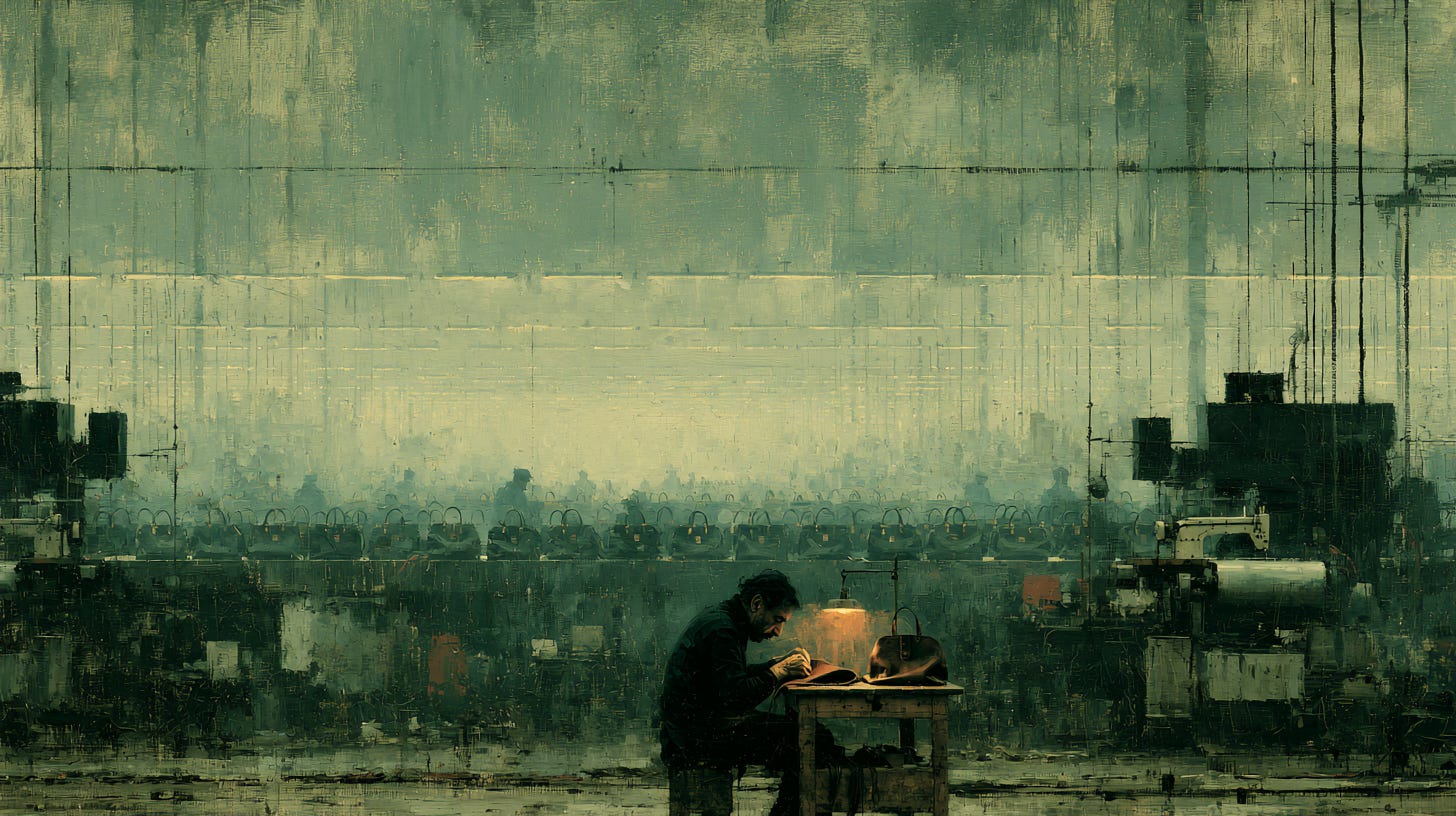
Here is the shape I actually expect, and it runs two directions at once. The abundance is one direction: cheap good work, everywhere, made by more hands than ever. The premium runs the other way, and a handbag shows you its shape. Every bag was once handmade, because there was no other way to make one. Then the machine came, and a bag became a twenty-dollar thing on every shoulder and a Cambrian explosion of variety, while the handmade one survived as the Birkin: stitched by a single artisan over days, priced past a car, bought by the very rich and no one else. Abundance at the bottom, a narrow premium at the top.
Writing is taking that shape, with one difference that is the whole point. For a bag, the hand is the value; nobody paying Birkin money cares whether the woman who stitched it ever had an interesting thought. For writing, the hand was never the point. The reader pays for the mind behind it: the sense that someone chose this, meant it, had something to say and the taste to say it well. And that sense has nothing to do with whether a machine helped type the words. A bored human can push out a thousand words with no mind behind them, score a perfect zero on the detector, all human, and it is still slop. A writer with a real idea can drive a machine hard, score a hundred, all AI, and leave a mind on every line. The premium sorts on the mind. The detector sorts on the tool.
So hold the two directions together and you can see what the scanner is: a Luddite with a hammer, and the loom is already running. And the hammer does worse than miss. It pays for the loom. The moment a platform the size of Substack makes a detector the gate, it posts a bounty on the tool built to walk past it. Wire in the scanner and you fund the other side of the arms race. Every detector that matters calls its own defeat into being, because the reward for beating it grows with how seriously the gate is taken. It saves no one, because the market is already splitting, and it splits on the one thing a detector cannot measure. The filler you scroll past will mostly be machine-made, because no one was ever going to pay for the hand that made it. The essay you send a friend will come from the shrinking number of people who have a mind worth the time, and some of them will have used every machine they could reach to make it. A scanner can tell you a human was present. It cannot tell you a mind was. The market has always paid for the second thing, without mercy, and it never once needed a scanner to find it.
Which brings it back to you, holding the scanner, deciding whether to read.
Here is what I want to say to the reader who runs the number before running their eyes. Glance at it if you want; it is a signal like a byline, and no signal was ever a verdict. But let a percentage decide whether a real idea is worth your eyes, and you have surrendered the one judgment that was always yours. Your inability to tell whether a machine helped is not a fact about the writer. It is a fact about you: about a judgment you would rather hand to a percentage than perform yourself. If the idea was good, if the claim was true, if it moved you or taught you or changed the shape of an hour, what exactly does the number subtract? You already know how to do this. You have senses. You can feel the difference between a sentence someone meant and a sentence assembled to fill space, and you can feel it faster than any classifier, because what you are detecting is the presence or absence of a mind. That is the instrument. Use it. Stop asking a machine to tell you whether you were moved, educated, informed, or entertained.
The whole time Lieberman ran his machine, there was a human on the other end. Someone choosing the idea, feeding the specifics, throwing out the drafts that rang false, deciding this was worth your attention. "No human thought on the other end" was only ever true of the slop, and the slop, as the man said, is us. It always was. The laziness was ours long before the tool arrived; the tool only made it easier to see.
So turn your brain on. The future showed up a little early, and it is asking you the oldest question there is, and it has nothing to do with AI: is this any good?
Tomorrow’s essay will be this same one. Written by a machine, and the machine detector will show 100% human generated.
This is silly incentive design. Show me the incentives, and I’ll show you the outcome.
You tell me which essay is better.
Sources and Inspiration
Conjectures and Refutations - Karl Popper