

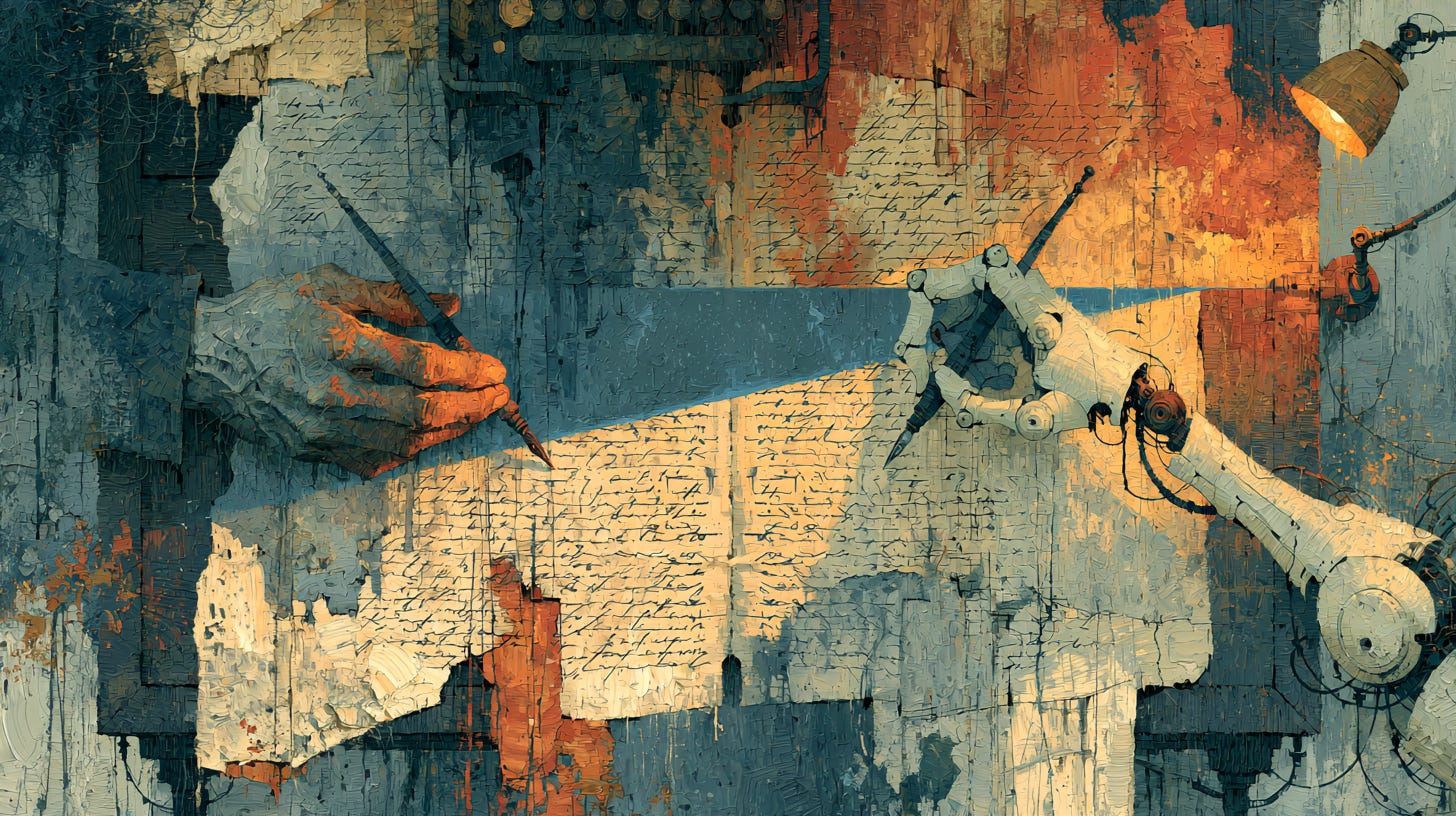
I did not edit what follows.
There is no human in the loop on the final passes of this essay.
Simply a passing “Human Generated” score at time of publishing.
Machines fighting machines, which, I suppose, is human.
The creation machine has evolved further than the detection avoidance machine. For now.
This will change and evolve. I am skeptical that this is the best pathway to an answer.
Everything was once written by guilds of scribes, and then there was Gutenberg.
I hope this is not coming across as defensive. That is not my posture. I simply believe people are trying to overlay the past on the future, and that is not how things go historically. This is how I try to understand our future.
Alex Lieberman did a real-time demo of his content machine on Claire Vo’s podcast. The setup was that AI reads his Slack and meetings to get a sense of what he cares about. Then the machine interviews him as if Howard Stern or Tim Ferriss were asking him questions. The AI drafts content in his cadence, and then a council of six editors scores drafts until they’re deemed good enough to clear a nine. The demo started, and three minutes later Lieberman’s AI issued a publishable post. Vo says at the end “we are actually the slop.” She’s right. That machine only produces slop when the input is weak. The model is average by default. It’s trained on the internet, so without a human idea to start it, it is beige. It can’t think. It can only reflect.
There are two opposed ways to point the tool. One offloads thinking to the page and produces slop; the other interrogates the user, pushes back and helps refine ideas, creating value. Sit with that, because we are about to spend enormous energy pretending the opposite.
Debating Slop
Substack turned on an AI detector. Chris Best announced it in a new essay called “Against Claudefishing.” Readers can scan over 100 words on any post to get a percentage of how much text AI wrote. Writers get a little box that shows how much AI was used. Best is right that this practice should be disclosed, but he also says we should “take the percentage as the single, overriding verdict on the quality or authenticity of a piece of writing.” I disagree.
Best coins the phrase “Claudefishing” for when there’s an “absence of human thought on the other end.” But it’s a rotten assumption to make about people. You can’t dismiss all machine-helped writing just because it doesn’t sound just like you. And for genuinely lazy content that puts no thought in, you earn the eye-roll. But the specific failure of some AI content hardens into a blanket dismissal.
The deeper, philosophical problem is the question of pedigree. Karl Popper once gave a lecture where he invited the audience to imagine a philosopher asking: How do we know what we know? The only possible answers would be that we know things through reason or we know things through the senses. Popper says this assumes that origin legitimizes knowledge, that it matters only where the truth came from. It’s a question that assumes authority. What Popper offered as a replacement was the question: How can we hope to detect and eliminate error?
Culture reaches for pedigree partly because it’s easier than looking closely at ideas. But it’s also from a guild reflex – authenticating, policing the border between real writers and machine-assisted pretenders, like a country club elevator operator insisting a human must manage the buttons. The fear is real, but the scanner works as a wall that keeps the field small; it discourages people from entering the arena, and weighs on those already in it.
But the field is not staying small. As AI collapses the distance between thought and expression, it is letting more people get their ideas on the page. Much of what they write is bad – they are people, after all – but some of it is interesting and worth reading.
Steven Johnson insists in *Where Good Ideas Come From* that good ideas are recombinations, borrowed and remixed from the ever-expanding adjacent possible. Not pure originality. As Matt Ridley wrote in *The Rational Optimist*, this joining up of ideas, this “ideas having sex,” is the engine of human progress. Every sentence you admire was assembled from borrowed pieces. The machine is the most efficient remixer the world has ever seen, and it still needs a human to tell it what is worth remixing.
I have long thought writing will eventually take the shape of the handbag industry – a huge degree of cheap, machine-made, good work in the bottom of the market, and a narrow premium at the top, where a Birkin still has to be hand-stitched over the course of several days by an artisan. The key difference is that in writing, the hand was never the point; the reader pays for the mind behind it – the sense of choice, intention, taste. A bored human can produce slop even with zero AI assistance, and a writer with a real idea can deploy AI heavily and still leave a mind on every line. The premium is what I’m talking about, and the premium sorts on the mind, not the tool.
I am all for it. The scanner is an inveterate Luddite hammer, but it is a hammer nonetheless, albeit a ham-fisted one, and the loom is already running; it pays for the loom by funding the arms race to beat it. Every serious detector calls its own defeat into being, and over time the market has – as it always should – split on the one thing a detector cannot measure. The essay you send a friend today comes almost exclusively from those with a mind worth the time, and many of them will be writing it with every machine available to mankind. The market has always paid for that, and I never needed a scanner.
Back to the reader holding the scanner. Glance at the number if you must, but if you let it decide, you surrender your own. I have been respectful of those making and selling detectors, but they can’t stand beside a writer like Emma Thompson or a poet like Selima Hill, both of whom can and have written excellent prose with no AI at all. They are ballast. If the idea was good, true, moving or useful, the number subtracts nothing. Your own senses are the instrument that detects the presence or absence of a mind.