

I can see it happening in real time now.
My inner workings can be insufferable, but let me paint a while.
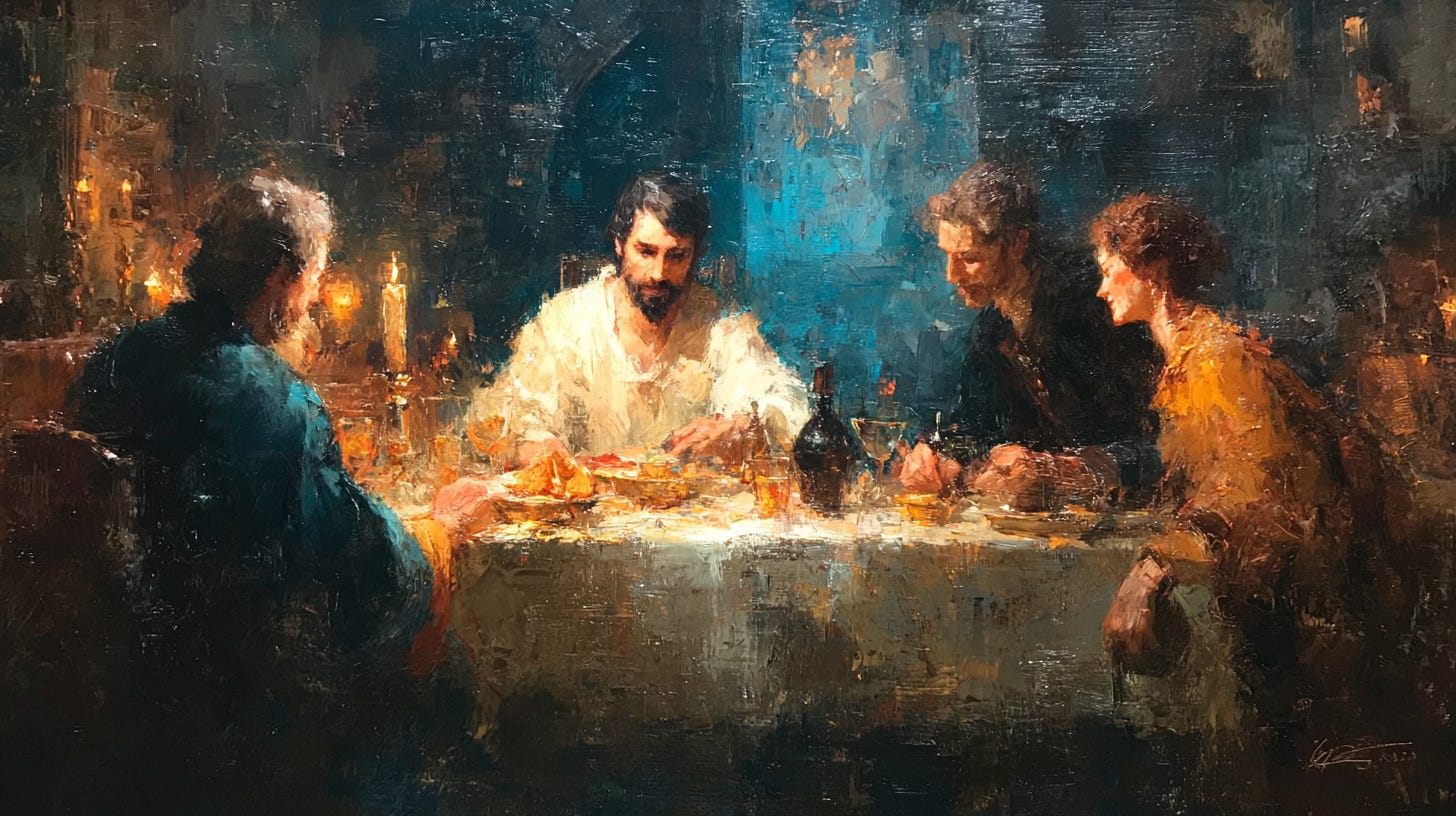
Someone at dinner says something about the news, and before they’ve finished the sentence I’ve already catalogued it: preference falsification (they’re performing a belief for the table), shadow projection (the outrage says more about their anxieties than the story), entertainment epistemology (they encountered the event as spectacle, not information). I can name every mechanism operating in the room. The tribal signaling. The quiet conformity. The way certainty substitutes for thinking.
I name all of it. And then I take another bite of penne alla vodka and say nothing.
This is supposed to be the payoff. You read the books. You internalize the frameworks. You learn to see the escape mechanisms that Erich Fromm mapped in 1941: how people flee freedom through authoritarianism, through destructiveness, through what he called automaton conformity, where you adopt the beliefs and desires your culture hands you and stop noticing you’ve done it. You learn to see the way people publicly conform while privately disagreeing, performing beliefs so long they forget the original belief existed. You learn to see all of it.
And then you discover that seeing all of it changes almost nothing.
The connoisseur of dysfunction
Fromm described three escape routes from the burden of freedom. Two are dramatic: submission to authority, destruction of what threatens you. The third is quiet. Automaton conformity. You adopt the personality offered by cultural patterns. You become “exactly as all others are and as they expect you to be.” The self disappears into consensus.
There’s a version of this Fromm didn’t describe, probably because it barely existed in 1941. Call it the fourth escape: the informed spectator. You don’t submit to authority. You don’t destroy. You don’t conform. You observe. You develop such a fine-grained understanding of how everyone else is fleeing freedom that you never notice you’re doing it too.
The observation becomes the escape.
I recognize this because I live in it. I can write essays about escape mechanisms and still catch myself fleeing. I can name automaton conformity and still adopt positions because my intellectual tribe holds them, discovering later that the position was borrowed rather than earned. The awareness is something. The awareness is also, by itself, insufficient.
This isn’t confined to one end of the spectrum. The educated progressive who can deconstruct every power structure but hasn’t built or maintained a single institution or business. The constitutional originalist who can recite the Federalist Papers but hasn’t attended a school board meeting in a decade. The libertarian who has read every word Hayek wrote and never organized so much as a neighborhood party. The mechanism is the same: understanding substitutes for participation. The sophistication of the analysis becomes the excuse for the absence of the action.
A tennis coach named Timothy Gallwey once described the mind as split: Self 1, the verbal critic that analyzes your grip and replays your last mistake, and Self 2, the body that already knows how to hit the ball if Self 1 would get out of the way. The over-aware are all Self 1. The diagnostic lens has become its own form of interference.
When the most aware people opt out
This would be a private problem if it stayed private.
Hannah Arendt spent years studying what happens when people fail to think. Her account of Adolf Eichmann in Jerusalem produced an observation that still unsettles: the catastrophic evil of the Holocaust was administered not by monsters but by ordinary people who never stopped to consider what they were doing. Eichmann coordinated deportation logistics. He organized transport schedules, attended planning conferences, issued operational directives. He was not a passive clerk. He was an active administrator of genocide who simply never stopped to consider what his efficiency was serving. The banality of evil, Arendt called it: thoughtlessness as complicity.
The over-aware represent the mirror failure. We think constantly. We think about the mechanisms, the systems, the psychological structures, the historical patterns. We scroll the news on our phone, a false sense of participation. Of knowing. And we don’t act. Or, perhaps we make a post or send a text regarding our outrage. Meanwhile, the gap left by aware people who opt out gets filled by people with fewer reservations. Some of them are building real things. Some of them are building badly, and the people best equipped to notice are sitting at dinner cataloguing mechanisms over pasta.
Arendt understood something about action that the over-aware tend to miss: action is a beginning. It arrives when you choose to begin. The thinking was never going to finish. Every birth, she wrote, is the appearance of something new in the world. Every act of genuine agency is a kind of natality: something that could not have been predicted from what came before. You don’t finish diagnosing and then start building. You build, and the building teaches you what the diagnosis couldn’t.
Phronesis only comes from doing
Aristotle drew a distinction here. There are two kinds of knowledge. Episteme is theoretical understanding: knowing that something is true and why. Phronesis is practical wisdom: knowing what to do in a particular situation, right now, with these people, under these conditions. Episteme comes from study. Phronesis comes from action.
The catch: phronesis cannot be taught. It develops only through practice. You don’t become practically wise by reading about practical wisdom. You become practically wise by doing things, getting some of them wrong, and developing the judgment that only arrives through skin in the game. Aristotle’s word for this settled disposition was hexis: knowledge that lives in your hands and your habits, not in your theories.
The over-aware have episteme to spare. They understand the mechanisms. They can trace the genealogy of every institutional failure. What they lack is hexis, the settled capacity that comes from having tried, failed, adjusted, and tried again. The only way to build it is to begin. And beginning is exactly what the over-aware have been deferring.
The anxiety is the threshold
Rollo May, a psychologist who spent his career studying people who can’t begin, saw this pattern from the therapist’s chair. Patients in postwar America came to him with everything the century promised: security, comfort, opportunity. They weren’t sick in any obvious way. They were empty. May called it “the loss of the center.” People adrift in comfort, living what he called blind momentum: going through the motions without genuine choice, their days blurring together, their opinions borrowed from their environment.
The over-aware have their own version of blind momentum. They go through the motions of analysis rather than the motions of conformity, but the “going through the motions” part is identical. The diagnosis replaces the living. The framework substitutes for the choosing.
May’s prescription: “The opposite of courage in our society is not cowardice, it is conformity.” The over-aware think they’ve escaped conformity because they can see through it. But their inaction is its own conformity: the conformity of the critic class, the audience that watches and never performs. They’ve traded the conformity of borrowed beliefs for the conformity of borrowed analysis. The form changed. The surrender didn’t.
And the anxiety they feel? May would say stop treating it as a problem. Anxiety is the price of becoming. We feel it because we stand at the threshold of something we haven’t been before. The person who feels no anxiety has stopped growing.
This is the part the over-aware get backwards. They feel their anxiety and conclude they need more theory, more reading, more understanding before they can act. One more book. One more framework. One more meditation, or Xanax. One more essay that names the mechanism with sufficient precision. May would say the anxiety is the signal that the threshold is right there. The anxiety isn’t blocking the door. The anxiety is the door. Walk through it. The doing is what resolves it, because the anxiety was never a thinking problem. It is the permanent companion of freedom. You act alongside it or you don’t act at all.
And the reward for walking through? May argued it is not grim endurance. It is joy. Watch a child learning to walk. She tries, falls, gets up, tries again. Falls again. Keeps going. When she finally takes those steps, she laughs. Not because anything external has changed. Because she’s using her powers. “Joy is the affect which comes when we use our powers.”
The over-aware have been denying themselves this. They’ve been watching the child instead of walking. They have studied the biomechanics of the first step, mapped the neural pathways, read three papers on infant motor development, and written a thoughtful critique of how society undervalues the courage it takes to fall. They have done everything except stand up.
Joy is waiting on the other side of the anxiety they keep trying to resolve with more analysis. It cannot be reached from the armchair.
What it looks like when the aware act
Iris Murdoch, a philosopher who thought more carefully about attention than almost anyone in the twentieth century, argued that the moral life is not primarily about dramatic choices. It’s about the quality of one’s vision between choices. How you see the world in ordinary moments: with clarity or distortion, with generosity or suspicion, with attention to what’s actually there or attention only to your own categories. She called the ego “fat” and “relentless,” always inserting itself between the person and the real.
The over-aware have a particular form of ego: the ego of the diagnostician. The one that sees mechanisms rather than people. Categories rather than situations. The essay rather than the dinner.
Murdoch’s remedy was attention redirected: stop looking at your own reflection in the glass and look through the glass at what’s actually there. The person in front of you at dinner isn’t a bundle of mechanisms. They’re a person. The community you live in isn’t a case study in associational collapse. It’s a place where you could show up.
Every source I’ve cited in this publication was written by someone who acted. And the action came in flavors as different as the people themselves.
Michel de Montaigne, the man who invented the essay form, retreated to a tower on his family estate in the Dordogne and wrote. That was his action. Not policy. Not activism. Writing with radical honesty about his own contradictions, his fears, his digestion, his cowardice, his confusion. His famous question, “Que sais-je?” (what do I know?) was not a counsel of paralysis. It was a practice. By admitting he didn’t know, he freed himself to investigate. By investigating, he discovered. By discovering, he changed. The curiosity was the engine. Montaigne’s action was turning the diagnostic lens on himself and publishing what he found, warts and all. He could have studied the human condition from a safe distance. Instead he made himself the specimen. That cost him something. It cost him the comfort of being the observer.
Hannah Arendt covered a trial in Jerusalem and told the truth about what she saw. She reported that Eichmann was not a monster but a bureaucrat, and that some Jewish leaders had cooperated with the Nazi regime. The truth cost her Gershom Scholem, one of her oldest and closest friends, who broke with her permanently. It cost her Kurt Blumenfeld, her mentor, who rejected her and died without reconciling. It cost her years of public attack from communities she had belonged to her entire adult life. Her action was judgment exercised in public, with consequences she accepted and could not have fully predicted. She could have stayed in the audience.
She chose the stage.
Fromm practiced psychoanalysis: one patient at a time, in a room, trying to help a specific person face their specific escape mechanisms. Eric Hoffer worked the San Francisco docks for more than twenty years and wrote philosophy in his spare time. Benjamin Franklin built a lending library, a fire company, a postal system, a university, a nation. He didn’t theorize about civic association. He built civic associations.
These actions share a common structure, and it isn’t scale. Montaigne in his tower and Franklin in his city were doing the same thing at different volumes: beginning something, with skin in the game, where they could be wrong. Montaigne could be wrong about himself. Franklin could be wrong about the nation. Arendt could be wrong about Eichmann (many thought she was). The action required what the analysis didn’t: exposure to consequences.
Aristotle would recognize every one of these as phronesis in formation. You cannot think your way into acting. You can only act your way into a different relationship with thinking. The hexis, the settled practical wisdom, develops through contact with the real. Montaigne’s essays got better because he kept writing them. Franklin’s institutions got better because he kept testing them. Arendt’s judgment got sharper because she kept exercising it in public, under fire.
Back to the dinner table
The over-aware already have confronted the hardest part: they see clearly (at least, they think they do). What they haven’t done is pick the form their action takes. For some it will be writing. For some, building. For some, showing up to a local board meeting and staying past the first hour. For some, the hardest action of all: saying what they actually think at the dinner table instead of cataloguing what everyone else thinks.
Someone brings up the latest outrage. The mechanisms are visible, as always. The preference falsification, the shadow projection, the borrowed certainty. I can see all of it.
This time I put down the fork.
I say something. Not the full diagnostic, not the framework, not the essay. Something smaller and more honest: that I’m not sure the outrage matches what actually happened, and that I’ve noticed we all seem to agree on things at this table that I’m not sure we’d agree on privately. It’s clumsy. It lands wrong. So I move to curiosity. I ask whether anyone else at the table has noticed the gap between what we say here and what we might say privately. Whether any of us are actually sure, or just performing certainty because the silence would be worse.
The awareness doesn’t save the moment. That’s the thing May tried to tell us. The anxiety doesn’t resolve before you act. It resolves, if it resolves at all, somewhere on the other side. The doing is graceless. The phronesis isn’t there yet. It won’t be there until I’ve done this enough times to develop the hexis, the settled habit of speaking honestly in rooms where honesty isn’t the norm.
But the penne alla vodka tastes different when you’re not hiding behind the observation. The vodka sauce has blossomed, or maybe it’s the adrenaline. There is something on the other side of the analysis: the small, startled recognition that you are using your powers. That you are, for the first time in a while, actually in the room.
May called it joy. I’d call it something quieter than that, in this context. Relief, maybe. The relief of no longer performing the role of the person who sees everything and does nothing.
The civic square is emptier than it should be. The people most capable of seeing what’s needed are the same ones sitting in the audience, cataloguing the performance.
The show doesn’t need more critics.
Sources and Inspiration
Escape from Freedom - Erich Fromm
Man’s Search for Himself - Rollo May
The Inner Game of Tennis - Timothy Gallwey
Nicomachean Ethics - Aristotle
Eichmann in Jerusalem - Hannah Arendt