

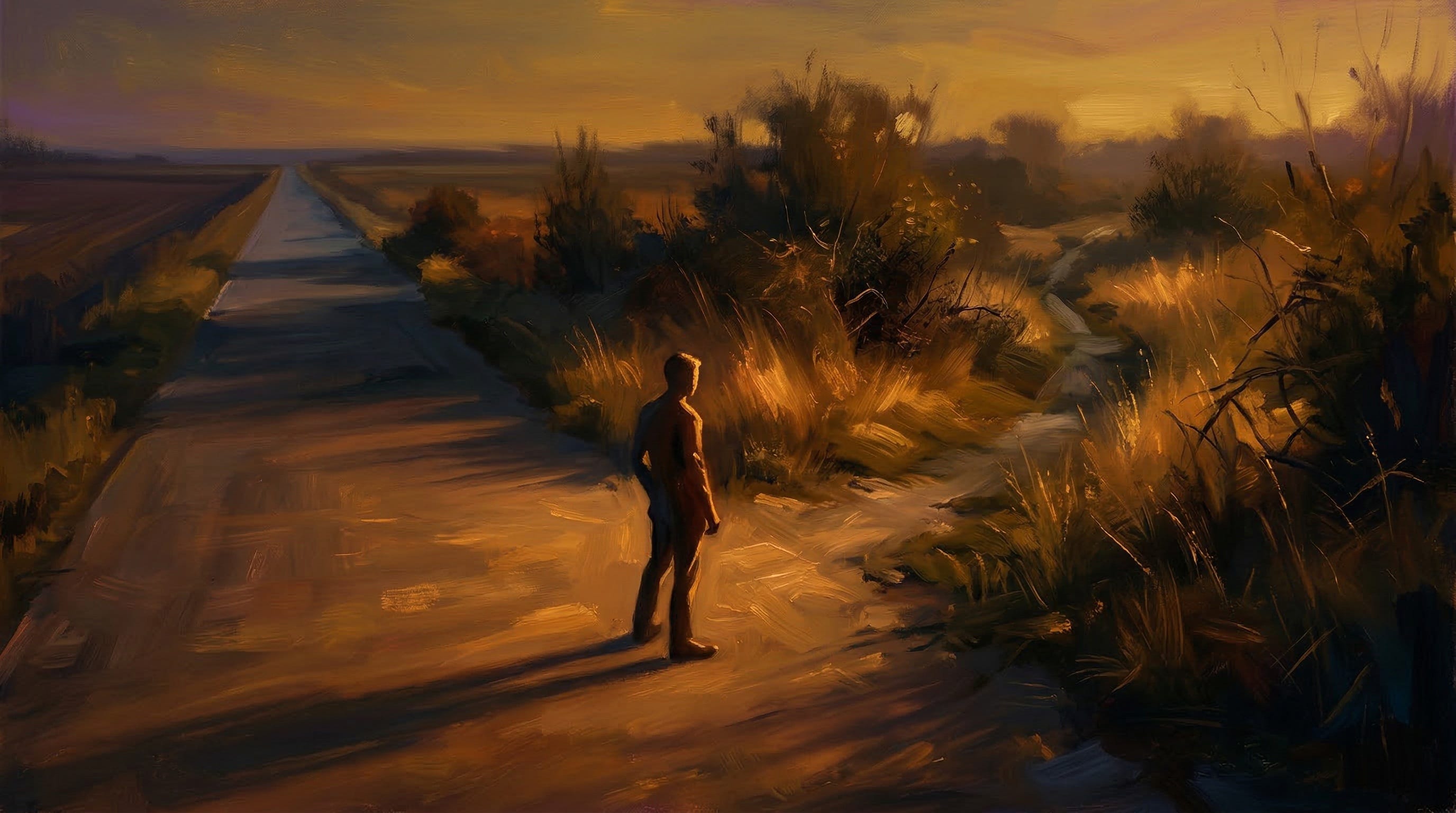
I keep a mental list of the lives I almost chose. The corporate track that would have paid better and felt less. The city I stayed in three years too long because leaving would have required admitting the move was a mistake. The version of myself that said yes to everything reasonable and no to everything that scared me.
That version looked fine from the outside. Good job. Good apartment. The right opinions at dinner parties. A life that checked every box on a form I didn’t remember filling out.
I wonder sometimes how many people are living inside a life like that right now. Not broken. Not unhappy, exactly. Just not quite theirs.
I get it. The chosen life is hard. I ruminate on how much better my other paths might have been, especially right now, while what I’m authoring is hard.
Joseph Campbell had a word for it: the wasteland.
Not poverty. Not war. Not the dramatic suffering we’d recognize as crisis. The wasteland is a full life that feels empty. People going through motions inside institutions that run on procedures nobody remembers the purpose of. A civilization that has everything except the sense that any of it matters. Sound familiar?
He spent decades studying the mythology of every culture he could find, and he kept discovering the same story. Someone leaves the ordinary world. They cross into the unknown. They face something that threatens to destroy them. And they come back carrying something the community needs. The details change (a Sumerian king, a Navajo twin, a carpenter’s son) but the architecture is identical. As if the species encoded its own operating instructions in narrative form and then forgot how to read them.
The journey is not optional. You either make it consciously or it makes you unconsciously. The alternative is the wasteland: the life that runs on autopilot, the self that was planned by someone who wasn’t you.
“Follow your bliss” has been diluted into self-help wallpaper. Do what makes you happy. Chase your passion. But bliss is not pleasure. It’s the signal that you’re on your authentic path, and that path involves sacrifice, descent, suffering. The life that’s waiting for you might be harder than the life you planned. It almost certainly will be.
If the path before you is clear, you’re probably on someone else’s.
So why do we stay?
Because the wasteland is comfortable. That’s the part most people skip. The wrong life has amenities. It has predictability, social approval, a clear measurement of whether you’re doing well. The right life, your life, offers none of that. It offers anxiety. It offers the terrifying possibility that you’ll succeed and have to become someone you don’t recognize yet.
Fromm understood this mechanism. Freedom creates anxiety. When no authority tells you who to be, you have to decide. And deciding is hard enough when the choices are small. When the choice is “which life am I going to live?” most people find a way to not decide at all. They adopt the life that was offered, the path that was obvious, the identity that their environment assembled for them. Not deliberately. Just by never quite choosing otherwise.
Wilson saw the same thing from the cybernetic side. Most people are running programs they didn’t write. The Thinker installs a belief (”I’m the kind of person who does X”), and the Prover builds the evidence. The belief becomes a reality tunnel: a perceptual world organized to confirm itself. You don’t experience the life you chose. You experience the life your programming produces. And the program was written by parents, culture, convenience, fear.
Fear!
The wasteland, seen this way, is a program running without a programmer. A life on autopilot where the autopilot was installed by someone else.
“Follow your bliss” is a metaprogramming instruction. Recognize that you’re running a program. Recognize that you can rewrite it. Then find the signal, the bliss, that tells you which program is actually yours.
Finding the signal is the hardest part. We’ve forgotten how to listen for it.
The great trackers of the South African bush can follow a leopard through dense cover by reading signs most people would step over. A bent blade of grass. A scuff in the dust. Birdsong that stopped three seconds too early. They don’t force the trail. They follow it. And the quality of attention this requires is exactly what bliss demands: patient, embodied, non-judgmental, open to what’s actually there rather than what you expected to find.
Your bliss is your track. The signs are there if you have the patience to read them. But the modern world trains the opposite of this patience: quick answers, clear metrics, algorithmic certainty. The wasteland is efficient. The track is slow, intermittent, full of stretches where you lose it entirely. You have to tolerate not knowing where it leads. You have to trust that the trail is there even when you can’t see it.
May called this tolerance the courage to be. The anxiety you feel at the threshold between the planned life and your life is the price of becoming. “One does not become fully human painlessly.” The person who feels no anxiety at the threshold hasn’t found peace. They’ve decided not to cross.
I want to be careful here. I don’t believe anyone can tell you what your bliss is, where your track leads, or when to cross the threshold. The mythology itself is suspicious of prescribers. “If the path before you is clear, you’re probably on someone else’s.”
What I believe is simpler and harder: most of us have an inkling. A signal that keeps returning despite our efforts to ignore it. The thing we’d do if no one were watching, the work that doesn’t feel like work, the question that won’t leave us alone. We know. We’ve known for a while. But the life we planned is easier to explain.
I recognize this in myself. The pull toward the thing that measures well, the life that makes sense on paper, the path where I know what success looks like. That pull is real, and I don’t think it makes me weak. It makes me human. The wasteland isn’t where broken people go. It’s where people go by default. The choosing, tracking, pathfinding, and bushwhacking is hard.
But the hero’s story has a final act: the journey is not complete until the return. Whatever is found in the crossing must be brought back. Self-knowledge hoarded is self-knowledge wasted. Authorship of your own life is preparation for the harder task: being useful to others in a way that only you can be. The wasteland doesn’t just cost you. It costs everyone who would have been served by the life you didn’t live.
The life that’s waiting is not the one you planned. It may be harder, stranger, less legible. But it’s the one that’s yours. And the species has been encoding this instruction for thousands of years, in every mythology, in every hero who crosses the threshold.
We must be willing to let go of the life we planned so as to have the life that is waiting for us.
I’m working on it.
Sources and Inspiration
Reflections on the Art of Living: A Joseph Campbell Companion - Joseph Campbell
Escape from Freedom - Erich Fromm
Prometheus Rising - Robert Anton Wilson
Man’s Search for Himself - Rollo May
The Cathedral of the Wild - Boyd Varty