

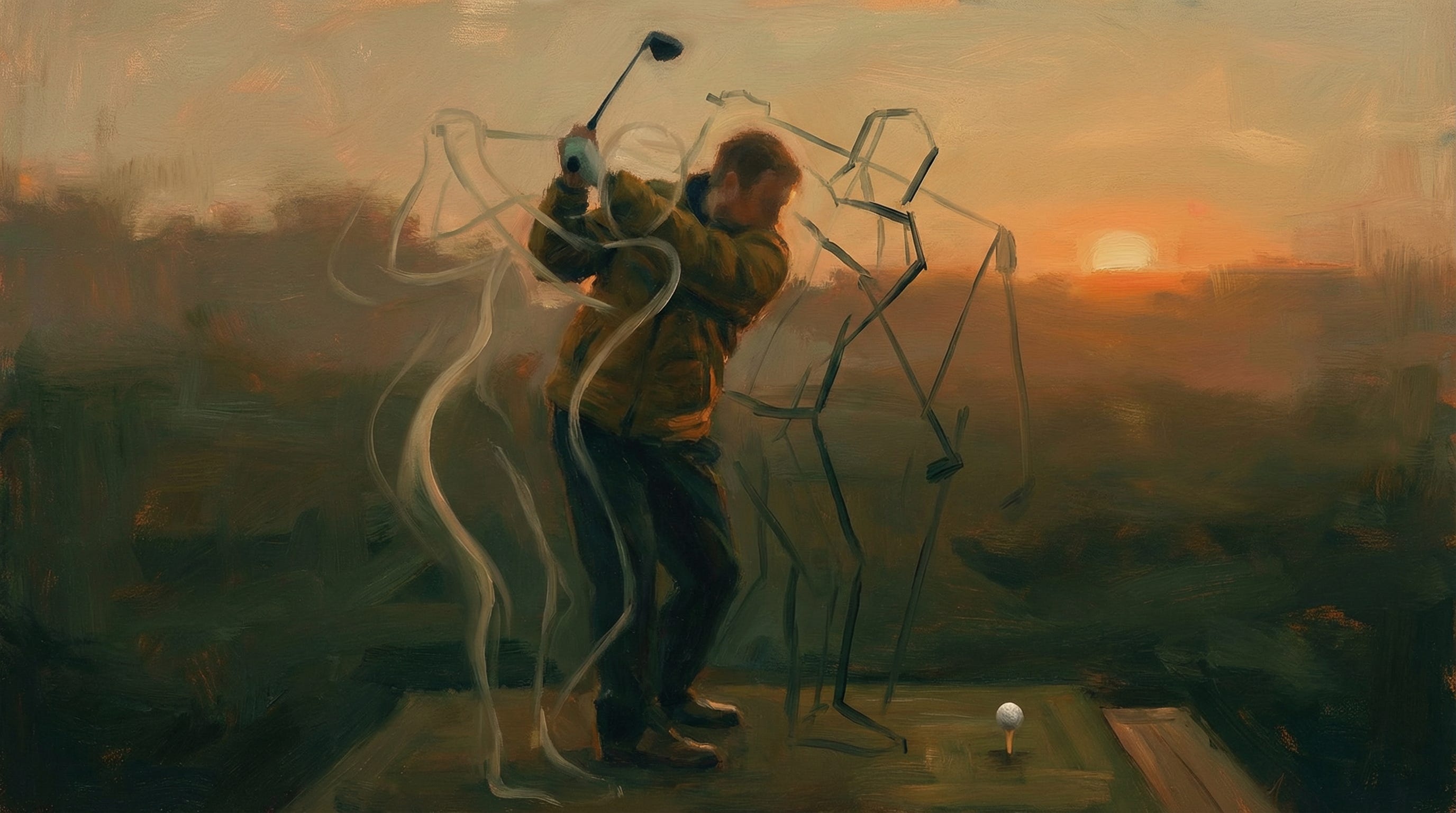
You’ve seen it on a golf course, or at a driving range, or in one of those simulator bays that smell like beer and false hope. The waggle. The practice swing. The careful positioning of feet, the micro-adjustments of grip, the ritualized settling-in that precedes every shot. Then the internal monologue starts: Keep your head down. Slow backswing. Don’t sway. Hips first. Follow through.
The instructions pile up and the body tightens against itself. By the time the club makes contact, the golfer is muscling through a motion that should be fluid, fighting his own limbs like they’re adversaries. The ball shanks into the rough. The club gets a look of betrayal, as if it were the problem.
The thing is, the body already knows how to swing. It’s been shown a thousand times. The motion of a golf swing isn’t fundamentally different from skipping a stone or swinging an axe: weight transfer, rotation, release. The knowledge is there. What’s also there, louder, is the voice narrating what the body already knows how to do.
This is the interference problem. We block the capacity we already have.
Timothy Gallwey spent decades working with athletes and executives on what he called the Inner Game. His insight: performance improves more by quieting interference than by adding technique. There are two selves at work in any skilled action. Self 1 is the teller, the instructor, the judge: the voice that narrates what you should be doing and critiques how you’re doing it. Self 2 is the doer: the body-mind that actually performs the action, drawing on years of accumulated learning and natural coordination.
Self 1 distrusts Self 2. And that distrust creates exactly the failure it fears.
Watch a child learn to walk. No one lectures her on biomechanics. She falls, she adjusts, she falls differently, she adjusts again. Her body is gathering information through experience and making corrections below the level of conscious instruction. This is how we learned almost everything that matters: language, social cues, balance, coordination. The learning happened when the conscious mind stepped aside.
Then we grew up and decided that the conscious mind should supervise everything. That nothing could be trusted to operate without explicit instruction. That the way to get better at something was to think harder about it.
I feel this in my own work. There’s a state where writing flows: one idea connects to the next, the words arrive close to right, I’m discovering what I think as I put it down. And there’s another state, much more common, where I’m watching myself write. Judging each sentence as it appears. Comparing it to some imagined standard. The watching creates a stiffness that shows up on the page.
The paradox is that I know more about writing now than I did ten years ago. I’ve read more, practiced more, thought more carefully about what works and why. But all that additional knowledge can become interference if it shows up at the wrong time. Craft knowledge belongs in preparation and revision, not the moment of generation.
This is an argument about timing, not against knowledge or technique. There’s a time to study the mechanics of a tennis serve and a time to forget them and trust your arm. The problem is that most of us have collapsed these into one continuous stream of self-instruction that never stops.
We’ve become Self 1 dominant cultures. Every domain has been colonized by explicit knowledge, conscious instruction, verbal framing. We turn intuition into frameworks. We turn practice into theory. We turn doing into knowing-about-doing. And then we wonder why performance feels so effortful, why even things we’re good at become occasions for exhausting self-monitoring.
The interference shows up in places beyond individual performance.
Watch what happens in organizations when every decision requires explicit justification, when every intuition has to be translated into the language of metrics and documented rationales. The people who are good at their jobs often know things they can’t fully articulate. They’ve developed pattern recognition through years of experience. They can sense when something is off before they can explain why. But if the only legitimate form of knowledge is the kind that can be stated explicitly and defended verbally, all that tacit understanding gets overruled by whatever sounds most convincing in a meeting.
This is Self 1 at institutional scale. The demand that everything be made explicit, legible, defensible. The result is decisions made by the part of the system that can talk rather than the part that actually knows.
Or watch what happens when people try to improve themselves through pure conscious effort. They identify the flaw. They commit to doing better. They monitor their behavior for signs of the flaw. And the monitoring itself keeps the flaw alive, keeps their attention fixed on exactly what they’re trying to move past. The conscious mind cannot solve problems it created by being too present in the first place.
Gallwey’s approach was counterintuitive. Instead of giving more instructions, he gave fewer. Instead of correcting flaws directly, he directed attention elsewhere. A player with a bad backhand might be asked to notice where the ball crossed the net, or to say “bounce” when it hit the court and “hit” when it met the racket. The conscious mind gets occupied with an observation task, and the body is freed to make its own adjustments.
The results were often immediate. The body was finally allowed to use what it already knew.
This is the subtractive approach to excellence. Removing what interferes with capacity already there. The athlete who performs effortlessly in practice but tightens under pressure has added something: the weight of self-consciousness, the watching, the judge. Remove the addition and the performance returns.
I think about this when I watch people struggle with things they should be good at. The presentation they’ve given a hundred times that suddenly feels impossible because the stakes are higher. The conversation with someone they care about that goes wrong precisely because they’re trying so hard to make it go right. The creative work that dries up the moment someone is watching, or paying, or expecting something specific.
These aren’t failures of capacity. They’re failures of trust. The inner judge has decided that the inner performer cannot be relied upon, that conscious supervision is necessary, that we have to think our way through what we used to just do. And the supervision creates exactly the stumbling it was meant to prevent.
The interference problem reaches beyond tennis or writing or giving presentations. It’s about the relationship we’ve developed with our own competence. Somewhere along the way we stopped trusting that we knew things. We decided that nothing counted unless it was explicit, monitored, managed. We made consciousness into a foreman rather than an occasional consultant.
I have no technique for fixing this, which feels appropriate given the subject matter. Techniques are what Self 1 wants: something to add, some new instruction to layer on top of all the others.
But I notice what works for me. When the internal narrator quiets, usually by accident, there’s something underneath that knows what to do. The accumulated years of practice, all the failures that taught something, the pattern recognition that happens below the level of words. It was there all along. It was just being talked over.
The question is what we’d have to stop doing to let our capacity through. Most of us have more than we’re accessing.
What’s in the way?
What will you remove?
How should you direct your attention, such that your inherent skills and knowledge take you to where you wish to go?
Sources and Inspiration