
The Imaginary Rules That Became Your Cage
When caution starts calling itself truth.

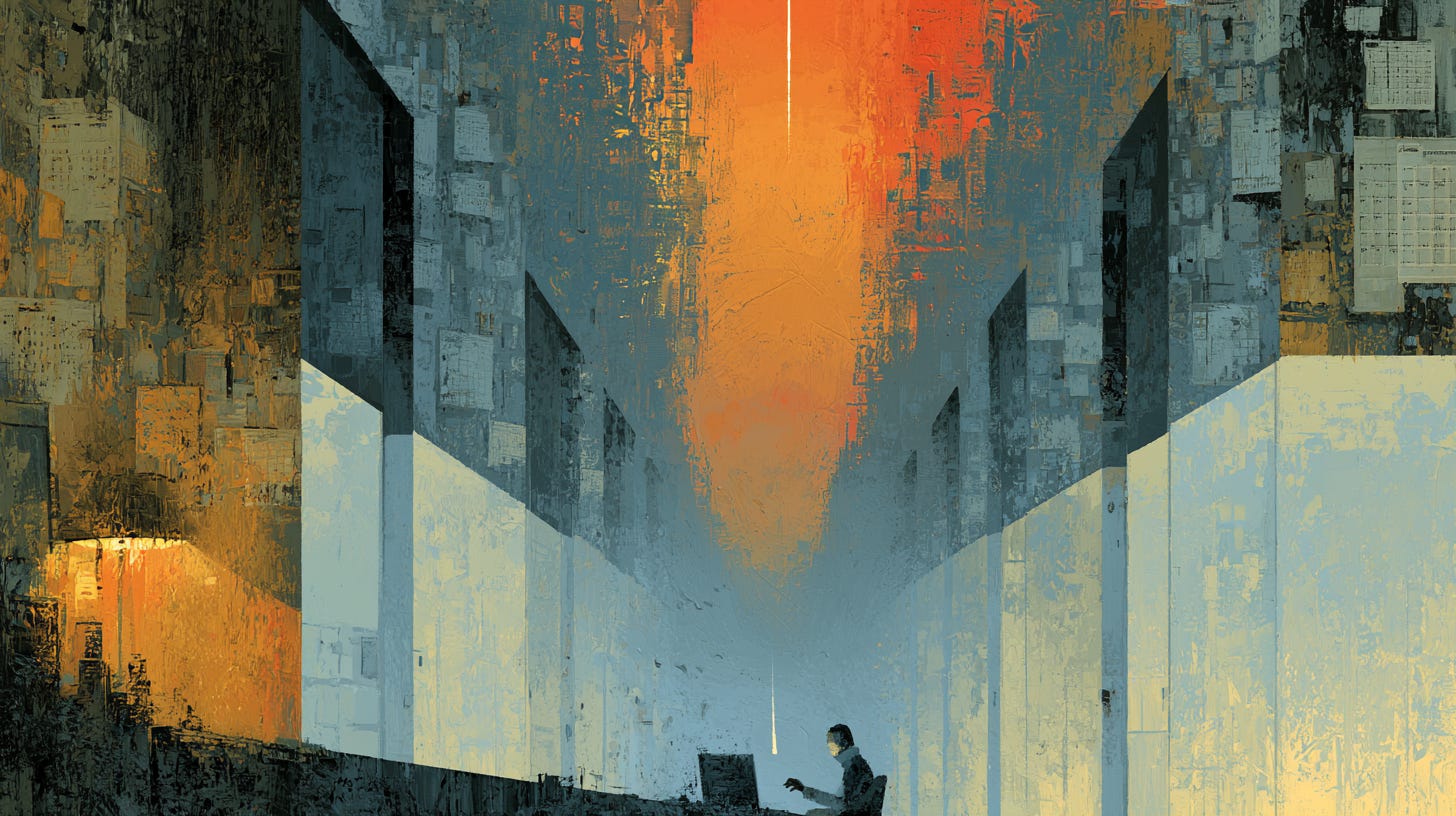
The cursor is blinking in the message box.
I need to fire a vendor.
I like the people. That is part of the problem. The underlying product is no longer right for the business, and we have tried to make it work. Instead of ending the relationship, I keep reaching for one more swing. One more change. One more chance.
I call the delay patience. Some days I call it loyalty. Ending a relationship with people I respect feels like a verdict on them, although the decision is about the product and what it is doing to the business.
Then the rules arrive.
Do not abandon good people. Do not mistake friction for failure. Do not make the hard decision until every possible repair has been exhausted. Give it another month. Try one more configuration. Be patient.
The strange part is that nobody is usually saying this out loud. The manager is not standing behind you with a hand on your shoulder. The audience is not gathered at the door with clipboards. The rules have your voice by now. They sound like judgment. They sound like maturity. They sound, worst of all, like realism.
I know this voice. I have called it prudence when it was fear. I have called it humility when it was a refusal to be seen. I have called it timing when the clock was not involved at all.
That is how a rule becomes a cage. It stops feeling like a rule.
It starts feeling like the room.
The Rule Starts Wearing Reality
Robert Anton Wilson had a gift for making invisible mental machinery feel tactile. This is part of what makes him useful and part of what makes him dangerous. He was brilliant, funny, excessive, and allergic to solemn authority. A writer like Wilson rewards selective reading. I read him with gratitude and scissors.
The clippings worth keeping are extraordinary.
Wilson's cleanest line in Prometheus Rising is still the whole engine: "Whatever the Thinker thinks, the Prover proves." The Thinker installs a proposition. The Prover searches reality for confirmation. If the Thinker says I am not ready, the Prover finds every tremor in the voice, every unread email, every person with better credentials. If the Thinker says people like me do not ask for that, the Prover finds the family story, the class signal, the social penalty, the one time someone rolled their eyes.
The Prover is loyal.
Wilson called the result a reality tunnel: a perceptual world organized around the assumptions that built it. The tunnel goes deeper than opinion. Opinions sit in the mind. Reality tunnels alter what the mind notices. They change which facts enter the room and which ones wait outside, tapping politely on glass.
That is how a rule becomes a cage. It stops feeling like a rule.
Dr. Julie Gurner, whose *Ultra Successful* essays translate executive psychology into weekly practice, has become a source of reckoning with my own reality tunnels.
Her pieces keep returning to a practical sequence: name the rule, notice the label, interrupt the reaction, find the avoided action, and change the inputs that keep reinstalling the old tunnel. The pattern is the same. People inherit or invent rules about permission, process, speed, scale, money, status, and social approval. Then they behave according to those rules. Then the behavior produces evidence that the rules were true.
Do not ask, so nobody says yes. Do not publish, so nobody responds. Do not apply, so nobody chooses you. Do not speak plainly in the meeting, so the room keeps thinking the same way. The absence of evidence gets misread as evidence of absence. The Prover reports back: see, there was no opening.
But the opening was never tested.
Some rules began as accurate readings of danger. The trouble starts when yesterday's evidence gets promoted into a law for every room.
The grounded version of the ethereal idea is smaller and more useful: a thought changes what you notice; what you notice changes what you try; what you try changes what reality gets to answer.
That is enough.
The Label Starts Managing You
A simple example is "imposter syndrome," because the phrase is familiar enough in professional life that we rarely hear what it says.
An imposter deceives. An imposter knows they do not belong and sneaks into the room anyway under false credentials. Most people who use the phrase are describing something else: the discomfort of learning at a higher level than the last one, in public, with witnesses.
That discomfort is real, and sometimes it contains a signal: underpreparation, thin support, a hostile room, a standard you have not met yet. The label becomes dangerous when shorthand hardens into identity. Treat the phrase as self-knowledge often enough and the mind receives its instruction. The Thinker says fraud. The Prover finds fraudulence everywhere. The email you reread three times becomes proof. The one question you could not answer becomes proof. The praise becomes suspect because the tunnel has already decided that any praise must be based on incomplete information.
Timothy Gallwey saw the same pattern on tennis courts. In his language, Self 1 is the judging narrator and Self 2 is the body-mind that actually performs. When Self 1 keeps telling Self 2 what it is, Self 2 begins to play the role. The bad server stays a bad server when the identity has been rehearsed into the body.
The workplace version is quieter, but it follows the same line.
During business school, I completed a 360 review. One piece of anonymous feedback came to me as little more than a word or two. There was no example, no explanation, nothing I could examine. The description felt antithetical to the person I believed I was trying to be.
My immediate reaction was disbelief. The observation sat so far outside my self-conception that I could not receive it. I could not process it. I could not get better from it. Totally orthogonal to the awareness of myself.
What I needed was one drop of curiosity. What had this person experienced around me that I could not see myself releasing into the room?
It took years to find the source. Their words still feel wrong to me. My intentions may have been good, like marshaling what I thought to be the best decision. When the room felt like I was being rigid and unopen to other ways. The feedback described some portion of my effect that my self-awareness had no way to register.
Dr. Julie's emotional resilience advice names the move I missed. Name the feeling. Buy time. Separate the signal from the delivery. Ask whether the reaction serves the work or only protects the ego. This leaves room for the delivery to be bad, the feedback to be wrong, or the room to be hostile. The first interpretation is often the tunnel speaking before reality has had a turn.
That speed is the danger. A feeling arrives and claims interpretive authority. Shame says exposed. Anger says disrespected. Fear says wait. Resentment says they never wanted you here. Superiority says they cannot handle the truth. How many characters from movies are right here in this paragraph?
Maybe one of those is accurate. Often one contains a signal.
Give the first story the whole room and information stops moving. The program has taken over.
The Culture Writes the Rule Before You Do
Wilson has a nasty little line that is easy to overuse and hard to forget: the easiest way to get brainwashed is to be born.
I am leaving most of Wilson's register behind here. Brainwashing overstates many ordinary things. Still, his point survives translation. We are born into rule systems before we can name them. Family rules. Class rules. Gender rules. Professional rules. Regional rules. Religious rules. Internet rules. The rules tell us what counts as ambitious, rude, humble, greedy, masculine, feminine, realistic, embarrassing, loyal, unserious.
By adulthood, many of these rules feel personal and fully installed. Incorporated. I am just not the kind of person who asks for that. I am just private. I am just cautious. I am just not political. I am just bad at conflict. I am just realistic about my lane.
Some of these sentences may be true.
Many are old group instructions wearing the costume of self-knowledge or some flavor of maturity.
The first interpretation is often the tunnel speaking before reality has had a turn.
Erich Fromm helps explain why we keep them. Freedom is psychologically expensive. It asks us to tolerate uncertainty, bear responsibility, and choose without a guarantee that the choice will be approved. The old rule may be cramped, but it is known. The tunnel may be narrow, but at least the walls tell you where to stand. That shelter has a cost.
"Declare war on the cage" has to be understood carefully. Recklessness only builds a new tunnel. The work is to stop giving inherited caution the dignity of truth before it has been tested. There is a difference between judgment and automatic obedience. Judgment looks at the actual room. Automatic obedience consults the old rule and calls the answer reality.
The same pattern scales beyond the self. A family can have a tunnel. A company can have one. A political movement can have one. A whole society can teach its members which possibilities are respectable enough to attempt.
Once a tunnel becomes a badge of belonging, the Prover stops protecting a private identity and starts protecting a tribe.
I know this reflex. I inspect the uniform before inspecting the claim. A source I distrust makes me search for the flaw. A source I favor makes the same scrutiny feel unnecessary. The Prover has already decided which evidence deserves a hearing.
On the right, the tunnel might turn institutional distrust into total capture, unwelcome facts into plots, and defeat into betrayal. On the left, the tunnel might turn disagreement into harm, disparity into proof of malice, and data into racism. The content differs, and the consequences differ. The shared failure is the reflex: the Prover learns what each tribe permits it to notice.
Private freedom begins when the Prover can receive evidence it did not choose. Civic freedom asks the same of us when the evidence arrives wearing the colors of a party, class, company, or crowd. The discipline that tests a private story also tests a public one: who taught me this, what does it help me see, and what does it train me not to notice? A free society needs people willing to test reality rather than merely defend the tunnel that made them comfortable.
That sounds abstract until you put the cursor back on the screen.
Ask the question. State the disagreement. Publish the piece. Or design the smaller test first: gather information, document a pattern, ask who else sees it, choose timing for reasons you can name. Tell the employee the truth with enough care that the truth can be heard. Tell the boss what the process is costing. Name the feeling before it becomes the story. Take one action that produces evidence the tunnel did not authorize.
Think of this as a way of collecting better data.
The tunnel may be narrow, but at least the walls tell you where to stand.
Some Walls Are Real
Some walls are real.
Bad bosses exist. Hostile workplaces exist. Family obligations, illness, debt, discrimination, grief, geography, and material limits exist. Sometimes the reason you have not walked through the door is that the door is locked, owned by someone else, and guarded by a person who benefits from your staying outside.
The agency claim cannot require pretending otherwise. That turns Wilson into magic and Dr. Julie into hustle culture instead of her steadfast, unapologetic realism.
A reality tunnel is a map problem. Reality is the territory. A good map can reveal a wall. A bad map invents one. The work is learning which one we are looking at before we organize a life around the conclusion.
There is another danger: confidence can be a cage. The Prover will confirm "I am an imposter," but it will also confirm "I cannot fail." The founder who ignores cash, the leader who mistakes bluntness for courage, the partisan who treats every disconfirming fact as enemy action, the writer who assumes all criticism is proof of reader cowardice: these are not free people. They are running brighter tunnels.
So the useful question is testability.
Freedom here is an error-correction practice: exposing the rule to an answer it does not control.
Design tests your Prover might fail. Let reality revise your priors.
Can I name the rule? Can I say where I learned it? Can I identify the action it prevents? Can I take one clean step that lets reality answer back? Can I survive the answer if it is not the one I wanted?
That last question is where the real work lives.
The cursor is still blinking.
I did eventually send the message to the vendor. By then, the delay had damaged the business, and rebuilding the lost progress cost far more than the conversation I had avoided. Ending the relationship hurt. The accumulated repair hurt more.
What I had called kindness was avoidance with good manners. Kindness would have delivered the truth earlier, while all of us still had more room to move.
The rule still had reasons. It always will. The Prover is excellent at reasons, and some of them will be true enough to slow you down. That is the genius of the cage: it rarely builds itself from total lies. It uses one bad meeting, one family warning, one social penalty, one embarrassing failure, one person who really did punish you for asking.
Then it generalizes.
Debating the rule keeps you inside the cage. Testing a bar changes the evidence.
Send the note. Ask for the room. Or design a smaller test: gather information, document the pattern, look for the ally, choose the timing on purpose. Name the feeling. Separate the signal from the delivery. Say the thing with enough force that it can be heard. Take the action small enough to be real and large enough to disturb the old rule.
Maybe the bar holds.
Then you have learned something about reality.
Maybe the bar moves.
Then you have learned something about the rule.
This is how we unshackle the mind and recover a larger life. The wrestling is the practice of freedom.
That is private practice for public freedom. A citizen who cannot test the rules inside his own mind will have a hard time testing the rules handed down by a party, a class, a company, or a crowd.
The cursor is still blinking. The cage has not disappeared. But the old rule no longer gets to call its own bars the world.
Sources and Inspiration
Prometheus Rising - Robert Anton Wilson
The Inner Game of Tennis - W. Timothy Gallwey
Escape from Freedom - Erich Fromm
Dr. Julie Gurner, *Ultra Successful* essays on imaginary rules, imposter labels, emotional resilience, and bending reality