

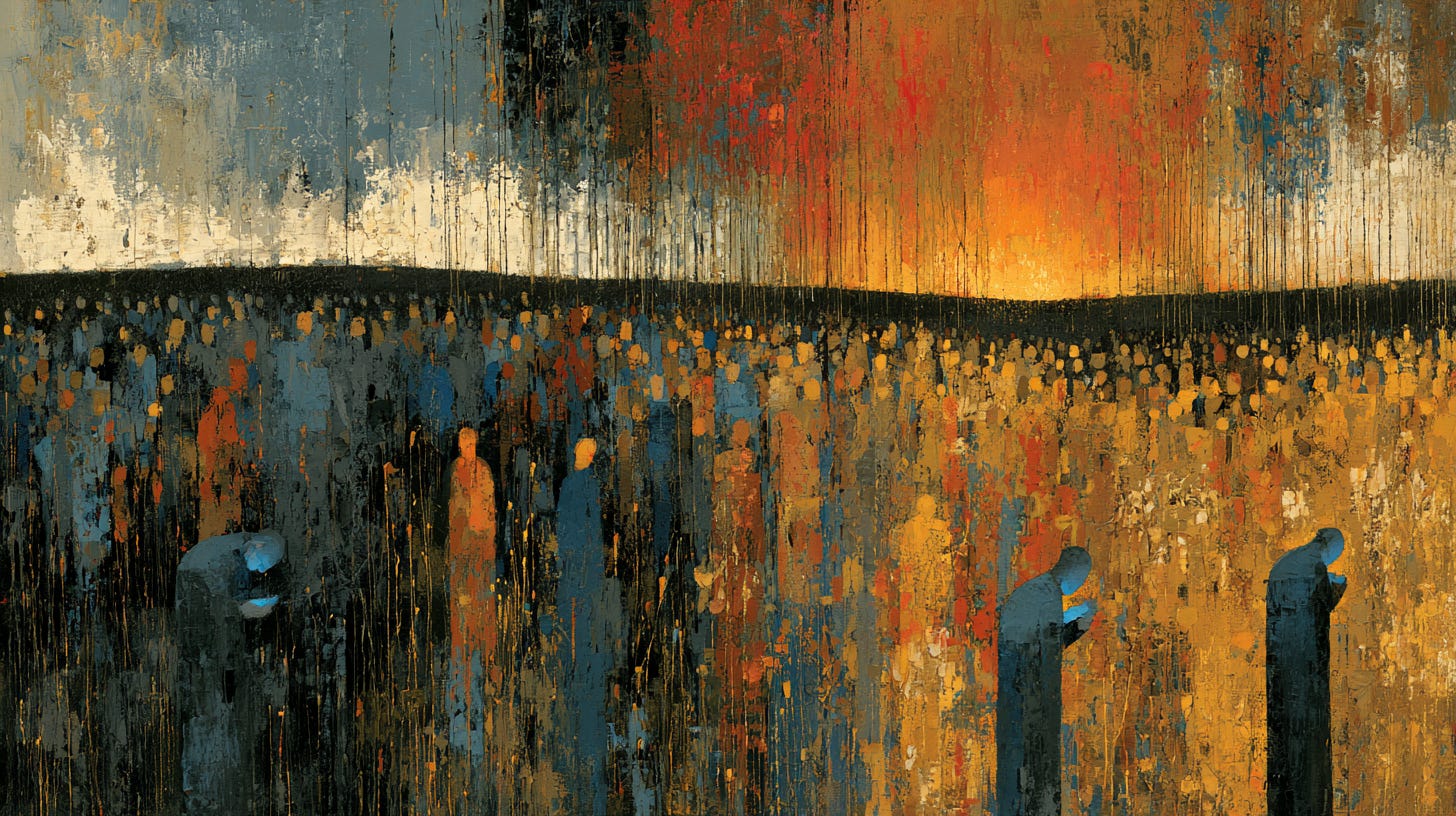
On Friday morning, before the market opened, a few hundred thousand people who will never see the inside of a Goldman Sachs allocation meeting picked up their phones and placed orders to own a piece of a rocket company. Most of them asked for a hundred shares and were handed twenty.
This is not how it usually goes. The richest day in a company's life, the initial public offering, is normally a velvet-rope event. The shares at the offering price go to hedge funds, pensions, university endowments, the institutions whose orders arrive through a banker who owes them a favor. The regular investor gets to buy in later, in the afternoon, at whatever price the morning's excitement has already inflated. The gate that keeps ordinary people out of the wealth-creation event is old and quiet and almost never mentioned, because almost no one on the outside of it knows it is there.
This week the gate came down. SpaceX set aside up to thirty percent of the largest public offering in history for retail buyers, against a normal five to ten. Institutions piled in so hard they clawed the retail share back to the low twenties, still triple what an ordinary investor ever sees. Fidelity dropped the threshold to get in the door from five hundred thousand dollars to two thousand. The orders that came back through Robinhood and SoFi and Schwab added up to something north of a hundred billion dollars, more than the entire company was raising, placed by people buying in two-thousand-dollar increments. Bankers who price these for a living haven't seen retail demand like it.
And by the closing bell, with the stock up nineteen percent, just shy of a hundred and sixty-one dollars, the man who founded the company was worth more than a trillion dollars. The first human being to cross that line.
I want to be explicit about what that number is, because almost everyone describing it this weekend has it wrong.
The people made him a trillionaire
A trillion dollars is not a vault. There is no room where it sits. Ninety-some percent of it is stock he has never sold in two companies that mostly have not yet done the things their price assumes they will do: land people on Mars, wire the planet for broadband, move the world's cars onto electricity. The Washington Post, no friend of the man, put it precisely in its own headline: the world's first trillionaire, on paper.
Benjamin Graham, who taught Warren Buffett how to think about this, said the market is a voting machine in the short run and a weighing machine in the long run. In the short run it counts votes. In the long run it weighs whether the thing was real. A trillion-dollar valuation is a tally of votes: a live, second-by-second count of how much a very large number of people believe a company will be worth. It is the public pricing one man's contribution in real time, and the contribution is enormous, and the price is the public's verdict on it.
Here is the part the weekend missed. The market is made of people, and people come in sizes. A multibillion-dollar fund and a nurse with a brokerage app are both casting votes; they are just weighted differently, and on the day that matters most, the small voters almost never get to vote at all. This week they did. The gate came down, the thresholds dropped, and a few hundred thousand ordinary people put their own money behind a man building rockets. They didn't get robbed. They lined up.
The market is a voting machine, and this week the smallest voters were finally let into the booth.
So when a senator goes on television to announce that trillionaires should not be allowed to exist, that this is a wealth transfer happening at your expense, there is a fact standing in the doorway. The people she means to protect were the ones placing the orders. They wanted twenty shares of the rocket company, and most of them wished they'd been handed the full hundred.
I'll grant the strongest version of the objection before going on, because it's real: a regular person buying into a euphoric offering at the top is one of the classic ways regular people lose money. That's Graham's weighing machine, and it does its work slowly. The vote happened Friday. The weighing happens over years, as the company delivers or doesn't. But notice what the objection concedes. It concedes that the bet was theirs to make. For once they were allowed into the room where fortunes are placed, and the dignity of that is not erased by the risk of it. Agency and risk are the same coin. You cannot hand someone the upside and protect them from the downside; the protection is the gate, and the gate is what just came down.
The model becomes the obstacle
Watch the feed the same hour the number crossed. The man is a parasite. He produces nothing. He took this from you. He should not be permitted to hold it. Whatever you think of him, sit with the speed of the reaction: a person creates more measurable value than anyone in the history of the species has created, and the dominant emotional response, within the hour, is that he must be stopped from having done it.
Charlie Munger watched markets for sixty years and concluded the thing that really drives the world is envy: the inability to bear that someone else has more. He thought it the strangest of the deadly sins because it's the only one that offers its practitioner no pleasure at all, not even the brief kind. You just suffer it, and call it justice.
René Girard, a French thinker who spent his life on the structure of human wanting, explained why the suffering scales the way it does. Desire, he argued, is rarely a straight line from a person to a thing. There is almost always a third figure in the picture: a model, someone whose wanting we copy without admitting we're copying it. When the model is far away, a saint, a hero, a figure on a mountain, we worship openly and feel no rivalry. But when the model comes close, when he is a peer, a neighbor, someone on the same plane as us, the worship curdles. The man we'd emulate becomes the man in our way. Girard's image is a sentry at the gate of paradise who shows you the entrance and bars it with the same gesture. The model becomes the obstacle. And then we hide the admiration even from ourselves, and what's left showing is the hatred.
Girard's claim was that envy does not spread because people have gotten worse. It spreads because the distance between people collapses. The modern emotions flourish, he wrote, "because internal mediation triumphs in a universe where the differences between men are gradually erased." Envy needs a peer. The duke did not envy the blacksmith; their worlds never touched. You envy the classmate one salary band up, the friend whose post outperformed yours, the neighbor with the better year, because those worlds touch yours completely.
Now hold the two halves of this week together, because they are the same fact. The thing that let the nurse buy her twenty shares is the collapse of distance: the gate down, the threshold dropped, the billionaire's company suddenly something an ordinary person could own a sliver of from her couch. And the thing that turned that same billionaire into an object of instant hatred is the same collapse of distance. When he is near enough to buy, he is near enough to resent. Equality is the engine of the verdict and the engine of the envy. The flattening that invites you in is the flattening that tells you the man who built the door is your enemy.
The same collapse of distance that lets the neighbor buy a share is what turns the man who built the rocket into everyone's obstacle.
Girard had one more piece, and it's the one that keeps this from being a story about a single senator and a single tribe. He called the two-person version of it double mediation: a closed loop where each side copies the other's wanting and each accuses the other of starting it, "opposed but alike, and even interchangeable, for they make exactly the same movements." Peoples and politicians, he wrote, "blame each other, with the greatest possible sincerity, for the conflicts between them."
Look at the two poles and you find the identical machine running different software. The left names the billionaire: he hoarded it, tax it back, no one should have that much. The right names a different mediator: the globalists, the coastal elites, the credentialed class who rigged the game and look down on you. The object on the table changes. The geometry never does. Both convert they have more than I do into they must have taken it from me, because the second sentence is bearable and the first one is not. Resentment of the person ahead of you is the most bipartisan emotion in American life. We have simply built, in the feed, the most efficient machine for manufacturing it that has ever existed: a device that puts every successful stranger on earth at arm's length, all day, forever. The triangle used to need a village. Now it runs between you and twenty thousand people you'll never meet.
Emulate, don't envy
There is an exit, and Robert Greene named it in three words: transmute envy into emulation. The comparing machine in the head doesn't have an off switch. What it has is a direction. The same engine that produces he should be stopped can produce I want to build the thing I'd want to live near, and the difference between those two sentences is the difference between a culture that makes things and a culture that divides them.
Resentment is manufactured for you. Emulation is the version you have to choose.
Moses Kagan, who invests in unglamorous real estate and writes about it, put the constructive version better than I can:
"The next trillionaire will undoubtedly get there by solving some very important problems (like advancing electrification of global personal transportation by a decade or more, dramatically cutting the dollar-per-kilogram of taking stuff to orbit, or supplying wireless broadband internet to the entire planet). I want to live in the world that person will help create."
That is the whole argument in two sentences, and the second one carries it. I want to live in the world that person will help create. You can hold that and still think the man who built it is difficult, reckless, wrong about half of what he says on any given Tuesday. The fortune is beside the point. What matters is what had to exist for it to be possible, and almost all of it is now load-bearing in other people's lives: the rocket that cut the cost of orbit, the network reaching villages no cable ever would, the cars. Matt Ridley spent a book showing that this is how prosperity has always worked, that wealth compounds when ideas meet and combine and that the people who set the combining in motion capture a thin slice of what they release into everyone else's hands. The builder, in Ridley's phrase, is "flotsam bobbing upriver on the tidal bore of invention," a current that long outruns him. The slice looks obscene. The river is the point.
And this, finally, is why I find myself with no political home this week. One side looks at the trillion and sees only the slice, and wants it back, and calls the wanting justice. The other has mostly stopped talking about building anything at all, trading the future for grievance and spectacle and a smaller, older country that never quite existed. Both are selling the same thing in different packaging: that the pie is fixed and your job is to guard your piece. I don't want the pie guarded. I want it bigger, and I want to be governed by people who can still tell the difference between a man who took something and a man who made something.
But the feed sets the terms. It does not get final authorship. That is the one thing it cannot take unless I hand it over. The gate came down for one strange week, and a few hundred thousand people walked through it and bought a piece of a future they'd rather live in than resent. The loudest voices in the country spent the same week insisting the man on the other side had locked them out. He hadn't. The door was open. It is still open. You were actively invited, unlike most times. What's left is the part no senator can legislate and no algorithm decides for you: whether you walk through doors like that and build something on the far side, or stand in front of them the rest of your life, certain you were robbed, nursing the one sin that was never any fun to begin with. That posture was always yours to choose. It is the only thing in this whole story that actually is.
Sources and Inspiration
The Intelligent Investor - Benjamin Graham
Poor Charlie's Almanack - Charlie Munger
Deceit, Desire, and the Novel - René Girard
The Laws of Human Nature - Robert Greene
The Rational Optimist - Matt Ridley