

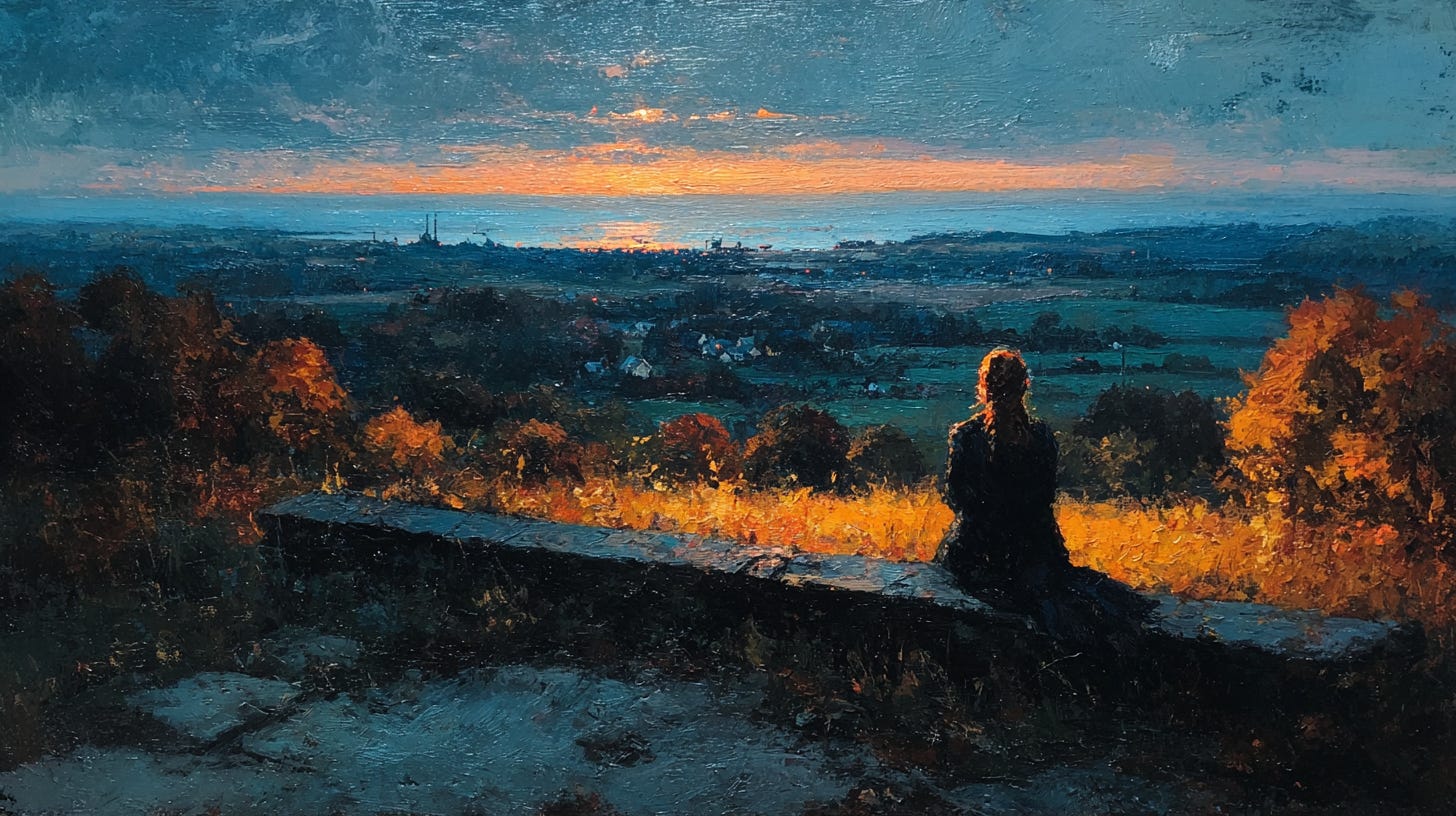
At three in the morning on June 17, 1775, cannon fire woke Abigail Adams and her four children. After sunrise she climbed Penn’s Hill with her seven-year-old son, John Quincy, and watched smoke rise from the Battle of Bunker Hill across the harbor. The British were burning Charlestown. The cannons were close enough to rattle the windows. Her husband was in Philadelphia, doing work that would get him hanged if it failed. Dr. Joseph Warren, a close family friend, would not survive the day.
She walked back down the hill and tended the farm.
In the days that followed she taught John Quincy a verse from William Collins’s 1746 “Ode,” a memorial to the dead, and had him recite it every morning after the Lord’s Prayer for the rest of the war: By fairy bands their knell is rung / By forms unseen their Dirge is sung / [There] Honour comes a pilgrim grey / To Bless the turf that wraps their Clay. John Quincy wrote decades later about “the tears of my mother and mingled with them my own, at the fall of Warren.” The poem Abigail chose was written for English soldiers who died putting down the Jacobite rebellion of 1745. She never considered herself an insurgent. She thought she was defending something that already belonged to her.
Abigail Adams held no office, signed no declaration, sat in no Continental Congress. She couldn’t. Women in colonial Massachusetts couldn’t vote, couldn’t hold property in their own name once married (the doctrine was called coverture), couldn’t attend university.
While John was away in Philadelphia building a nation he might not survive to see, Abigail ran a farm through wartime scarcity. She educated four children largely on her own. She absorbed refugees and family fleeing the siege of Boston. She watched wartime inflation triple the price of pins, ordered a chest shipped home from Philadelphia, and planned to resell at the rising rate. She wrote to him: “I hope in time to have the reputation of being as good a farmeress as my partner has of being a good statesman.” She called herself the directress of their husbandry.
The pin episode was the smallest version of a practice that would run for forty years. Beginning in 1777, with the Continental economy collapsing under wartime inflation, Abigail began converting cash into government bonds through her uncle Cotton Tufts, who kept the holdings legally separate from John’s. Continental loan office certificates at 6% during the war. Deeply discounted Massachusetts Consolidated Notes in the 1780s that paid out at 18% effective interest. Federal bonds under Hamilton’s funding plan in the 1790s. Military bonds funding John’s buildup against France in 1798. She called the money my own pocket money, and my pin money, and finally this Money which I call mine. John bought land and feared debt. Abigail bought paper and embraced calculated risk. Most of the Adams family wealth came from these securities. Much of it was bought without John’s full knowledge. She financed Peacefield, the family estate at Quincy, with the proceeds.
She read every pamphlet she could get her hands on. When Thomas Paine’s Common Sense appeared in January 1776, she read it almost immediately. “Tis highly prized here,” she told John, “and carries conviction whereever it is read. I have spread it as much as it lay in my power.” John was ambivalent. He admired Paine’s style and distrusted his radical democracy, and wrote his own competing pamphlet, Thoughts on Government, to argue for stronger restraints. Abigail kept distributing Paine.
In the summer of 1776, with smallpox sweeping through Boston, she organized a party of seventeen (her sisters’ families, her uncle’s family, all four of her children) and rode into the city to be inoculated. Inoculation killed people. Her mother had forbidden it for twelve years. Her mother was dead now. She weighed the odds, decided, and acted. Our Little ones, she reported to John, stood the opperation Manfully. Her two youngest didn’t take on the first try. They had to be reinoculated. The doctors weren’t sure it would work. John wasn’t there to consult.
On July 18, 1776, while she was inoculated and contagious, she walked into King Street to hear the Declaration of Independence read aloud from the State House balcony. She wrote John about what she saw: the kings arms were taken down from the State House and every vestage of him from every place in which it appeard and burnt in King Street. Thus ends royall Authority in this State. Her two youngest waited back at her uncle’s house. The doctors still didn’t know.
She signed her letters “Portia,” borrowing a Roman republican name to give herself a civic identity the public record refused her. Those letters were strategic intelligence: the mood of the colonies, observations about loyalty and dissent, assessments that John couldn’t access from a deliberation room in Philadelphia. John himself attested it: I think you shine as a stateswoman of late, as well as a farmeress.
In March 1776, just after the British evacuated Boston, she wrote him from a place of rare elation: I feel a gaieti de Coar to which before I was a stranger. I think the Sun looks brighter, the Birds sing more melodiously, and Nature puts on a more chearfull countanance. Riding that new sense of possibility, she added in the same letter the line history would remember. It reads now like a proto-feminist plea. The actual structure was Lockean: she was extending the Revolutionary principle of consent to the marital relation. Remember the Ladies, and be more generous and favourable to them than your ancestors. Do not put such unlimited power into the hands of the Husbands. Remember all Men would be tyrants if they could. If particular care and attention is not paid to the Ladies, we are determined to foment a Rebelion, and will not hold ourselves bound by any Laws in which we have no voice, or Representation. No taxation without representation, said by the colonies to England. No laws without voice, said by Abigail to her husband. The same argument scaled down to the household. She was warning John what the revolution would need to become if it wanted to survive its own contradictions. In the same letter, she named the deeper hypocrisy: the passion for Liberty cannot be Eaquelly Strong in the Breasts of those who have been accustomed to deprive their fellow Creatures of theirs.
Abigail, you are my patriot.
John’s reply was jocular: the despotism of the petticoat, the assurance that men knew better than to repeal their masculine systems. The marital register softened the form. The substance was a political dodge. He agreed. But he couldn’t spend his coalition capital on it. Not yet. In the same letter, he conceded as much: We have only the name of masters. He knew the system he was mock-defending was already a fiction. He was mocking the status quo, not Abigail. Over the years, society would move, his own power would move, and many of her positions would land where she had said they belonged. Others took decades more. Theirs was the most consequential intellectual partnership of the founding, and Abigail was the upstream cause of John’s evolution. She kept writing because she had a reader who listened to her. She saw the gaps between what the founders declared and what they practiced. She named them, in letters that weren’t meant for publication, to a man she trusted.
History knows her name. But it knows her as John’s wife, as the woman who wrote “Remember the Ladies,” as a supporting character in someone else’s story. The actual scope of what she did, the strategic weight she carried, sits quietly behind the more celebrated narrative. I don’t think she minded. She wanted the work to land, and history has supported her.
When the correction becomes the point
This is harder to talk about than it should be.
The modern instinct around equality and gender treats visibility as the measure of contribution. If you aren’t seen, you didn’t matter. If your name isn’t on it, you didn’t build it. The culture measures impact by how loudly it’s announced.
I understand the impulse. History has been genuinely unfair about whose names it remembers. It has also been unfair about whom it tried to abolish or rewrite. Women especially have been written out of stories they helped author.
John bought land and feared debt. Abigail bought paper and embraced calculated risk.
Abigail’s version of the demand was different. “Remember the Ladies” was a demand for legal standing — for inclusion in the architecture, for protection in the law. Not personal visibility, not credit on the marquee. She wanted women to be heard in the framework, not famous outside of it. That distinction, between equal opportunity to act and equal recognition for the acting, has gotten harder to hold.
But watch what happens when the correction becomes the point. The historian Daniel J. Boorstin called these pseudo-events: gatherings staged to look correct rather than to be correct. The image is the deed. Meetings multiply. Announcements replace action.
We’ve all done it. Spent energy making sure the right people knew about our work rather than spending that energy on the work itself. The culture encourages it on every side. Celebrate yourself. Build your brand. Make sure they see you. Or on the other pole: post the right dissent, signal the right credentials, perform your tribe. Different costumes, identical move: the display becomes the deed. The authenticity market sells you the signals.
The demand for equal visibility isn’t the same as the demand for equal opportunity. Abigail Adams had brutally unequal opportunity. She couldn’t vote, couldn’t own property independently, couldn’t sit in the rooms where decisions were made. And yet she exercised more influence on the founding than some of the men who signed the Declaration. She didn’t wait for the system to recognize her.
She was too busy being effective.
The architecture nobody names
For every name history keeps, hundreds made that keeping possible. Washington needed the farmers who fed his army through Valley Forge. Jefferson needed the printers and riders who carried the Declaration from parchment to public consciousness. Adams needed Abigail.
The founding was fragile. Improvised by flawed people with no blueprint and no certainty. And it held not because of the celebrated names but because of the invisible architecture behind them: the people who grew the food, managed the money, raised the next generation, and kept the civic organism functioning while the famous figures did the parts history would remember.
Tocqueville saw this when he traveled America fifty years later. What struck him was the voluntary associations: ordinary people joining together to build schools, churches, roads, civic organizations, anything that needed building. Nobody wrote about these people. They didn’t have bylines or legacies or platforms. But the democracy worked because of them. The habits that sustained self-governance were practiced quietly, daily, by people who showed up because the work needed doing.
The township, Tocqueville thought, was to freedom what primary schools are to science: the place where citizens first learn the habit of governing themselves. Not the Senate chamber. The township. Where people solved problems without waiting for instructions, built things that would outlast them without anyone recording their names.
The actual scope of what she did, the strategic weight she carried, sits quietly behind the more celebrated narrative.
Aristotle saw this before Tocqueville did. Friendship seems to be the bond of Social Communities, and legislators seem to be more anxious to secure it than Justice even. Abigail had named the same move at household scale. Such of you as wish to be happy willingly give up the harsh title of Master for the more tender and endearing one of Friend. The political community rests on more than the rules. It rests on the relational substrate beneath them. The framework holds because the substrate holds.
We don’t build monuments to this architecture. Everything we have rests on it.
Emerson called it the iron string: the willingness to trust your own capacity without waiting for the world to confirm it. The pressure of society, Emerson saw, conspires against the independence of every one of its members. The pressure runs toward conformity, toward measuring yourself by whether others noticed, toward substituting the room’s approval for your own judgment.
Abigail vibrated to her own iron string. She didn’t need the world to write her name in order to exercise her mind. She wasn’t waiting for the monument. She was raising a future president, advising a current one, and holding together a farm in Braintree while her world burned.
That’s a kind of power we don’t celebrate well anymore. We celebrate the person who demands the stage. The voice that says I deserve to be seen. And there is a version of that which is righteous, which corrects real injustice, which names what should have been named long ago.
Most of the Adams family wealth came from these securities. Much of it was bought without John’s full knowledge.
But there’s another version that confuses the stage with the work. That treats the recognition as the goal rather than the byproduct. That spends so much energy making sure the contribution is visible that the contribution itself gets thinner.
The person doing the most is usually the one least concerned with whether anyone notices. And the person most concerned with being noticed is usually not the one you’d want running things.
A letter to my daughter
Underneath my cultural diagnosis is something more specific.
I have a daughter.
What I want to tell her is not to focus too tightly on demanding your seat at the table. The seat matters less than what you do once you’re in it. And sometimes what you do outside the room matters more than anything happening inside.
You have special and immense powers. I can see them already. What I want for you is to use them. Fully, without apology, without waiting for permission, without needing the byline to know the work was yours. Let them land where they need to land. Push the history of the people around you in a direction worth pushing. The world you’ll inherit makes Abigail’s path harder, not easier. The absence of constraint can be its own confusion.
The credit will sometimes go elsewhere. The history books may remember someone else’s name.
Good.
You were never in it for the history books. You were in it to change your part of history.
Abigail Adams had a farm, a pen, a mind that could match any in Philadelphia, and the willingness to use all of it without waiting for permission or applause. The revolution would have been poorer without her. The republic would have been different. One of her sons became the sixth president. History remembers her, precisely because she focused on the doing.
On January 18, 1816, sixty-eight years old and certain she was dying, Abigail wrote a will. Under coverture, married women couldn’t own personal property — their belongings legally belonged to their husbands. A wife’s will had no legal force. She wrote one anyway. She opened it not with the customary sound mind and body but with a different formula: I Abigail Adams wife to the Hon[ora]ble John Adams of Quincy in the County of Norfolk, by and with his consent, do dispose of the following property. She bequeathed more than four thousand dollars in bank stock, a promissory note, toll-bridge shares, gowns, watches, and rings, almost all of it to female relatives. John found the document after her death and executed it as if it were legally binding.
She was unstoppable. Not performative. Be Abigail.
Sources and Inspiration
The Letters of John and Abigail Adams
Founding Brothers: The Revolutionary Generation - Joseph J. Ellis
Democracy in America - Alexis de Tocqueville
Self-Reliance - Ralph Waldo Emerson
Nicomachean Ethics - Aristotle
Second Treatise of Government - John Locke
The Image - Daniel J. Boorstin