

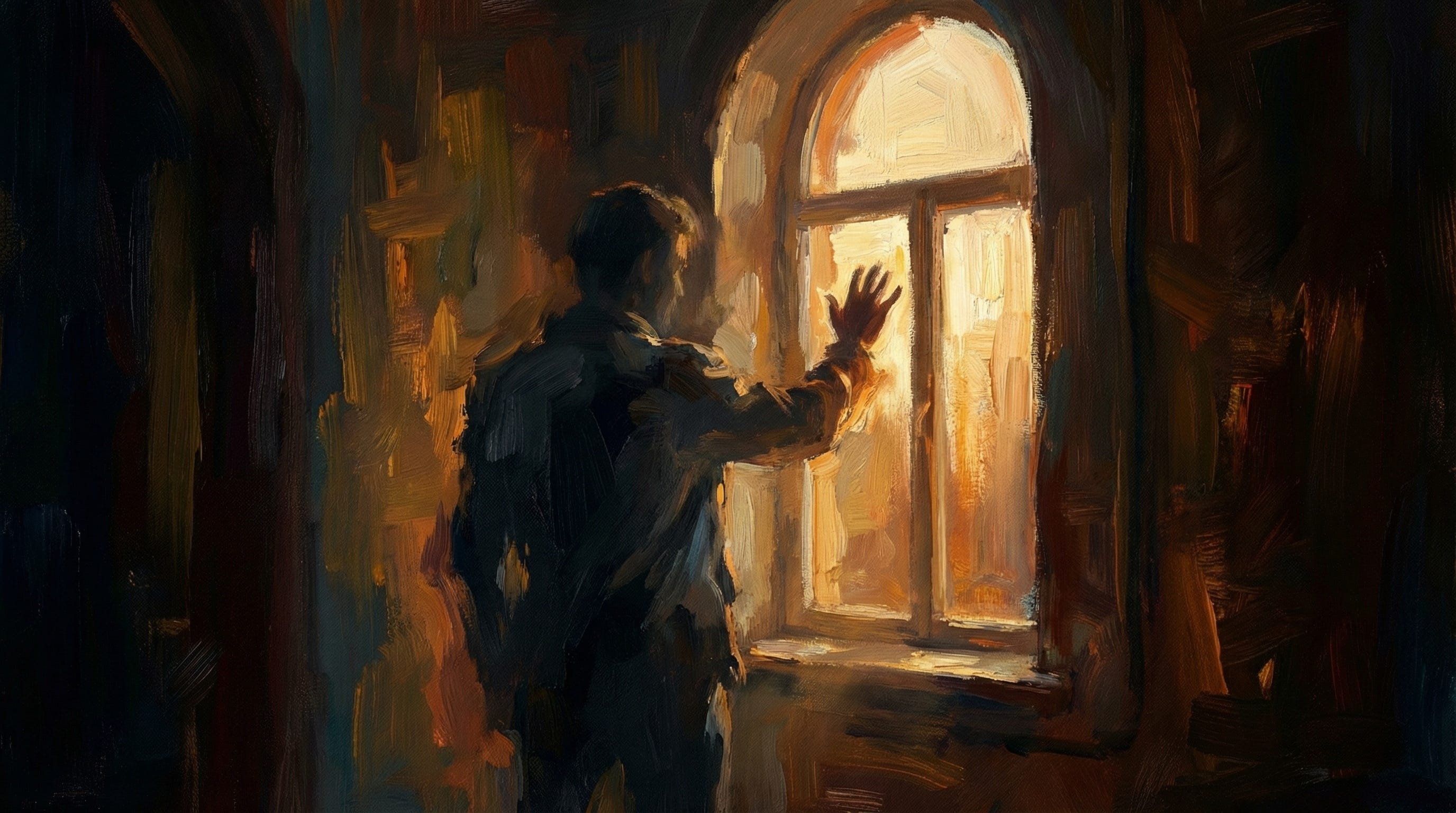
“He only earns his freedom and existence who daily conquers them anew.”
Goethe put these words in the mouth of Faust at the end of his life, the final wisdom of a man who had tried everything: knowledge, pleasure, power, love. What he learned was that freedom is not a possession. You don’t achieve it and then have it. You earn it each day or you lose it.
This sounds like motivational rhetoric until you watch yourself lose it. Not through some crisis or conquest. You just stop choosing. The days blur together. You do what you did yesterday because that’s what you did yesterday. Your opinions are the opinions of your environment. Your life is the life that happened to you while you weren’t paying attention.
Rollo May called this “blind momentum.” The opposite of choosing one’s self. The path of least resistance that feels like normalcy but is actually a slow evacuation.
Freedom is psychologically expensive. This is Fromm’s insight, the one he arrived at watching Europe burn in 1941: modern people are free in ways their ancestors couldn’t have imagined, and many of them are miserable because of it.
The medieval peasant had no choices. He was born into a role, a place, a meaning. He didn’t have to figure out who he was or what his life was for. The world told him. We broke those bonds. We declared that every person could choose their own path, their own beliefs, their own identity. We called it liberation.
It was. It also created a new kind of burden. When no one tells you who to be, you have to decide. When no authority dictates what to believe, you have to think. When your life has no predetermined meaning, you have to make one. This requires tolerating uncertainty, bearing responsibility, and maintaining a self without external scaffolding.
Many people find this unbearable. Because it’s genuinely hard.
So they escape. Fromm identified three routes: submit to an authority who will tell you what to think (authoritarianism), destroy what threatens your fragile self (destructiveness), or become indistinguishable from your environment (automaton conformity).
The third is the quietest and most common. You adopt the personality offered by cultural patterns. You think what you’re supposed to think, want what you’re supposed to want. It doesn’t feel like surrender because it feels like common sense. Of course I believe what everyone around me believes. These positions are obviously correct.
The self that would exercise freedom has been replaced by something that looks like a self but isn’t choosing anything.
Rollo May saw the same thing from a therapist’s chair. His patients weren’t suffering from dramatic pathologies. They were suffering from emptiness. From the sense that their lives weren’t quite their own. From what he called “the loss of the center.”
His prescription was strange-sounding but precise: you have to choose yourself.
Not once. Each day.
“The basic step in achieving inward freedom is ‘choosing one’s self,’” he wrote. “This strange-sounding phrase of Kierkegaard’s means to affirm one’s responsibility for one’s self and one’s existence. It is the attitude which is opposite to blind momentum or routine existence; it is an attitude of aliveness and decisiveness; it means that one recognizes that he exists in his particular spot in the universe, and he accepts the responsibility for this existence.”
This is not self-help advice about morning routines or positive thinking. It’s an existential claim about what it means to be free. Freedom is not a state you achieve and then coast on. It’s a practice. You either do it today or you don’t. And if you don’t do it enough days in a row, you start to forget that you could.
Here’s the part that surprised me when I first read May: he says the reward for this daily work is joy.
Not happiness. Joy.
He distinguishes them carefully. Happiness is circumstantial, dependent on things going your way. Joy is something else: “the affect which comes when we use our powers.”
Watch a child learning to walk. She tries, falls, gets up, tries again. Falls again. Keeps going. And when she finally takes those steps, she laughs, she beams. Not because anything external has changed. Because she’s using her powers. Because she’s becoming what she is capable of becoming.
“This is nothing in comparison,” May writes, “to the quiet joy when the adolescent can use his newly emerged power for the first time to gain a friend, or the adult’s joy when he can love, plan and create.”
Joy is the signal that you’re doing it. That you’re not in blind momentum but in active becoming. That the self exercising freedom is actually present.
This reframes the whole project. The daily conquest isn’t grim duty. It’s the path to the deepest satisfaction a human being can experience. The people who escape into routine, who let the phrases think for them and the crowd choose for them, aren’t just losing their freedom. They’re losing access to joy.
You can see this playing out in language.
Orwell noticed it in 1946: when people stop choosing their words, the words start choosing for them. “Ready-made phrases,” he wrote, “will construct your sentences for you, even think your thoughts for you, to a certain extent, and at need they will perform the important service of partially concealing your meaning even from yourself.”
That last part is the key. The ready-made phrase doesn’t just save effort. It hides you from yourself. You can speak fluently in the dialect of your tribe without ever confronting what you actually believe. The phrases do the work. You’re technically talking, but no one is home.
This is automaton conformity applied to speech. And speech shapes thought. Sloppy language, Orwell argued, makes sloppy thinking easier. The two corrupt each other in a feedback loop.
But he also believed the process was reversible. That’s the hopeful part. If you choose your words carefully, if you ask “what am I actually trying to say?” instead of letting the familiar phrases rush in, you’re doing a small version of the daily conquest. You’re being present where you could be absent. You’re choosing where you could be coasting.
Clear language is evidence of a self that showed up.
This has political implications. May made them explicit:
“We simply propose that our social and economic ideal be that society which gives the maximum opportunity for each person in it to realize himself, to develop and use his potentialities and to labor as a human being of dignity giving to and receiving from his fellow men.”
The good society is the one that makes the daily conquest possible. That gives people the space and the tools to choose themselves. Not freedom from constraint only, but freedom to become.
Collectivism, whether fascist or communist, fails not because it’s the wrong tribe but because it forecloses this possibility. It tells you who you are. It chooses for you. The relief it offers is real (Fromm understood this), but the price is the self that would have done the choosing.
We oppose these systems not out of tribal loyalty to our own side but because we believe something about what human beings are for. We believe they’re for becoming. For using their powers. For the quiet joy that comes when the adult can love, plan, and create.
This is what we’re trying to build. This is what we’re trying to protect.
I notice that I haven’t done this well today.
I woke up and checked my phone before I was fully conscious. I read opinions I already agreed with. I felt the small satisfaction of having the right views without the effort of arriving at them. By the time I sat down to write, I was already in blind momentum, already coasting on yesterday’s choices.
The daily conquest is not something I’ve achieved. It’s something I fail at regularly and try to resume. The trying is the point. Goethe didn’t say “he only earns his freedom who conquers once.” He said daily. Each day. Anew.
There’s something strange in that word: anew. It suggests that yesterday’s conquest doesn’t carry over. That you can’t bank it. That freedom is less like a possession you accumulate and more like a fire you have to keep feeding or it goes out.
Maybe that’s why it’s so easy to lose. We expect that once we’ve figured things out, we can relax. We can coast on our previous clarity. But clarity fades. Choices calcify into habits. The self that was present yesterday can be absent today without anyone noticing, least of all you.
The only remedy is to begin again.
May saw patients in the 1950s who were materially comfortable and spiritually empty. They had achieved the external markers of success and felt nothing. They came to therapy not with dramatic symptoms but with a vague sense that something was missing, that their lives were not quite their own.
Seventy years later, I don’t think the problem has gotten smaller.
We have more freedom than any humans in history. More choices, more information, more paths available. And yet the blind momentum is everywhere. The tribal dialects, the ready-made opinions, the lives that happen by default. The escape routes are more numerous and more comfortable than ever.
But so is the possibility of joy. That hasn’t changed. The child still laughs when she learns to walk. The adult still feels the quiet satisfaction of using her powers well. The self that shows up, that chooses, that conquers anew, still has access to what May called “the profoundest joy to which the human being is heir.”
It’s available today. It was available yesterday, and I missed some of it. It will be available tomorrow.
Did you choose joy, today? There is still time.
Sources and Inspiration