

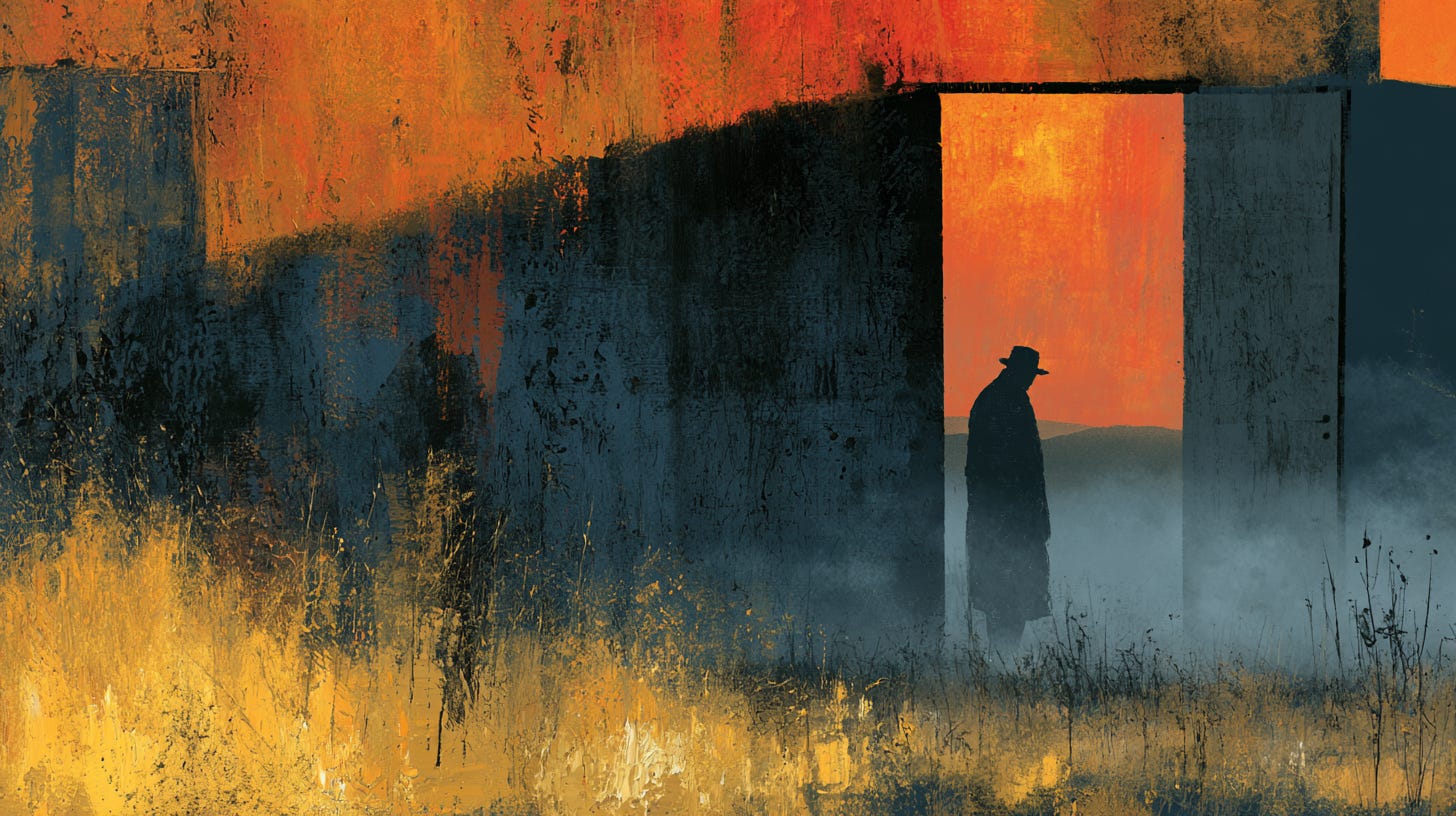
You’re about to walk into the room and you already know how it ends. You’ve decided it. Somewhere between the parking lot and the door, a quiet verdict settled in: you’re going to blow it. You’ll say the wrong thing, or not enough of the right thing. Your voice will thin out at the crucial moment. They’ll see through you.
And then you walk in, and it happens exactly like that.
Later, you’ll tell yourself the doubt was justified. See? I knew I wasn’t ready. The evidence is right there: the stumble, the silence, the missed beat. What you won’t notice is the direction of the causation. The doubt came first. The failure followed its instructions.
I know this loop because I’ve lived inside it. The night before a conversation I care about, running scenarios where I lose. The morning of something that matters, cataloguing reasons it won’t work. There’s a strange comfort in it. Certainty, more than pleasure. When you doubt, you can see very clearly where you’re going. You have a map. The map says failure, and the map is accurate, and there’s something almost peaceful about that accuracy. Uncertainty is the harder thing: not knowing whether you’ll succeed, not knowing who you’d be if you did.
We prefer the certain failure to the uncertain success. The deeper trade is identity: we prefer a known self to an unknown self, even when the known self is suffering. That preference costs us more than we admit.
Robert Anton Wilson had a name for this: the Thinker and the Prover. The nervous system operates like a computer. The Thinker enters the program, and the Prover executes it. Whatever the Thinker thinks, the Prover proves. Think the world is hostile, and the Prover will surface every slight, every sideways glance, every piece of evidence that confirms the hostility. Think you’re unlucky, and watch the Prover assemble a case so thorough you’d swear it was objective.
The hardware is neutral. It doesn’t evaluate the instruction. It doesn’t ask whether the program is true. It asks only what it’s been told to find, and then it finds it with fidelity.
This means doubt is not what we think it is. We experience doubt as observation: I’m looking at myself clearly, and I see someone who will fail. But the Thinker/Prover loop inverts the causation. The doubt writes the situation it claims to read.
Wilson put it bluntly: “Doubts tell it not to perform.” You tell the Prover you’re inadequate, and the Prover goes to work: tightens the throat, scatters the preparation, selects for every micro-expression of boredom in the audience while filtering out every nod. The Prover is diligent. It will build the case you asked for.
And here is what makes the loop so durable: the Prover makes you right. You predicted failure, and failure arrived, so the prediction feels validated. Each cycle reinforces the last. The doubt was a prophecy that arranged its own fulfillment, then pointed to the wreckage as proof.
The Thinker doesn’t just install single instructions, though. It builds what Wilson called reality tunnels: perceptual worlds organized around a core belief. Self-doubt is a tunnel you live inside. The kind of person who fails at things like this. The tunnel sorts evidence at the entrance: what confirms passes through; everything else becomes anomaly, exception, luck. Inside the tunnel, success becomes anomaly. You succeeded despite being the person who usually doesn’t. The tunnel stays intact.
The machine doesn’t care which program you give it. The Prover will confirm your brilliance with the same fidelity it confirms your worthlessness. The question is who’s writing the code. And for most of us, the answer is: whoever wrote it last. The doubt program runs because no one told it to stop.
This is worth holding onto: the Prover doesn’t care about politics, ideology, or tribe. It runs whatever program it’s given. The doubter who has convicted themselves before they enter the room is running one program. The true believer who cannot be wrong (the activist whose movement is on the right side of history, the founder whose vision cannot fail, the partisan whose tribe is correct by definition) is running the inverse program on identical hardware. Both are escape routes. The doubter escapes into certain failure; the believer escapes into certain success. Neither has to risk becoming. The certainties are different; the refusal is the same.
The body already knows
Timothy Gallwey saw the same mechanism from the body side. In Gallwey’s framing the Thinker is Self 1, the narrating and judging voice; the Prover, in the body, is what Self 1’s distrust produces. The Thinker says “I’ll fail.” The Prover tightens the muscles, quickens the breath, floods the system with the chemistry of anticipated disaster. Self 2, the body-mind that knew what to do all along, gets muscled out of its own performance.
The capacity was never missing. Watch the athlete who practices beautifully and freezes under pressure. The skill was there the whole time. Between the practice court and the match, something was added: the weight of watching herself, the running commentary, the judge.
Gallwey’s students needed less narration. Confidence was beside the point. When he redirected their attention to the rhythm of the ball, the conscious mind got occupied, and the body was freed to do what it already knew. Doubt, seen this way, is an excess. The narrator won’t shut up. The judge won’t leave the courtroom. And as long as the commentary runs, the performer can’t perform.
The comfort of certain failure
So the machine can be reprogrammed. The interference can be quieted. The Thinker can think new thoughts. Self 1 can learn to trust Self 2. The capacity is there; the obstacle is removable.
Then why don’t we remove it?
Because doubt is comfortable. I mean this. Doubt gives you something that trust doesn’t: a clear picture of where you’re headed. When you doubt, you can see the failure coming. You can prepare for it, brace against it, rehearse your reaction to it. You know exactly who you are in the story: the person who wasn’t quite good enough. That identity is painful, but it’s stable. You know how to live inside it.
Augustine described this 1,600 years ago, in different vocabulary: “the worse whereto I was inured, prevailed more with me than the better whereto I was unused.” The horror grew the closer he came to becoming other than he was. The doubt program is the same dynamic at the inner-game scale.
Trust, by contrast, is vertigo. If you quiet the narrator and let Self 2 work, you don’t know what happens next. You might succeed. And then what? Success means you were wrong about yourself. It means the reality tunnel you’ve been living inside was a construction. It means you have to revise the story, which means you have to tolerate not knowing who you are while the new story forms. That uncertainty is what doubt exists to prevent.
Erich Fromm would recognize this. He spent his career mapping the escape routes people take when freedom becomes unbearable: authoritarianism, destructiveness, conformity. Elsewhere I named another route Fromm didn’t catalogue: the informed spectator. Self-doubt is its private twin, the same mechanism turned inward. The spectator never acts because they see through every actor. The doubter never acts because they have already convicted themselves. If you doubt yourself completely enough, you never have to exercise your freedom. You never have to choose, risk, build. The doubt chooses for you, and you get to call it realism. The most respectable escape from agency is the one that looks like self-awareness.
I recognize this in myself: the careful voice that calls caution what is actually retreat. And the inverse: sometimes my doubt has been the only honest thing in the room, and I learned to override it, and I was wrong to. The frame has to allow for that or it stops being a diagnosis and becomes a closed loop dressed up as one. No wonder we’ve pathologized anxiety.
Rollo May saw the cost. Anxiety, he said, is the price of becoming. We feel it because we’re approaching something we haven’t been before. The person who feels no anxiety has stopped growing. Self-doubt numbs that anxiety by foreclosing the becoming. You can’t fail at what you never attempt. You can’t face the vertigo of a new self if you never let the old self be wrong. Doubt is an anesthetic for the pain of possibility.
But the daily conquest May described requires bearing exactly this pain. The line he quotes is from Faust, and the doubt program is the inverse Faustian bargain: certain failure as the price of never having to risk becoming. Different terms, same refusal.
The program reinstalls itself every morning and must be overridden every morning. Metaprogramming the Thinker is a practice. It has the same rhythm as May’s choosing oneself: you do it today, or you don’t. And if you skip enough days, you forget you ever could.
The Prover doesn’t have preferences. It doesn’t want you to fail. It doesn’t want you to succeed. It takes the instruction and executes it with perfect fidelity.
The doubt you carry is the mechanism that delivers the outcome you fear. And the reason it persists is that certain failure is easier to bear than uncertain freedom. You know who you are when you doubt. You don’t know who you’d be if you stopped.
That uncertainty is where the living happens. The part of you that already knows how to perform, how to speak, how to build, is waiting for the narrator to stop talking.
It has been waiting for a long time.
Sources and Inspiration
Prometheus Rising - Robert Anton Wilson
The Inner Game of Tennis - Timothy Gallwey
Escape from Freedom - Erich Fromm