
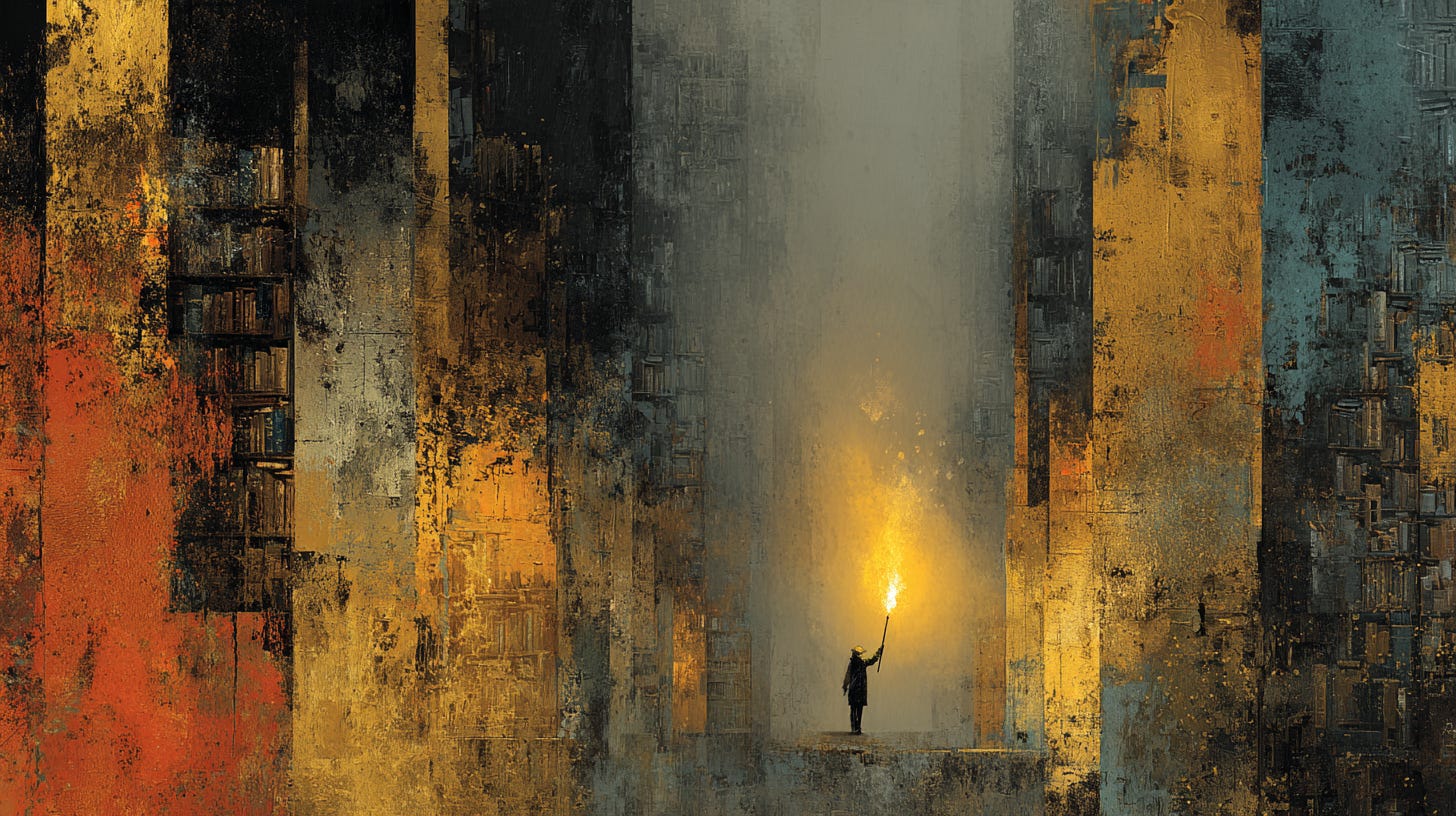
Fifty-three works that ground everything published here. Read seriously, returned to often, allowed to argue with each other.
These are the books I have found necessary for my own education. The American school system I grew up in taught facts but left the foundation unspoken: the why of self-governance, the contingency of the inheritance, the responsibility each of us carries to keep the fire lit and pass it on.
Part of the reason this publication exists is to make the work I had to do alone a little easier for the next person. The name is not accidental. Prometheus stole fire from the gods and gave it to humanity — a gift, a transgression, a cost. The Canon below is the fire I was handed without instructions and had to assemble book by book. This page is where I try to pass it on.
These are not sources chosen for ideological coherence. Many of them disagree with each other on important questions. What unites them is that each one held up under attention and gave me language for something I had previously been struggling to name. When I cite Fromm in an essay, the goal is for his insight to do load-bearing work in the argument, not to show that I read him. When a source becomes decoration rather than structure, I cut it.
Where to Start
A handful of short, narrative books across four doors into the publication’s argument. Each pair is paced for a couple of weekends. Each opens appetite for the heavier Canon work behind it.
Diagnostic
Why we flee freedom.
Erich Fromm — Escape from Freedom (1941). The keystone. Modern societies hand individuals freedom they cannot bear; the predictable response is flight into authoritarianism, destructiveness, or automaton conformity.
Eric Hoffer — The True Believer (1951). Mass movements as relief from individual responsibility. Fanatics across the political spectrum share the same structure under different costumes.
Constructive
What flourishing actually requires.
Viktor Frankl — Man’s Search for Meaning (1946). Meaning under conditions where it is hardest to find. The reversal of the question: from “what do I want from life?” to “what does life ask of me?”
Rollo May — Man’s Search for Himself (1953). Selfhood under the anxiety of freedom. The companion that finishes the existential frame.
Self
The inner ground.
Ralph Waldo Emerson — Self-Reliance (1841). An essay, ~50 pages, read in a sitting. The 19th-century American statement of the disposition the publication keeps coming back to.
Jim Murphy — Inner Excellence (2009, revised 2020). Three pillars (love, wisdom, courage) against three adversaries (the Critic, the Monkey Mind, the Trickster). The additive companion to Emerson.
Civics
What’s the same, what’s different.
Joseph J. Ellis — Founding Brothers (2000). Ellis follows the founders into the 1790s, where the political messiness — Hamilton vs. Jefferson, vicious partisan press, talk of secession — rhymes with what we live in now. Continuity in human dynamics across two and a half centuries.
Neil Postman — Amusing Ourselves to Death (1985). What has actually changed: the media substrate underneath the politics. Together with Ellis, the publication’s stance comes into focus: persistent dynamics on transformed epistemic ground.
The Full Canon
Below, the Canon is organized into eleven categories. They are not airtight; many sources work across more than one. The category tells you what the source does most strongly.
I. Freedom and Authoritarianism
Why people flee freedom. Mechanisms of escape. Authoritarian appeal.
Erich Fromm — Escape from Freedom (1941)
Eric Hoffer — The True Believer (1951)
F.A. Hayek — The Road to Serfdom (1944)
II. Media and Epistemology
How media shapes thinking, public discourse, and the conditions of truth.
Neil Postman — Amusing Ourselves to Death (1985)
Martin Gurri — The Revolt of the Public (2014)
Timur Kuran — Private Truths, Public Lies (1995)
Karl Popper — The Open Society and Its Enemies (1945)
David Deutsch — The Beginning of Infinity (2011)
III. Integration and Balance
Both/and thinking. Hemispheric balance. Tools serving purpose.
Iain McGilchrist — The Master and His Emissary / The Matter With Things (2009 / 2021)
Plato — The Republic (~375 BCE)
IV. Psychology and Individual Excellence
Inner game. The subtractive and the additive. The work of becoming a person.
Carl Jung — Man and His Symbols and Collected Works
Joseph Campbell — Reflections on the Art of Living
Robert Greene — The Laws of Human Nature (2018)
W. Timothy Gallwey — The Inner Game of Tennis (1974)
Jim Murphy — Inner Excellence (2009, revised 2020)
G.H. Hardy — A Mathematician’s Apology (1940)
Lao Tzu — Tao Te Ching (~4th century BCE)
Robert Anton Wilson — Prometheus Rising (1983)
Rollo May — Man’s Search for Himself (1953)
Robert Bly — Iron John (1990)
Boyd Varty — The Cathedral of the Wild (2014)
V. Constructive Philosophy
What flourishing looks like. What virtue requires. What attention demands. The Canon’s answer to “now what?”
Aristotle — Nicomachean Ethics (~330 BCE)
Michel de Montaigne — Essays (1580)
Adam Smith — The Theory of Moral Sentiments (1759)
Iris Murdoch — The Sovereignty of Good (1970)
Richard Sennett — The Craftsman (2008)
Alasdair MacIntyre — After Virtue (1981)
Hannah Arendt — The Human Condition and Eichmann in Jerusalem (1958 / 1963)
Erich Fromm — The Art of Being (written 1974-76)
Viktor Frankl — Man’s Search for Meaning (1946)
Wendell Berry — The Unsettling of America (1977)
The Buddha (attributed) — Satipatthana Sutta (~5th-4th century BCE)
VI. Foundational Political Philosophy
The texts in which the concepts American democracy rests on were forged.
Thomas Hobbes — Leviathan (1651)
John Locke — Second Treatise of Government (1689)
Alexander Hamilton, James Madison, John Jay — The Federalist Papers (1787-88)
VII. Political Philosophy and Institutions
Institutional design. Power dynamics. The conditions for free societies.
Thomas Sowell — A Conflict of Visions (1987)
James Burnham — The Machiavellians (1943)
Alexis de Tocqueville — Democracy in America (1835, 1840)
Ralph Waldo Emerson — Self-Reliance and Other Essays (1841)
Adam Smith — The Wealth of Nations (1776)
Friedrich Nietzsche — selected works (1880s-1890s)
Fareed Zakaria — The Future of Freedom (2003)
Sun Tzu — The Art of War (~5th century BCE)
Niccolò Machiavelli — The Prince (1532)
Giuseppe di Lampedusa — The Leopard (1958)
VIII. American History and Contingency
Founding fragility. Historical contingency. The cost of inheriting without understanding.
Joseph J. Ellis — Founding Brothers (2000)
David McCullough — 1776 (2005)
Walter Isaacson — Benjamin Franklin: An American Life (2003)
IX. Classical History
How republics destroy themselves. How individual character shapes institutional fate.
Thucydides — History of the Peloponnesian War (c. 431-404 BCE)
Plutarch — Parallel Lives (c. 100-120 CE)
X. Historical Cycles and Crisis
Generational patterns. Fourth Turning dynamics. Cyclical crisis and renewal.
Neil Howe — The Fourth Turning Is Here (2023)
XI. Literature
Fiction and confession as the experience of moral complexity, not just argument about it.
Fyodor Dostoevsky — The Brothers Karamazov (1880)
Augustine of Hippo — Confessions (c. 397-400 CE)
I add to the Canon as sources earn their way in. This list reflects April 2026.