

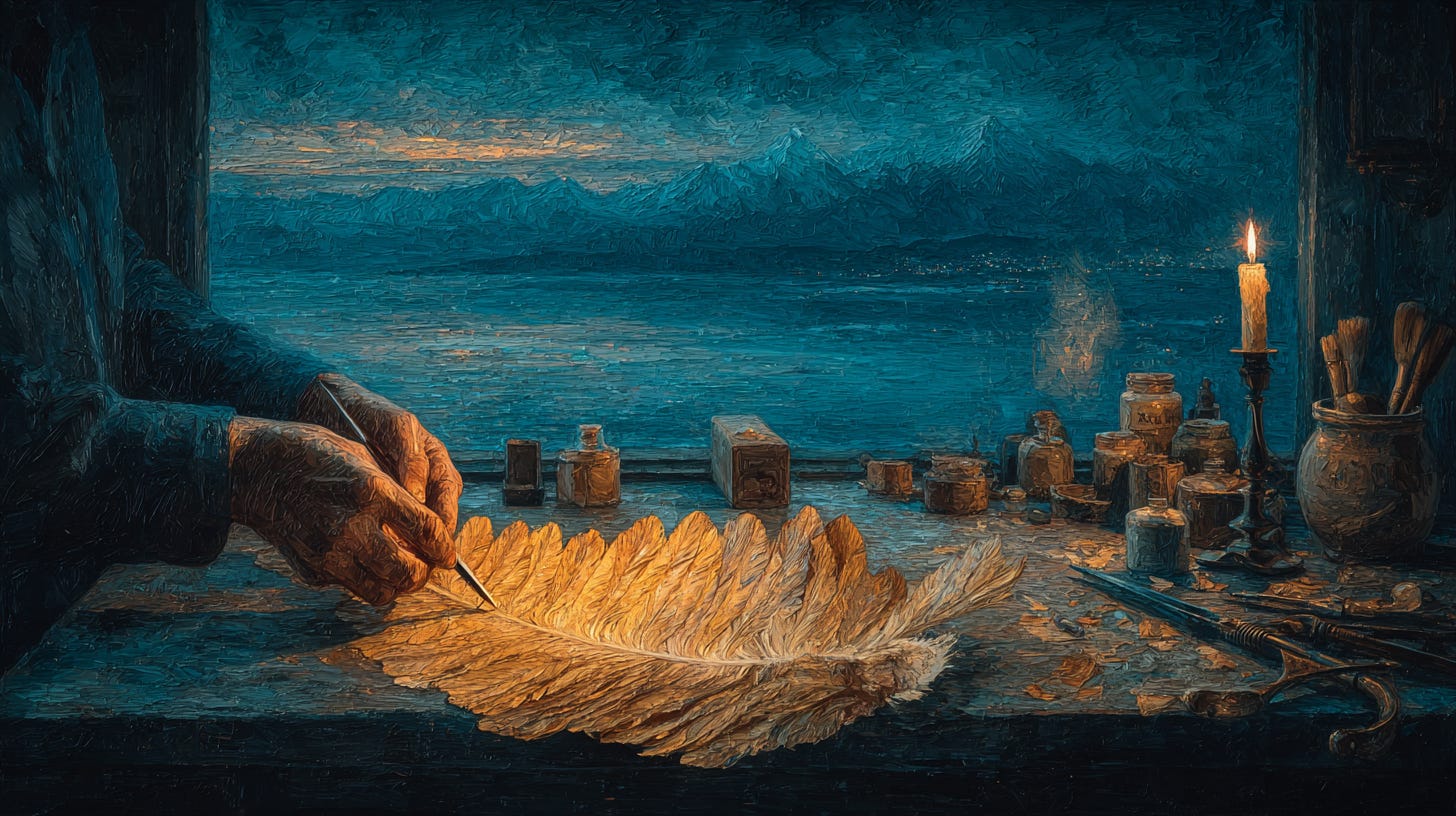
On March 22, 1997, Stanley Kubrick accepted the Directors Guild’s D.W. Griffith Award by video. He sent a film recorded at his home in England, where he was deep in Eyes Wide Shut production and unwilling to interrupt it. He died two years later, and the speech became one of his last recorded statements about the craft.
He used it to highlight an old uncertainty.
He was telling the story of D.W. Griffith, the early-cinema giant whose career ended in shunning after a decade of soaring fame. Kubrick described the arc as Icarus and his wax wings. Then he told us what he had never been able to settle in his own mind:
“I’ve compared Griffith’s career to the Icarus myth, but at the same time I’ve never been certain whether the moral of the Icarus story should only be, as is generally accepted, ‘Don’t try to fly too high,’ or whether it might also be thought of as, ‘Forget the wax and feathers, and do a better job on the wings.’”
Two readings of the same story. We have been raised on the first. The second is the reading this publication is named after.
“There are two ways of spreading light: to be the candle or the mirror that reflects it.”
— Edith Wharton
The other lesson of Icarus
The standard reading punishes Icarus for ambition. Don’t fly too close to the sun. Don’t rise above your station. The myth becomes a parable of humility, and humility, in this telling, means staying low. More don’t than do.
Tall poppy syndrome in myth form.
Kubrick saw something else inside the same story. Daedalus warned his son about the sun because Daedalus knew the wings had a known weakness. He had built them himself, in a prison on Crete, with wax that could not hold heat.
The wax was the problem. The flight only made it visible.
Different question. The standard reader hears the myth and asks, “How do I keep from flying too high?” The Kubrick reader hears the same myth and asks, “What would it take to build wings that don’t melt?” The first question paralyzes. The second does work.
It expands the plane of possibility.
Alexis de Tocqueville named the same disposition in 1840, and he named it as the American one. Walking through Jacksonian villages, he watched citizens treat inherited tradition as information rather than authority and he watched citizens solve practical difficulties without waiting for permission. They got on with it.
He wrote it down: “Each American calls only on the individual effort of his reason.” A few lines later: “everything in the world is explicable... nothing exceeds the bounds of intelligence.”
That second sentence is almost two centuries old, and it is a description of what Kubrick was pointing at. The engineer’s posture is older than Silicon Valley by two hundred years. Tinker, try, discover the failure mode, build the next version. Tocqueville was describing American village life when he wrote it. He could have been describing the first lab to build an antibiotic, the first crew to land a reusable rocket, the first team that taught a model to write its own evaluations.
There is a cost to this disposition. It is the burden of being responsible for outcomes. You take the engineer’s posture seriously and you no longer get to point at the heavens when things break. The wax was your problem; the wings were yours to build.
But Icarus did die. The wax did melt. The cautionary reading is grounded in a real event, and Daedalus’s warning to his son was correct.
The engineer’s reading has to be honest about what it absorbs. Kubrick never said the wings have no failure modes. He named what the failure mode was, and he asked what the response should be. What should this relationship be? How do we orient with our world? The cautionary reader hears “the wax melts” and concludes: don’t fly. The engineering reader hears the same sentence and concludes: don’t use wax. Both agree on the diagnosis. They diverge on the prescription.
The cautionary prescription costs almost nothing. It requires no skill, no apprenticeship, no exposure to consequence, no attempts that may lead to public failure. You can sit out the entire experiment and still tell yourself you were wise. The engineering prescription is expensive. It requires you to learn metallurgy. You have to test the wings in conditions you have not yet faced. Sometimes you lose someone during the testing.
Restraint is cheap. Engineering is expensive.
This is why the standard reading appeals so persistently. It flatters the modesty of the listener while excusing the work of the engineer.
The same disposition operates at the civic scale. The American republic’s self-correcting capacity has always belonged to citizens who refused to wait for the system to fix itself. Frederick Douglass treating the Constitution as a glorious liberty document despite its writers’ hypocrisy. The suffragists building seven decades of voluntary association into the Nineteenth Amendment. The marchers in Birmingham using the framework’s stated principles against its practiced failures.
That work is the engineer’s posture applied to moral substrate. The framework was inherited with known failure modes. The cautionary reader surveyed those failures and concluded the framework was unworthy. The engineering reader looked at the same failures and asked what would have to be built to address them. The handholds were the answer in every case.
Citizens build moral substrate by extracting promises from frameworks that resist. Engineers build technical substrate by extracting capacity from materials that resist. Both work on the next version. Both refuse to let the failure mode become the verdict.
Recession of progress
There is a useful word for what happens when fear spreads through a system. Economists call it a recession. Someone loses their job, gets cautious, stops spending. Businesses earn less, get cautious, stop hiring. More people lose their jobs. Fear feeds on fear, and the only thing that interrupts the cycle is a deliberate injection of activity — stimulus — into durable parts of the economy.
We are in a recession of progress.
A wide segment of the country has adopted the cautionary reading as a default. They will not bet themselves on advancement. They will not stake reputation, identity, or effort on anything that requires building. Martin Gurri, a CIA analyst who studied how networked publics topple authority without constructing alternatives, called this pattern negation without construction at the political scale. The reasonable-sounding caution becomes the cultural baseline, which lowers the cost of joining it, which raises the cost of dissenting from it, which produces more caution. The cycle works the same way the economic one does. Nothing breaks it except people who step into the engineer’s posture deliberately, knowing the prevailing current is against them.
That is the stimulus this recession needs. Not a policy. People.
David Deutsch, the Oxford physicist who is Karl Popper’s most direct intellectual heir that has entered my life, has a phrase for the reading we were taught. He calls it bad philosophy. Bad philosophy, in Deutsch’s sense, denies “the possibility, desirability, or existence of progress.” It is the kind of thinking that makes problems seem unsolvable by design.
The cautionary Icarus reading is bad philosophy in exactly this sense. It denies the possibility of better wings. It treats Daedalus as a hubristic father rather than a craftsman with a known engineering tolerance. It treats the wax as the final word.
Deutsch writes: “Only progress is sustainable.” The triumphs are always temporary. The current generation of antibiotics is always temporary. The current solution is always going to give way to a different problem, which will require a different solution. Freezing where we are produces only the road back to Easter Island, where every static civilization has eventually arrived. The Easter Islanders survived by extinguishing the creativity of their members until the civilization itself collapsed under a problem its surviving members were no longer equipped to solve.
The substrate-upgrade arc is visible in the small lights. Our species spent a million years with fire on sticks. Then candles. Then oil lamps. Then kerosene. Then electricity. Then fission. Each rung was someone refusing to let the previous rung become the verdict. Each rung was an engineering decision to do a better job on the wings.
The lamp in your kitchen is the great-great-grandchild of a feather and a piece of wax that melted somewhere over the Aegean.
The disposition is what compounds. The bad-philosophy reader would have stopped at the stick. The engineering reader is the reason you can read this in your house at night.
The live test
This brings us to where we are.
The most consequential technological development of any of our lifetimes is unfolding now, and the question being asked of every adult in the room is the question Kubrick named. Two readings of Icarus. Which one will you live by?
The cautionary camp is real and not foolish. There are serious failure modes in what is being built. Misalignment. Deployment without sufficient understanding. Concentration of capability in fewer and fewer hands. The displacement of human capacities we do not yet know we needed. The people naming these risks include sober minds across the political spectrum. Some on the left argue that misalignment risks outpace safety research. Some on the right argue that outsourcing thought to machines hollows out the human capacities institutions depend on. The cautionary disposition crosses tribes because its source is psychological rather than ideological.
The engineering camp is also real and crosses tribes. They see the same failure modes. They are doing the alignment work, the interpretability work, the institutional design, the governance experiments. They are testing the wings before they ship them. They are the reason any of these risks are being addressed at all. The cautionary camp’s prescription is “don’t build,” and it was never going to hold against a technology this useful. The real question was whether the building would be undisciplined or disciplined.
The substrate-upgrades that built modernity happened under genuine uncertainty, with real costs, by people who saw the costs and built anyway.
In 1942, Edward Teller raised the possibility that an atomic detonation could ignite the atmosphere. Hans Bethe ran the calculations and concluded the probability was vanishingly small. It was not zero. The Trinity team built the bomb anyway, under wartime duress, knowing what the weapon would do to Hiroshima and Nagasaki even if the calculations were right. They were Daedalus watching the wax, flying anyway because Hitler was racing them.
The printing press is older but the structure is identical. Gutenberg cast movable type in the 1450s, and within two generations Europe was at war over what could be printed. The religious wars that killed roughly a third of Central Europe were downstream of an engineering decision that ended the Catholic Church’s monopoly on the construction of meaning. The press got built. It also broke the previous order. The Enlightenment, the scientific revolution, and three centuries of democratic experiments are impossible without it. The substrate-upgrade was worth the cost.
The internet is the version we are still inside. We have not landed the protocols. The cycles are faster, the local culture is thinner, the information environment is more fragmented. The cautionary reading wants to legislate this back to 1990. The engineering reading says we built it, we are inside it, and the work now is figuring out how to live well with the substrate we have chosen.
I have made my choice. I do not believe the failure modes are arguments against the project. I believe they are the engineering specification. The wax melts. We know it melts. The wings are being built with that knowledge by people who have read Daedalus and decided he was an engineer giving an engineering warning.
That is the Promethean reading.
Prometheus stole fire and chose the chains. Daedalus built the wings and chose the flight.
The engineer who gives humanity capability and the engineer who uses it are two generations of the same myth-family. The publication is named after the first because the disposition is older than any one application of it.
The engineering disposition is harder than the cautionary one. It implicates you. You cannot stand outside the project and watch the failures with detachment if you have accepted the engineering reading. You become responsible for what gets built and how. You lose the consolation of having played Chicken Little.
That is the price of the better wings. It is a price worth paying, because the alternative is the static condition that has destroyed every civilization that adopted it. We have built better wings before. We are nothing if not Icarus himself, and Icarus, read correctly, is the patron saint of every advance our species has earned.
The wax melts. Build the next pair anyway.
Sources and Inspiration
Democracy in America - Alexis de Tocqueville
The Beginning of Infinity - David Deutsch
The Revolt of the Public - Martin Gurri