

We have voles in the backyard, and after I did the dirty work, the yard needed repair: filling the trails and veins with soil, smoothing them out, laying seed. My son wanted to help. I knew it would 4x the time to completion. But, sign me up.
I had a bucket with soil and a small shovel. I showed him one go of the task. He could hardly be restrained from taking the shovel right out of my hands. He tried, missed, soil is everywhere. He’s yanking on the shovel which is jammed under the lips of the bucket and he’s about to spill the whole bucket. That is the moment I felt like sticking my hand in the job. He wasn’t causing a mess from mischievousness — he was dialing in his movements and trying. He’s three.
The hardest part of fatherhood is standing three feet away while your child struggles with something you could solve in seconds, and choosing not to reach in. Or choosing not to reach in knowing that the mess about to follow will be yours to clean up.
Because reaching in feels like love. The desire to smooth every path and remove every obstacle runs deep, almost gravitational: make it easier, fix the problem, resolve the frustration. Any parent knows this impulse. It arrives as warmth, as care, as the certainty that your help is what they need.
And sometimes your help is the very thing that takes from them what they need most.
Michael Lewis wrote a book about becoming a father called Home Game. Its central honesty is this: you have no idea what you’re doing. You show up at the hospital, your child arrives, and at no point does anyone verify that you’re qualified for what’s about to happen. Because you aren’t. Nobody is.
Lewis was being funny. But underneath the humor sits something the culture doesn’t handle well: the gap between the father you think you’re supposed to be and the father you actually are. And the modern answer to that gap is to optimize. Track the milestones. Schedule the enrichment. Download the app that tells you whether your three-year-old is on pace. Turn fatherhood into a project, because projects have metrics, and metrics tell you whether you’re doing it right.
This is a specific kind of mistake. It treats the child as clay: raw material that you shape, mold, and press into form through effort and intention. The father becomes the sculptor imposing a design. And the design is usually some version of the father himself, or worse, some version of what the father wishes he’d been.
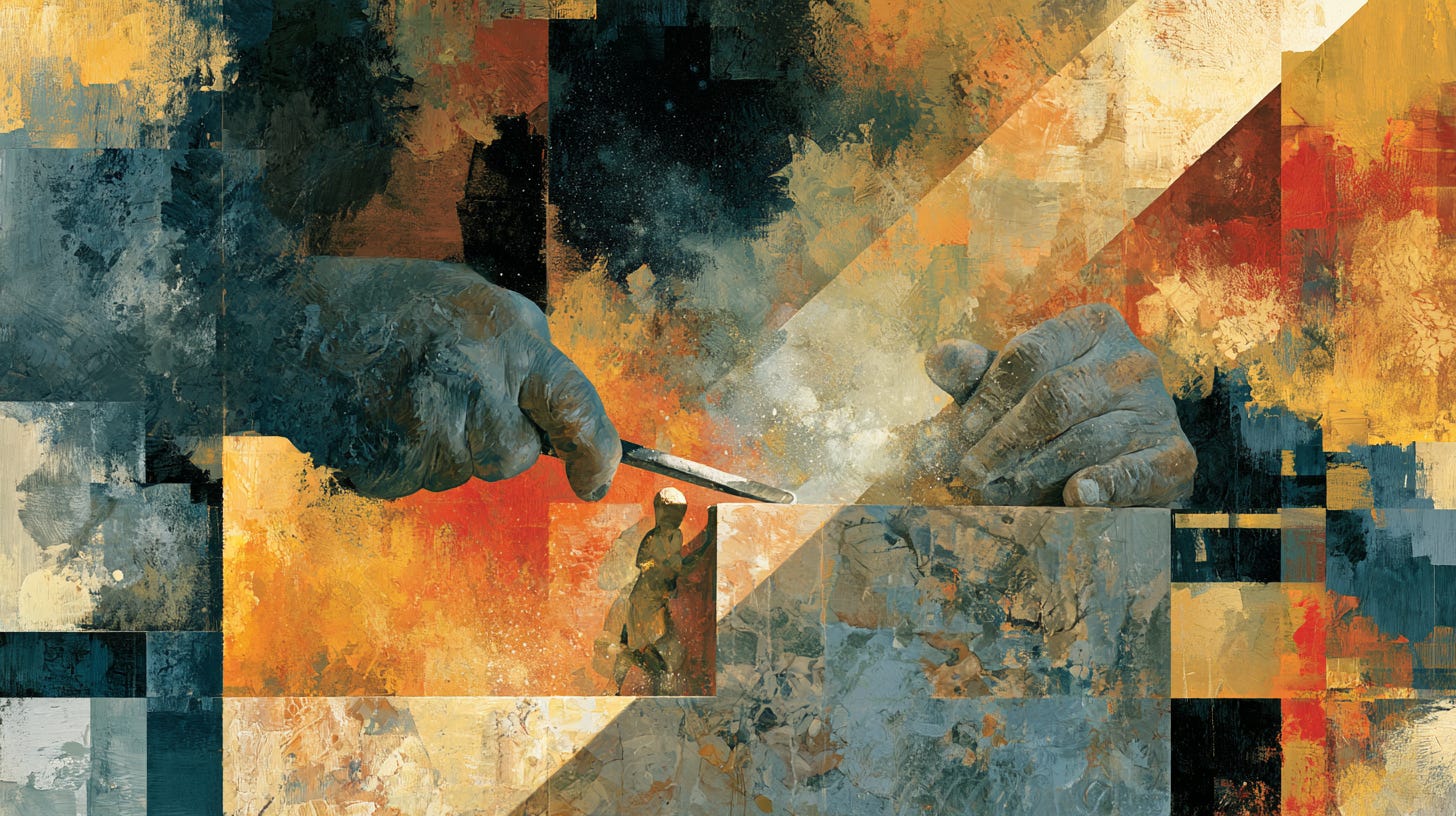
But children aren’t clay. They’re marble.
Clay has no form until you impose one. Marble already has a figure inside it. Michelangelo understood this: the sculptor’s job is to remove what’s in the way. The work is subtractive. You study the stone. You attend to its grain, its fractures, its tendencies. You chisel carefully, working with the grain to reveal what the material is already becoming.
Lao Tzu named this practice twenty-five centuries ago: “In the pursuit of knowledge, every day something is added. In the practice of the Tao, every day something is dropped.” Fatherhood is closer to the second tradition than the first.
Timothy Gallwey called this the subtractive approach to excellence: performance improves by removing interference rather than by adding instruction. The capacity is already there. Your child already has temperament, instincts, curiosities, fears, and a developing will that belongs to them. The father’s work is removing what interferes with that emergence: the bad habits, the destructive patterns, the impulses that would calcify into character if left unattended. But the figure itself isn’t yours to decide.
This requires authoritative parenting, which is different from authoritarian parenting. Authoritarian is clay thinking: I impose the rules, you comply, the shape is mine to determine. Authoritative is marble thinking: I provide structure, I hold boundaries, I set expectations that serve the figure I can see emerging, and I adjust my approach as the form reveals itself. The authority is real. The boundaries are firm. The support is a deep well. But they exist for the child’s becoming rather than for the father’s control.
The sculptor works hard. This is not passivity dressed up as wisdom. Removing interference takes active attention, deliberate effort, and a kind of study that never ends. You have to watch the marble constantly to know what to remove next. You have to know when a crack is the stone breaking and when it’s the figure breathing. The father who stands back and lets everything happen neglects the work as thoroughly as the father who grips too tightly. The chisel does the work. Where you place it does the figure.
Fatherhood asks you to do two things that feel contradictory: be the strongest presence in your child’s life, and gradually make yourself less necessary. Cat Stevens wrote “Father and Son” about exactly this. I remember listening to it with my father. It still moves me.
Lao Tzu, again, wrote it twenty-five centuries ago: the best leader’s people barely know he exists. When his work is done, they say: “We did it, all by ourselves!” That’s the goal: presence so well-calibrated that the child’s strength felt like their own.
This is the yielding curve. Early on, the father is a pillar: solid, visible, bearing weight. The child leans on that pillar because they must. They learn what stability looks like by experiencing it in someone they trust. They learn what authority feels like when it’s exercised in their interest rather than against it.
Then the curve bends. The pillar becomes a bridge. The father’s job shifts from holding to connecting: connecting the child to their own judgment, their own capacity, their own growing sense of what they can handle. The boundaries widen rather than disappear. The expectations evolve and maybe steepen. What was “because I said so” becomes “because you understand why.”
And then the bridge becomes a witness. The father is still there. Still solid. But standing further back, watching the child test themselves against the world, and resisting every impulse to make it easier.
The urge to intervene when your child is struggling, failing, hurting. The urge to deploy what you know to spare them what you suffered. And the understanding, hard-won over years, that suffering is part of the chisel. If you take it away, you take away part of what reveals the figure.
What you give them instead is something no app can measure and no milestone can track: the sight of a human being who has been in the dirt before, who got back up, and who is still here.
This is fatherhood’s vulnerability. The real thing. Your child sees you fail and watches what you do next. Sees you afraid and watches whether you move forward anyway. Sees you confused, uncertain, in over your head, and files it away as evidence that confusion is survivable. That fear is walkable. That the dirt washes off.
Rollo May called this the daily conquest: freedom is not achieved once, it must be conquered each day. Fatherhood is the same. You don’t get to be a good father once and coast on the credential. You show up every morning, sometimes exhausted, sometimes unsure whether anything you’re doing is working, and you show up anyway. The daily conquest of fatherhood is: be present. Not perfect. Present. Available. Human.
And the reward for this daily work is something deeper than satisfaction. Watch a child who has been struggling with something finally break through, because you held the space while they helped themselves. The look on their face. The laugh. May called this joy: the affect that comes when we use our powers. And the father’s joy, watching it happen, mirrors the child’s. You feel it because something you built is working. The marble is showing its figure.
We talk about what strong individuals make possible for institutions and civilizations. But we rarely trace the chain back far enough. Strong individuals don’t emerge from nowhere. They emerge from homes where someone modeled what strength looks like: the willingness to bear weight without making the weight someone else’s problem.
The shadow masculine energy I wrote about recently has a significant source here, among others. Somewhere in the chain, a father was missing. Or present but authoritarian, imposing shape on clay. Or present but passive, watching marble crack without picking up a chisel. Or present but optimizing — calibrating every input, scheduling every minute, refusing to trust the marble at all.
The helicopter parent and the authoritarian parent are mirror images. One smothers the figure with attention; the other carves it to a pattern fixed in advance. Both refuse to trust the marble.
Robert Bly, drawing on Alexander Mitscherlich, named the mechanism:
If the son does not actually see what his father does during the day and through all the seasons of the year, a hole will appear in the son’s psyche, and the hole will fill with demons who tell him that his father’s work is evil and that the father is evil.
The shadow forms are, in part, the result of fathers who couldn’t hold both sides: structure and yielding, authority and vulnerability, presence and restraint.
Some truths belong to the household. The truth that striving builds character, that difficulty is the medium of growth, that freedom is constituted by the willingness to bear weight: these are formative truths. Aristotle named the mechanism twenty-three centuries ago: we become builders by building, just by doing just actions, brave by doing brave actions. Character is formed by repeated doing under the right conditions. You learn this by watching your father get up after falling down. You learn it when the person who could most easily solve your problem trusts you to solve it yourself.
The civilization depends on this. Free societies require people capable of bearing freedom, and the capacity for bearing freedom starts in the home, with a father who understands that his most important work is the interference he removes rather than the shape he imposes. The figure was always there. His job was to believe that, and to chisel with care until it emerged.
I don’t have this figured out. I feel the pull every day: to intervene, to instruct, to make it easier, to deploy what I know in service of outcomes I can see. And every day I have to remind myself that the marble has a figure inside it, and my job is to trust what’s there while working carefully with the grain.
The stakes go up as they grow. The failures become more consequential. The space between you and them widens, and the yielding curve demands that you let it widen, even when everything in you wants to close the gap.
But I think this is what it means to be a father. The version that shows up, rather than the one that optimizes or performs having it together. The one who has been in the dirt and can show you how to get the mud off. The one who holds the chisel with care because he knows the figure is already there, waiting to be revealed.
Sources and Inspiration
The Inner Game of Tennis - Timothy Gallwey
Man’s Search for Himself - Rollo May
Nicomachean Ethics - Aristotle
Iron John: A Book About Men - Robert Bly