

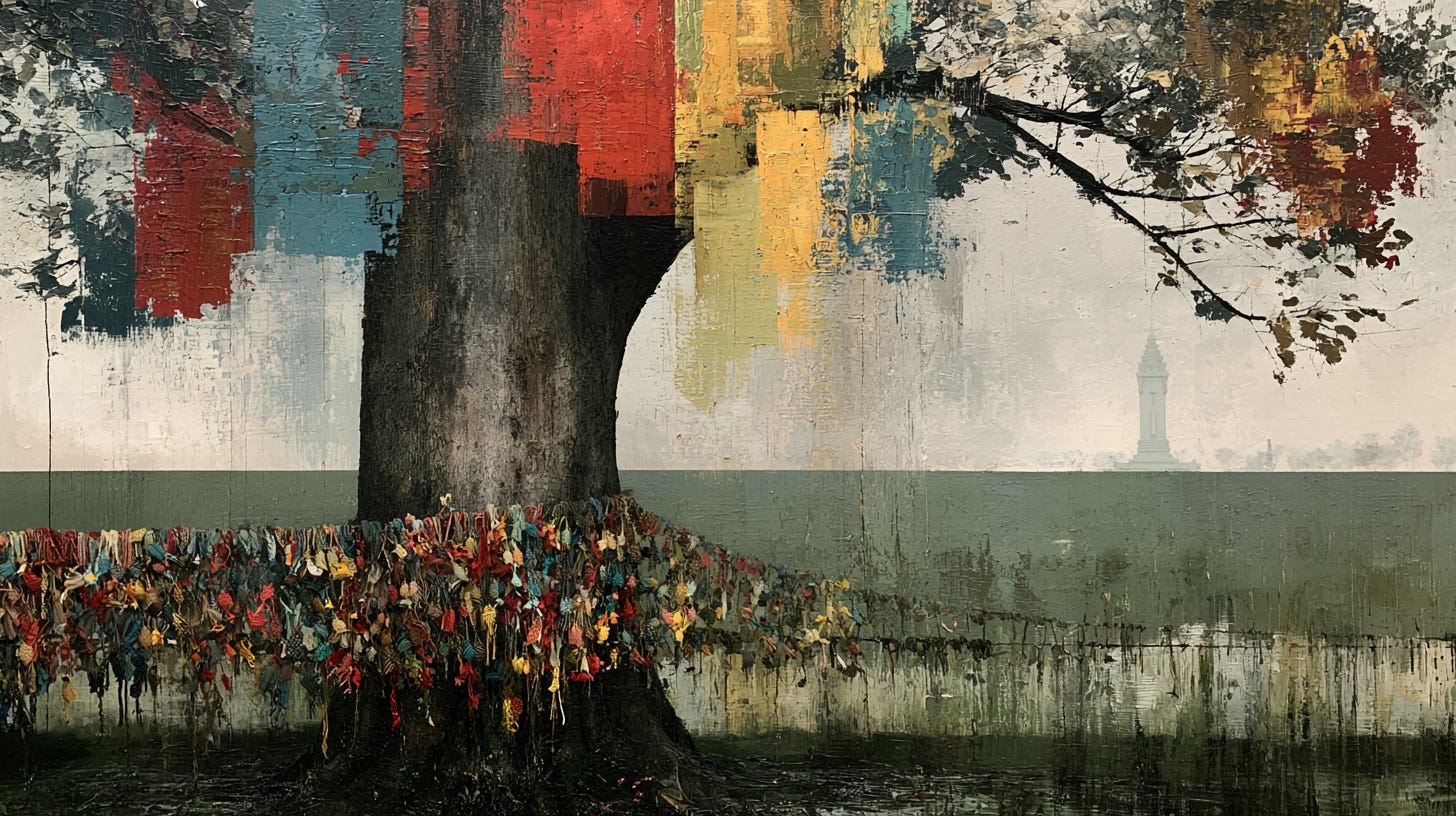
At Choeung Ek, outside Phnom Penh, the ground does not keep its secrets. It is a quiet field now, green, with a tall memorial stupa at the center and a pond where dragonflies hang in those dancing visions of radiating heat. You walk on raised wooden paths. There are small signs asking you not to step on the bone. After heavy rain, fragments still work their way up through the soil: a tooth, a knuckle, a scrap of checked cloth from someone’s shirt. The staff collect what surfaces. The earth keeps offering it back.
There is a tree near one of the grave pits with a sign in front of it. I stood in front of it for a while and then I could not stand in front of it anymore. My photograph:
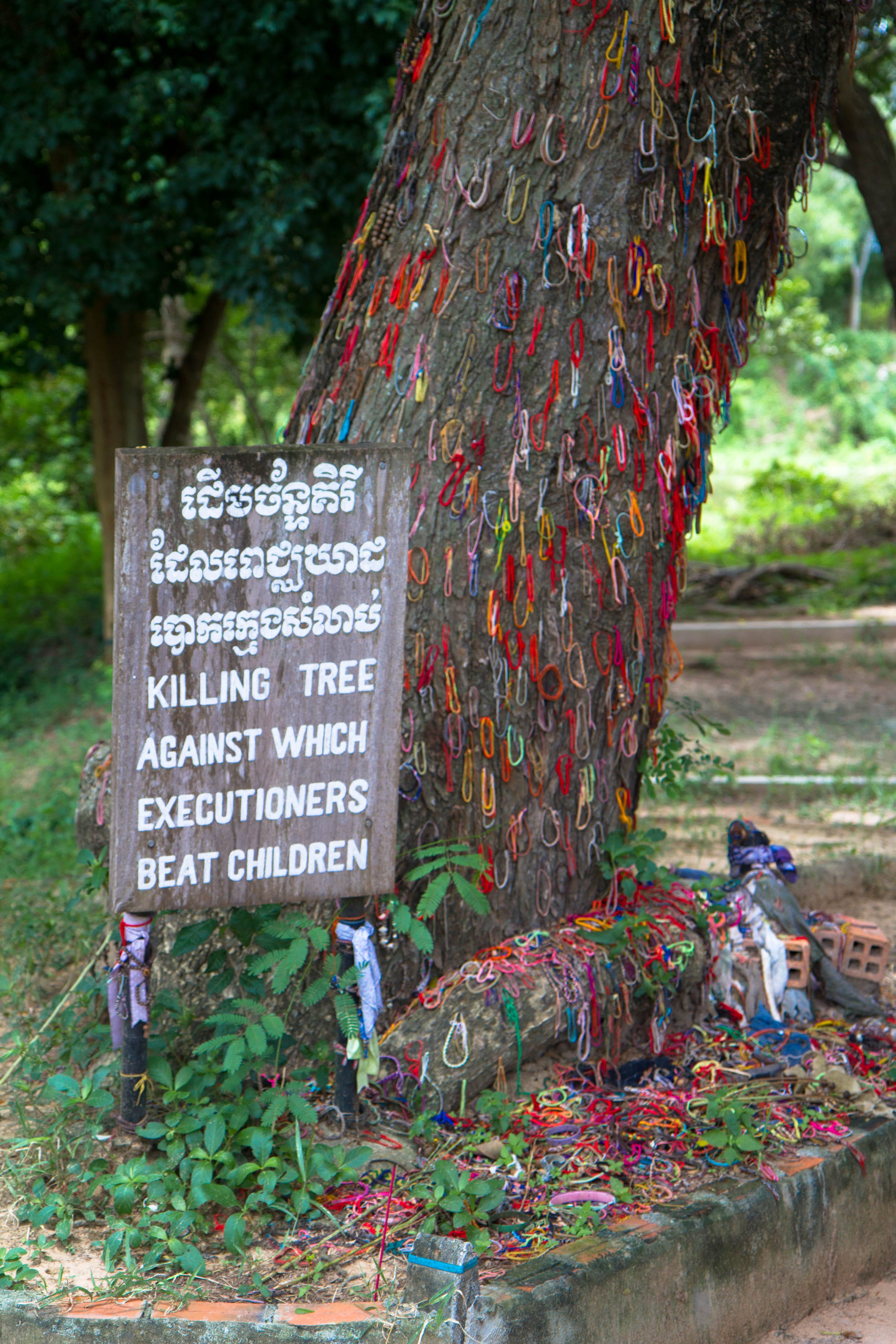
The men who did this were not monsters, most of them. They were schoolteachers and clerks and farm boys handed a theory about building a just society, a more fair society, from the ground up, and they believed it, some to the end. That is the part that should frighten us, and the part we have mostly chosen to forget.
I have stood on both sides of a border that ran through the same people.
If you take the train east across what used to be the inner-German frontier, you can still read the two systems off the land itself, decades after the wall came down. At reunification in 1990, East Germany was producing at something like a third to two-fifths of the West’s output per worker, on the same soil, in the same language, same genetics, built from the industrial base the two halves once shared. The gap has narrowed since. It has not closed. At significant expense subsidizing the east.
Go further. In 1948, before the communists took full control, Czechoslovakia was richer than Austria. Same central-European stock, same starting line. By 1989, forty years later, the Czechoslovak economy had fallen to roughly half of Austria’s. Slovakia, the more rural half, still sits at roughly three-fifths of Austrian output today, more than a generation after it got its freedom back. The border did that. The people were the same on both sides. The border, and what each side chose to build behind it.
There is a photograph, taken from the space station, of the Korean peninsula at night. The South is a sheet of light. The North is a black hole with a single dim smudge where Pyongyang sits. One peninsula, one people, cut in two in 1945 by nothing but which army arrived first. The light is the difference between two ideas about how humans should be organized.
So the question is not whether central planning is inefficient. I have made that argument elsewhere, and the numbers make it better than I can. The question this field at Choeung Ek forces is darker and simpler. Why does the road from we will build a just society keep arriving at the same address?
The ledger nobody wants to read
Before the mechanism, the weight. Time has sanded the numbers into a vague millions, and vague is how you forget. The honest scholars refuse to give one big total, and their refusal is why you should trust them. Here is the record the way they keep it: as ranges, the disputes named, the famines and executions and camps kept separate, because they are separate crimes.
China, the Great Leap Forward famine, 1958–62. Somewhere between sixteen million (the demographers working from census reconstruction, Coale and Peng) and forty-five million (Frank Dikötter, working from local archives). Yang Jisheng, whose own family starved and who spent decades in the provincial records, lands near thirty-six. The dispute is over how to count. That it happened, no one serious disputes.
Ukraine, the Holodomor, 1932–33. Three and a half to five million dead in a grain-growing region, while the state kept requisitioning the grain. Historians still argue about whether it was engineered as genocide or produced by ideological policy that would not admit failure. They no longer argue much about the number.
The Soviet Great Terror, 1937–38. The archives, once opened, showed 681,692 people shot in two years, a figure the secret police kept themselves.
The Gulag. Something over 1.6 million documented deaths in the camps, and probably more: dying prisoners were often released just before the end, to keep the mortality figures clean.
Cambodia, the Khmer Rouge, 1975–79. Between roughly 1.5 million confirmed in the mass graves and 2.2 million by demographic reconstruction. Out of a population under eight million. The field I stood in was one of hundreds.
North Korea, the famine of the 1990s. Around half a million to 635,000 dead by the careful census-based estimate, in a country that still runs prison camps holding on the order of a hundred thousand people.
You can add these. People have. The famous aggregations run to eighty, ninety, a hundred million. But the best-known of them, The Black Book of Communism, was disowned in part by its own authors, who said the editor had inflated subtotals and forced a comparison the evidence would not carry. Sum a famine and a firing squad and a labor camp into one number and you have stopped counting and started campaigning.
So I will not campaign. The stack says one thing, without a total: this happened in Russia and China and Cambodia and Korea and Ethiopia, everywhere the same idea was carried to its end. One unlucky nation is an accident. A dozen is a mechanism.
The point was never that our tyrants outscored theirs. Line up the twentieth century’s horrors and the Nazi regime is right there in the front rank; in the specific bloodlands where German and Soviet killing overlapped, Hitler’s machine killed more. A body count is not a scoreboard; keeping one is a whataboutism that changes nothing about the machine. What I am after is how the machine works, and what we have chosen to remember.
History already ran the experiment
The comforting story is that these regimes were hijacked by bad men: if only Stalin had not followed Lenin, if only Pol Pot had been gentler. It comforts because it locates the disease in a person and leaves the theory clean.
The trouble is that history ran the experiment both ways, and the variable that changed the outcome was not the man. It was the choice the system made when its plan failed.
Watch it happen in the same country, twice. Lenin imposed War Communism, seized the grain, abolished the market, and produced economic collapse and a famine that killed perhaps five million. And then Lenin reversed himself. The New Economic Policy of 1921 let the markets and the peasants breathe, and the country began to recover. The reform was available; a communist reached for it. Then Lenin died, and Stalin reversed the reversal, drove the peasants back onto collective farms at gunpoint, and the corpses returned by the millions.
Now watch the other country. Mao’s Great Leap produced the worst famine in recorded human history. His successor, Deng Xiaoping, looked at the wreckage and made the opposite choice. He let the farmers keep what they grew. He opened the coast to trade. He did not become a liberal, and the regime stayed brutal. But on the single question of whether to feed people or to feed the theory, he chose people, and the World Bank put it exactly: over the next four decades, “the number of people in China with incomes below $1.90 per day... has fallen by close to 800 million.” Eight hundred million. The freed farmers grew new food, wealth that had not existed the week before. The largest escape from poverty in our species’ history, and it began the day the doctrine was allowed to lose. Capitalism did it, under a flag that never stopped calling itself communist, and stayed authoritarian to the end.
One more, closer to home. Franklin Roosevelt met the Great Depression and did not abolish capitalism. He rewired it. The Hoover Institution, no friend of the New Deal, puts it simply: Roosevelt’s people believed their mission was to save capitalism, and they did. He is a hero of this essay, a man the left claims and the right resents, because when the system failed he corrected it instead of replacing it.
The reversal is not only a communist story. After the war Britain took the commanding heights into public hands, coal and the railways and the Bank of England, and Austria took even more: its largest banks, its steel, its heavy industry. Both got a version of the stagnation the theory promises. Britain’s nationalized industries spent a generation subsidized, strike-bound, and losing money; Austria’s state steel was hemorrhaging by the mid-eighties. And both, being democracies with their courts and their newspapers and their ballots intact, did the thing a democracy can still do when the plan fails. They admitted it and sold it back. Thatcher privatized British Telecom, British Gas, British Airways; Austria sold much of its state sector back over the following decades. The ownership took them partway down the road. The machinery to reverse let them turn around before it hardened.
That is the whole game, and it runs two ways. Deng and the Lenin of 1921 corrected from the top, by choice, with nothing forcing their hand, which is why the correction lasted exactly as long as the man who made it: Lenin reached for the reform and it worked, and then Stalin reached back. Roosevelt, Britain, and Austria corrected the durable way, because a court and a ballot they had never suspended could overrule the men in charge whether those men liked it or not. Both routes exist; only the second survives its founder. Public ownership is only the accelerant. It generates the pressure: the shortage, the falsified quota, the plan that cannot admit it failed. What decides whether that pressure ends in a correction or a coffin is whether, when the system is proven wrong, anything is still standing that is permitted to say so.
Why it cannot admit it
The thinkers saw this machine long before I stood in the field it produces.
Adam Smith saw the first gear turning two hundred and fifty years ago, watching the men he called of system, the ones so in love with their own plan for society that they could not bear a deviation from it:
He seems to imagine that he can arrange the different members of a great society with as much ease as the hand arranges the different pieces upon a chess-board.
The pieces move on their own. That is the flaw the plan can never design around, because the plan needs the pieces to hold still. A price is the pieces talking: a signal, assembled out of millions of things nobody at the center could know, telling everyone what is scarce and what is abundant. Abolish the price and you go blind. The scarcity is still real; you have simply lost the instrument that could see it, and now you are steering a country you cannot see.
So the plan fails. It always fails, because it was blind from the first day. Now the system meets Deng and Stalin’s choice, with a trap folded in: a system that owns the economy has also, without quite meaning to, taken ownership of the truth about it. The plan’s failure is now the state’s failure: to admit the harvest fell short is to admit the theory was wrong, and the theory is all that legitimizes the people in charge. So the harvest did not fall short. The quota was met. The bad news dies at every level on its way up, and the lie travels smoother the higher it climbs, until the men at the top are steering by a map of a country that does not exist.
Karl Popper gave this its deepest name. He spent the war years arguing that the real root of the terror was certainty: the belief that history has a known destination and that you can read its trajectory. Once you believe you know where history is going, everyone standing in the way stops being an opponent and becomes an obstacle to the future itself. In place of a better plan, Popper offered a humbler question. Stop asking who should rule and start asking how we can design institutions that let us remove bad rulers without bloodshed. A society that cannot correct its errors, he understood, is a society that must eventually defend them.
A system that has made being wrong impossible does not simply stagnate. It keeps being wrong on purpose, and it punishes whoever notices.
Watch what that punishment becomes. James C. Scott, mapping the century’s planning catastrophes, found the same four ingredients every time: a state that flattens a complex society into something it can command, a muscular faith that the plan is science, the power to impose it, and a population too broken to resist. He is careful to insist the machine is not owned by one political side, that the bulldozer and the collective farm are cousins. But he shows you the revolutionary version in Lenin’s fight with Rosa Luxemburg. The vanguard, Lenin held, knows what the workers want better than they do, and must seize the state to give it to them. Luxemburg saw the ending from the beginning: substitute the party for the people and you get a new despotism in the people’s name.
James Burnham named that despotism’s grammar. Democracy, redefined as the leader embodying the will of the people, curdles into its opposite, because once the leader is the people, opposition to the leader is opposition to the people, which is to say treason. He quotes the mechanism at its coldest: the chosen of the people can no longer be opposed in any way. He personifies the majority... He is, moreover, infallible. This is the doorway, and it does not have a left or a right sign hung over it. Pinochet handed most of Chile to the market and murdered some three thousand of his opponents anyway; the machine runs on the removed check, and does not care who owns the factory. As Huey Long said, if fascism destroys democracy in this country, it will do so in the name of democracy. The form changes. The thrust is always the same: one party, leading, silencing.
And at the bottom of the stairs you find the hardware. Forced labor to break the body. Forced concentration to sort the population. And forced belief, enforced by the men who steam open the mail and file your private fears in numbered jars. I have stood in one of those filing rooms, in Berlin, and written about what it does to a people to make everyone an informer on everyone. It is the last room on a corridor that begins with a sincere desire to build a better world.
There is a stage past the filing rooms. When a system has abolished every check and used up every external enemy, it does not stop; it turns on the people it has left and makes them complicit, so that none of them can ever safely accuse it. In the summer of 1968, in Guangxi province, the Cultural Revolution reached that stage. A geography teacher named Wu Shufang was beaten to death by her own students in a struggle session, the Maoist ritual of public denunciation, and then she was eaten. She was one of at least four hundred and twenty-one people cannibalized across the province that year, once the archives were counted, in counties where there was no famine and plenty of food. Hunger was never the point. The scholar who documented it found the real one: sharing the act spread the guilt, so the organizers were safe and no one who had swallowed a mouthful could ever testify. Refusing marked you as suspect; some were forced to eat to prove they were not. That is the bottom of the staircase, the same mechanism as the filing cabinets, only naked: a whole population made to swallow its own conscience so that the party would be safe.
Why we forgot the second room
We know the first room. We have made it, correctly, into the moral center of our civilization: the ghetto, the cattle car, the camp. A child in any Western school can tell you what the swastika means (maybe I’m wrong these days). This is right, and it is one of the few unambiguous moral achievements of the last century.
But there is a second room, and we have let it go cold.
The Harvard historian Charles Maier called this the difference between hot memory and cold memory: fascism’s crimes stay hot, monumentalized, taught, felt in the body, while communism’s crimes go cold, receding into a fog of well, that was complicated. Even Robert Conquest, the man who spent his life documenting Stalin’s terror, admitted he still felt the Holocaust was the worse thing, though the arithmetic would not obviously support the feeling. Anne Applebaum, who wrote the definitive history of the Gulag, put it flatly: it rivaled the Holocaust in barbarity and exceeded it in sheer numbers, and almost no one in the West can name a single camp.
The polling makes the forgetting measurable. The Victims of Communism Memorial Foundation, chartered by Congress, found that most Americans do not know the Chinese Communist Party killed more people than Nazi Germany. It is an advocacy group, so weigh it accordingly, but a Cato Institute survey lands in the same place: a majority of Americans under thirty now hold a favorable view of socialism, and a striking share extend the goodwill to communism itself. You can watch the asymmetry walking down any street. A young man in a Che Guevara shirt reads as mildly rebellious, a little romantic. He is wearing the face of a man who ran firing squads and founded a labor-camp system. Put the equivalent fascist on a t-shirt and the room empties.
I am not claiming the two horrors are morally identical, and serious historians are right to guard against the crude equivalence that some have used to launder local collaboration in the Holocaust. The claim is narrower and, I think, undeniable: we remember one and we have forgotten the other, and the forgetting is not neutral. It clears the stage. The path looks new and daring to the young people setting out on it because we took down the signs that said where it goes.
What they say they want
Every one of them said they meant well, and we never teach that part.
Lenin ran on Peace, Land, Bread. In the first free election Russia ever held his Bolsheviks came in second, and when the assembly the people had chosen sat down to govern, he let it meet for thirteen hours and dissolved it at gunpoint. The Red Terror was declared ten months after the coup. The peasants who had been promised land got the grain requisitions instead, and when the drought came, five million of them starved.
Fidel Castro told the New York Times in 1957, on the record, that he and his movement were not communists; his platform was free elections and a free press. The revolution took Havana in the first days of 1959, and the firing squads began within the week. The elections never came.
Hugo Chávez ran in 1998 as a moderate, the anti-corruption outsider. He seized more than a thousand companies, and by the time the currency had inflated into wallpaper a quarter of the country had walked out on foot.
Daniel Ortega returned to power in Nicaragua as a chastened democrat who had made his peace with elections, then jailed a Catholic bishop for twenty-six years, exiled him, and stripped his old revolutionary comrades of their citizenship.
Every one of them made that same sound on the way in. Most of them were lying to themselves first.
Which is why I am writing this in 2026 instead of leaving it as history. The machine has a right-hand door too, the strongman who keeps the market and burns the constitution, and it is a real fear. But the door with a written 2026 constitutional blueprint behind it is the left one, so that is the one I am standing in front of. The Democratic Socialists of America announced it had crossed a hundred and twenty thousand members this summer, by its own count the largest socialist organization in American history, and adopted a new program. Their own words are more honest than any summary I could write, and they deserve a fair hearing, so here they are.
They are not hiding a gulag. They say the opposite, and I believe they mean it: their vision, the program says, leaves behind authoritarian visions of socialism in the dustbin of history. They want, in their words, a world where everyone is free, equal, and cared for. Nobody in that room means the tree at Choeung Ek. That is the whole point. Every name in the list above could have signed that sentence, and several of them, in their way, did.
And then read what they propose to build. Establish public ownership of the largest corporations and essential industries. A new constitution, and a democratic socialist republic. And this, which I had to read twice: Replace the President and Supreme Court with an executive and judiciary chosen by and subordinate to Congress.
Sit with that last one. Public ownership of the largest firms is arguable; Britain tried it and lived, though it already fixes the eye on the pile that exists and misses the firms not yet founded, the same blindness abolishing the price produced. Subordinating the courts to the Congress and abolishing the Senate is a different order of thing. It reaches for the one machine Britain and Austria left alone, the one that let them turn around, the machinery Popper called the only thing standing between us and the corridor. That is the plank that matters, and it is why the disavowal does not move me. A DSA sympathizer will say, fairly, that his movement would correct the way Roosevelt did, that America has two hundred and fifty years of reversal built into it. He is right that the machinery is there. He is proposing to spend his first act tearing it out.
The move that matters is older than Marx: raise a single body above all rivals and bend the courts to serve it, so nothing is left with the standing to tell the majority it has erred. Mao’s 1949 Common Program did exactly that. An executive answerable to a legislature is only a parliament, and Germany runs one well; the lethal specific is the court that can no longer say no, welded to the ownership of the commanding heights, so that when the plan fails there is no judge to stop the search for someone to blame and no market to reveal the failure in the first place. That is the room that can only double down. I do not think they know whose house they are drawing.
Nobody means the gulag. Whatever else they intended, none of them set out for the tree at Choeung Ek. That has never been the safeguard; it may even be the fuel, because the more sincerely you have staked your life on the theory, the less able you are to let it lose. The people who built every room on that corridor believed they were building a humane and democratic society, right up until the harvest came in short and the only choices left were to confess the theory had failed or to find someone to blame.
The door marked exit
The field ended for me at the ground that would not stop giving up its dead.
There is something almost unbearable in it, and something like hope. Choeung Ek does not forget. Decades on, the rain still lifts the evidence to the surface, a tooth, a button, a strip of cloth, as if the earth itself refuses the amnesia the rest of us find so easy. The memory we have let go cold is held, stubbornly, in the stifling Cambodian heat.
We could choose to be that stubborn, and choose it generously. The young idealist in the Che shirt wants what humans have always wanted, a world with less suffering in it. The answer to a bad theory of how to build a better world is a better theory, and ours is a modest one: a way to keep finding out where we are wrong before the cost comes due. We happen to have it, tested against the bloodiest evidence any argument ever had.
The theory is this. No one is wise enough to hold the whole plan, so do not build a system that requires anyone to. Keep the price signals and the open argument and the independent court, because they are how a society stays able to notice it is wrong. David Deutsch put the two halves together: wealth is created knowledge, and knowledge is created only by systems free to find out they were wrong. Build the abundance instead of dividing the scarcity; the light on the southern half of that peninsula was not redistributed from the North, it was created, by people left free enough to create it. And keep the memory hot. Keep it as hot as the other one, out of the same respect for the same dead. The Promethean fire.
I stood in front of that tree and I could not stand there anymore. But the standing is the point. Someone has to keep the sign up, and read it aloud, and refuse to let it go cold, so that the next generation of good people who mean a better world can see, before they take the first step, exactly where the road runs out.
Sources and Inspiration
The Open Society and Its Enemies - Karl Popper
The Beginning of Infinity - David Deutsch
Seeing Like a State - James C. Scott
The Machiavellians: Defenders of Freedom - James Burnham