

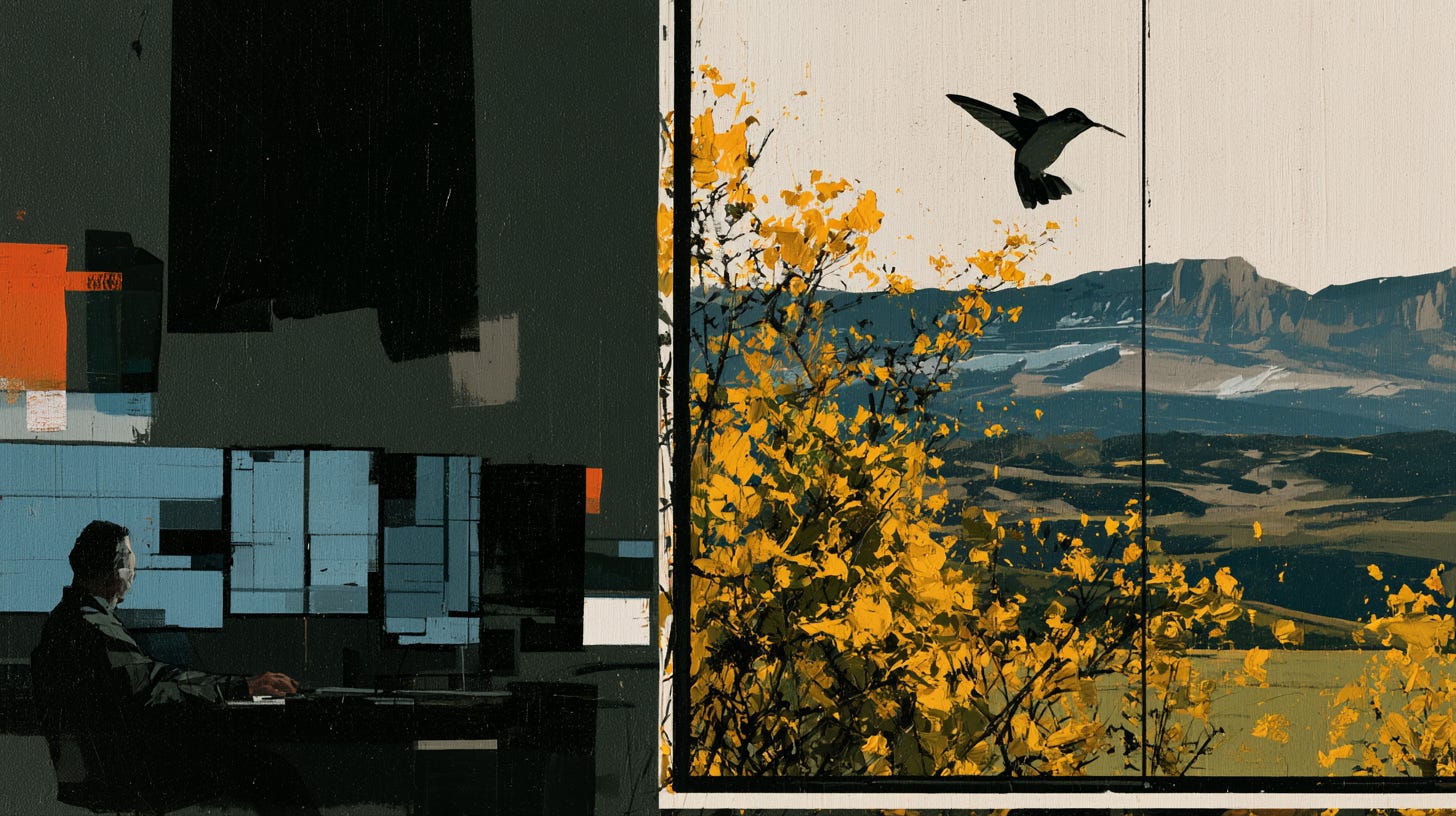
I came to a decision point and stared at the wall of screens in front of me. Then I took a breath and turned to my right, to the window.
The Rockies were out at the far edge of it. I had just read that there was a dusting on some of the peaks. Winter is coming.
Closer in, there are bushes with yellow flowers that bloom in every season but that one. The bees work them all summer. So do the hummingbirds, and there was one out there doing the thing hummingbirds do, which is look. It hangs and it looks. It moves like a spacecraft, not like a bird. Nothing else outside that window flies by holding still.
They are persistent here, more this year than the last few, since the neighborhood came into bloom. But it is September, which means they are going. Broad-tailed hummingbirds winter in the highlands of Mexico, well over a thousand miles from my window, and the animal making the trip weighs a few grams.
What held me was the combination. All that violence in the wings and nothing happening in the body at all. The bird is perfectly still, but also not. On a cold night at this elevation it will let its temperature fall and its heart slow, until it is barely running, then start itself again in the morning. The animal with the highest burn rate in the yard also knows how to go almost entirely out.
In a few weeks it will fly to Mexico. It does not know it has undertaken anything. There is no deliberation in it, no weighing, no window it turns toward. It does what it needs to do, and the whole thing is beautiful in its scope.
Wendell Berry died on Monday at ninety-two, at home in Port Royal, Kentucky, on the ground he came back to in 1965.
He had the exit ramp. Stanford, NYU, the whole ascending literary life available in the cities where literary life is celebrated. He went home to Henry County and farmed the ground his family had farmed for five generations. He wrote in pencil.
That is a good life, because he chose it. A man born onto that farm with no way off would have lived something admirable and not something instructive. Berry had every door open and walked back through the one he came from, and he kept walking back through it for over sixty years.
In the middle of The Unsettling of America he stops the agricultural argument entirely and spends a chapter on the Odyssey, on why Odysseus coming home is moving. It is moving because Kalypso offered him immortality and he turned it down. "Where there is no possibility of choice, there is no possibility of faith," Berry writes. The man who returns home wanting again what he wanted before is "neither the world's stranger nor its prisoner, but is at once in place and free."
In place and free — he is describing his own life, and he is telling you what would void it.
The window is where the old things are
I turn toward the window because that is where the old things are.
The carbon in that hummingbird was assembled inside stars that burned out before there was an Earth to catch it. The same carbon is in the flowers it is working, in the snow behind it, in my hands on the desk. Same material. The mitochondria driving its wings, and mine, descend from a bacterium swallowed by another cell something like a billion and a half years ago that stayed. That is the arrangement I am living inside while I decide which tab to open.
Berry put it this way: "But the care of the earth is our most ancient and most worthy and, after all, our most pleasing responsibility."
Most ancient. He means it the way it sounds.
So: touch grass.
I mean that straight. The phrase has been worn down into a put-down, but the instruction underneath it is good, and Berry spent sixty years making the case for it. "Connection is health," he wrote. "And what our society does its best to disguise from us is how ordinary, how commonly attainable, health is."
Ordinary is the word to catch. Not rare, not expensive, not something you schedule. Go outside and put your hand on something that was here before you were.
Where I part with him
Berry spent his career convinced that the life he chose was being taken from everyone else by force. "I remember, during the fifties, the outrage with which our political leaders spoke of the forced removal of the populations of villages in communist countries," he wrote. "I also remember that at the same time, in Washington, the word on farming was 'Get big or get out.'" The difference, he said, was only method: "the force used by the communists was military; with us, it has been economic."
That is not a difference of method. It is a difference of kind. The villager loaded into a truck at gunpoint had no choice. The farmer who sold up had one, and we know he had one, because Berry did not sell.
Policy tilted the field. Credit rules and price supports favored scale and sped the consolidation up. But nothing in them outlawed a small farm. What emptied the countryside got decided in kitchens, one at a time. Machines had begun doing the work of forty hands, the town paid better than the field, and a great many people did not want the work anyway. They did not want to get up in the dark for the animals, or hand their children a life that hard. They left in the millions — under real pressure and never under orders — and every one of those was a decision.
I cannot blame them. I did not choose it either.
That is a market, and a market is not a mandate. It is what millions of private decisions look like once you add them up. No one decreed it. Everyone decided it. Reading that verdict as oppression is the error, and it is the error that makes the real damage possible, because a man who believes his neighbors were coerced out of a life will feel entitled to coerce them back into it.
He knew this. Earlier in the same book, writing about the consumer rather than the farmer, he describes the exact thing he will not grant here. "He can choose, and exert the influence of his choosing, because he has given himself choices. He is not confined to the negativity of his complaint. He influences the market by his freedom."
Influences the market by his freedom. That is a person acting through the market rather than a person being ground under it. Berry grants it to the man deciding what to eat, and withholds it from the man deciding whether to sell the farm. I think the difference is that he loved the second one and could not stand to watch him go.
Then came the people who would fix it. The de-growth left reinvents Berry, the postliberal right cites him outright, and both want the life he chose for himself to be the life everyone is issued. Opposite fears, same instrument.
That is the failure worth naming, and it is the only one here. Not the market, which is people choosing. The mandate, which is people being chosen for. It arrives as prohibition or as prescription and it does the same thing either way. Berry already told us what it costs. Where there is no possibility of choice, there is no possibility of faith.
None of this is generosity toward people who want to live differently. It is the floor. It is the condition that makes anything anyone builds mean something, and the question to ask about any political program is simple: does it leave that condition standing?
Berry kept his. He was able to choose, and he chose, and he lived it out on the ground he picked. That is what I respect. He was freer than he believed.
The membership includes its dead
The fiction says it more warmly. Across a lifetime he wrote a county called Port William, and the idea underneath all of it is the membership: a community that includes its dead, who do not stop being members when they stop being present. That is connection is health applied to people instead of to soil. You are held by what you are joined to, and the joining outlasts the body.
He wrote about the inside of that membership too, and he would not make it sound manageable. "Parenthood is not an exact science," he wrote in an essay called "Family Work," "but a vexed privilege and a blessed trial, absolutely necessary and not altogether possible."
He will not let you off either hook. Not an exact science, so no expert is going to hand you the method. Absolutely necessary, so the difficulty does not excuse you. He aimed that at the thing most people care about more than they care about land.
The hummingbird will leave in a few weeks. It will cross a thousand miles of country it cannot conceive of, on a schedule it did not set, and it will not experience any of it as a decision. It is beautiful. It is not a model. Berry decided, and then decided again every year for over sixty years, on ground that nobody was going to make him keep and nobody was going to make him leave.
The window is still on my right. The flowers are still out there, and the bees, and for another week or two, so is the bird. Nobody can make you look. Go look.