

I was trying to decide what to wear to breakfast.
It was ISTEP week in Indiana. Every junior had to sit the standardized test, which meant the seniors got the morning off, which meant a half day, which meant my friends and I had a plan: a late breakfast at Cracker Barrel, then drive into school together.
I had a little nineteen-inch television in my room, and while I got ready, I turned it on for some news and caught the second plane going into the tower — live.
I didn’t know what to do with it. I sat on the edge of the bed and watched. The professional talkers — the ones who are never at a loss for words — stumbled. You could hear people whimpering off mic. If memory serves, texts cost a quarter apiece back then and nobody I knew really sent them, so there was no group thread. We had a time and a place. I finished getting dressed and drove to Cracker Barrel.
We sat there and didn’t have as much to say. What was there to say? I was seventeen. The first plane was something you could argue about for a minute. The second plane closed the argument. I think we all knew, sitting at that table, roughly where it had come from, and everything after that turned out to be true no matter how anyone wanted us to feel about it.
The certainty came easy; the cost did not
A friend asked me that day whether there’d be a war. I said of course there would be.
The war I predicted so casually got carried, for decades, by people I knew. A friend who hung out the side of helicopters near places I have traveled to. A friend I’ve since lost touch with who was at Fallujah. Others who spent years in Afghanistan, and others who did their part through an engineer’s drawings instead of a rifle. One afternoon a group of men who’d been Green Berets and SEALs trained me in a few things, and told anonymized versions of what they’d done and seen.
We are good at force, so force is what we reached for. We sent a generation to give that answer, and the answer took so long, and cost so much, and resolved so little that you can watch the confidence drain out of the national posture in real time. The spirit of the place has been taking it on the chin ever since. What’s worn down is the sense that the country is worth defending out loud.
The war was the answer we reached for first, because it was the answer we knew how to give.
Somewhere in those twenty-five years it became respectable to be against the whole American project. Wanting the country better is the most American impulse there is. Wanting it disowned is a different thing. I find that genuinely hard to stomach. You can hate what the country does and love what it’s for. The people who went where my friends went were not confused about the difference, and neither am I.
We rebuilt the easy half
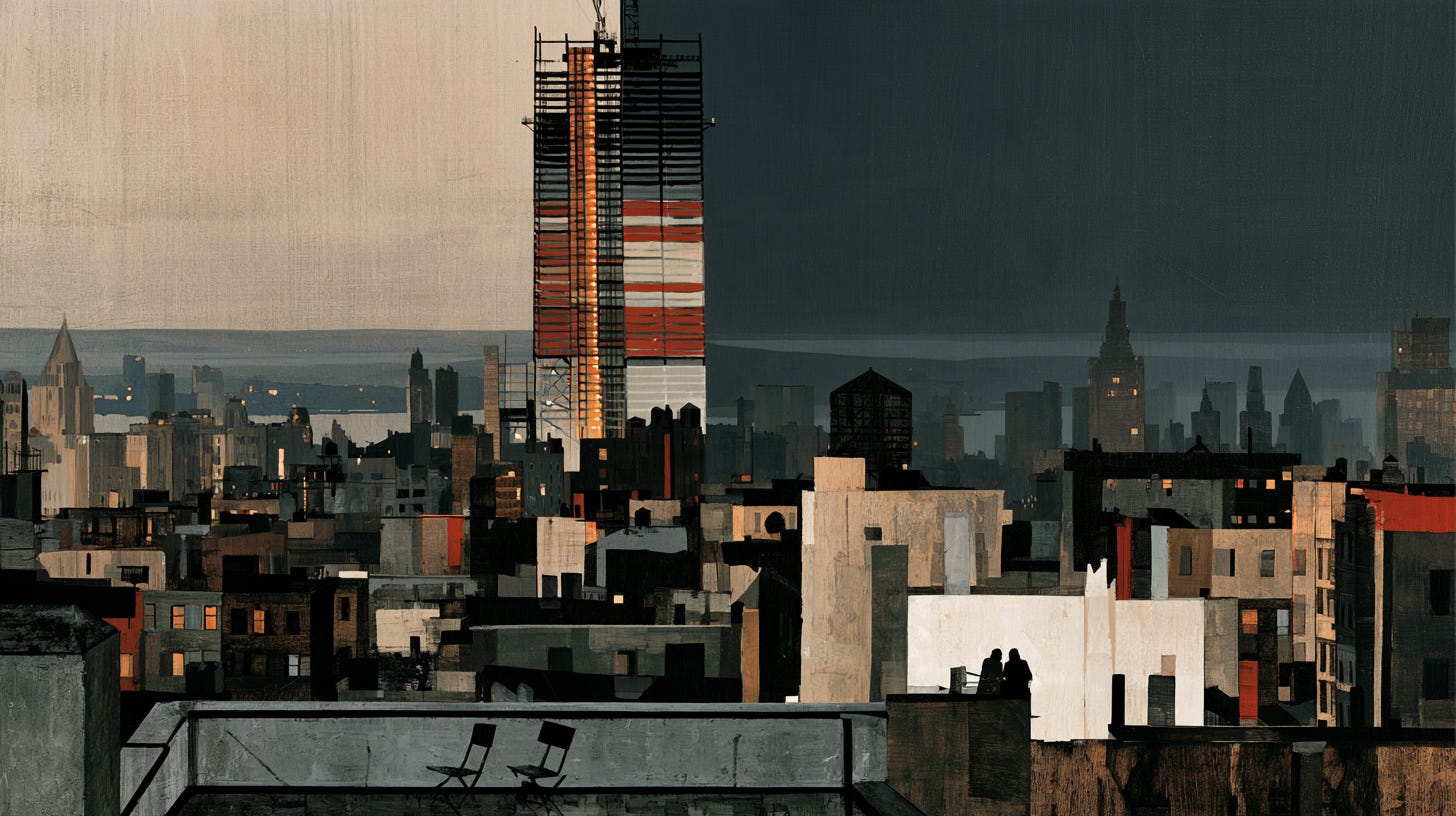
For a stretch of years in my twenties and early thirties I lived in Greenwich Village, in an apartment somewhere between the Comedy Cellar and the Blue Note. Long hours, long commute, home late. One of the things we did in those years was climb up to the roof at night, hush each other on the stairs, and try not to laugh loud enough to wake the neighbors.
When I moved in, you couldn’t see the new World Trade Center from up there. Then you could. It came up over the other rooftops inch by inch, a little more of it each season. For what felt like years it had no windows, just floors of raw structure lit around the clock by industrial bulbs for the crews. They changed those bulbs out for the Fourth of July and for the September anniversaries, so a few nights a year the unfinished tower burned red, white, and blue over lower Manhattan. Then the glass went on and it turned shiny, and the industrial light softened into office light, and then there were tenants. A friend in real estate liked to brag that more firms had committed to the building before anyone set foot inside it than had committed to the Burj Khalifa. I have no idea whether that was true. I liked it anyway. One of the last things I did before leaving the city was ride to the top.
Twenty-five years out, we rebuilt the tower. It’s finished. It’s clad and lit and full of people paying rent, and you can buy a ticket to the top.
The other rebuild is the one still in doubt.
We rebuilt the tower faster than we rebuilt the thing the tower was supposed to mean.
I’ve made the case before that a country holds together because ordinary people keep building it, and that sitting in the stands cataloguing its flaws is a way of quitting that dresses up as insight. I watched us pour the concrete and raise the steel, floor by floor. It was our answer to the attack, and it worked, and it’s beautiful at night. What we haven’t managed to pour back is the confidence that lets a free people say, without a running apology, what it stands for proudly.
The thing I miss most about New York, after the friends, is that you almost never had to guess where you stood with someone. People told you. That directness is a kind of civic muscle. A place where you know where you stand is a place that still knows what it is. A place where everyone hedges, and reads the room, and waits to see which way the sentiment breaks before committing to a position, is a place quietly renegotiating a fabric it used to take for granted.
This past Friday, twenty-five years to the day, I watched an American reach the final of the U.S. Open, with a real shot at the first men’s title an American has taken there since Andy Roddick in 2003. He hasn’t won it yet. I’ll be cheering him on today.
The tower is finished and the match isn’t, and the second rebuild, the one I deeply care about, looks a lot more like the match than the tower. It’s less a monument than a chance you take or let pass, over and over, in how you talk and what you’ll defend.
From the roof where I watched the light come up over the harbor inch by inch, the distance some people now keep from their own country doesn’t read as wisdom. It reads as the one repair we’ve decided not to attempt.
Sources and Inspiration
We Keep Building — the argument this essay is the receipt for.
Leaving New York City — what I wrote when I left the city.