

We had just cleaned up from a day on the lake. Dinner prep for the family gathering hadn’t started yet, and my uncle and I were sitting at the table with a glass of red from his cellar. He’d had a long and successful career. Somewhere in that time at the table, he told me to find a strategy day.
I’m paraphrasing him. The idea was a day set apart from the work of the job, more exploratory, more fallow. You don’t do your job on that day. You give your mind room to get to the work it has been leaving untended: the thinking that only happens in the background, in the shower, on the long solo drive, once you stop pushing on everything in the foreground.
I wanted it right away. I also had no idea where it would come from. I have two young kids. Mornings and evenings belong to them. In between, I work as fast as I can, and after they’re in bed I keep going. Most weeks in 2026 run past seventy hours, I’ve been logging it. A day away from the job to go think felt like a luxury I hadn’t earned yet. Our life wasn’t stable enough to allow it.
I come back often in these pages to agency, and my own version of it is going permissionless. The things worth having in this life you usually have to go get, because the person withholding permission is almost always you. It has been two and a half years since that table, and I have not taken a single strategy day.
What I did instead was get squeezed. My income got cut. My taxes tripled in the form of tariffs. I was already careful with my time, and I had to get maniacal about it. Nearly vicious, to the point that I know I have hurt people’s feelings.
Mostly that has meant saying no. I haven’t traveled to see a friend since 2019. Every trip since has been local or for family. I skipped my five-year business school reunion. I turned down two or three invitations to Formula 1 Grands Prix. I’ve said no to several trips to see my wife’s parents. The reasons were always the same two: cost and work that kept overflowing its banks.
My personal life is the one taking the hit, and I know that too. The order in my head hasn’t changed. My kids’ daily routine comes first, then how the house runs, then work. And work asks more of me now than at any point in my career. Everything else sits sidelined or barely squeezed in.
The field
A farmer leaves a field fallow on purpose, so the ground can recover what a run of harvests took out of it. Nothing gets planted. Something is still happening in the soil.
My uncle’s advice sat in me like that. I couldn’t act on it, and Iain McGilchrist, a psychiatrist, has an explanation for why. In The Master and His Emissary, he argues that the two halves of the brain attend to the world in different ways. One brings a narrow, focused attention, aimed at getting what we need. The other brings a broad, open attention to everything else that’s going on. Pressure pushes us toward the narrow kind. In his words, “an increase in stress, fear and excitement actually inhibits the spread of neuronal recruitment in a manner that favours this very closely targeted kind of attention within the left hemisphere.”
Two and a half years of that pressure is a long time spent in the narrow beam. A strategy day asks for the other kind of attention, and I didn’t have any to give.
Still, the advice kept appearing while I ignored it.
When I first pictured the day, I pictured a long hike, and a couple of other ideas like it. I was grasping in the dark. I didn’t know what the day was for, so I couldn’t want it very hard. Now I know exactly what I’d do with it, and knowing has made me want it more. Time is the scarcest thing in my week. Open time with no purpose used to look like a luxury I hadn’t earned. Open time with a purpose, left untaken, looks like waste.
Always invert.
The court
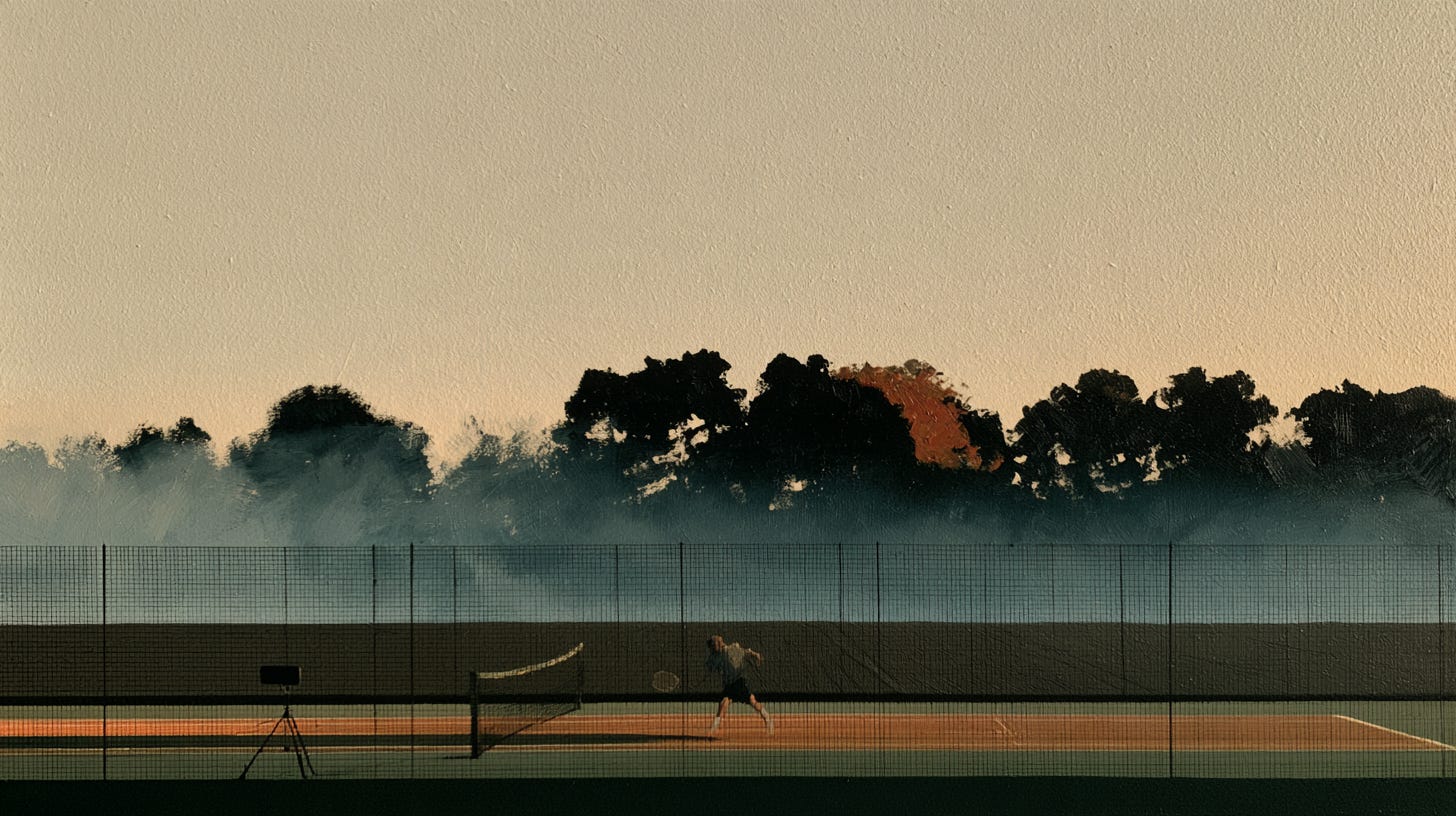
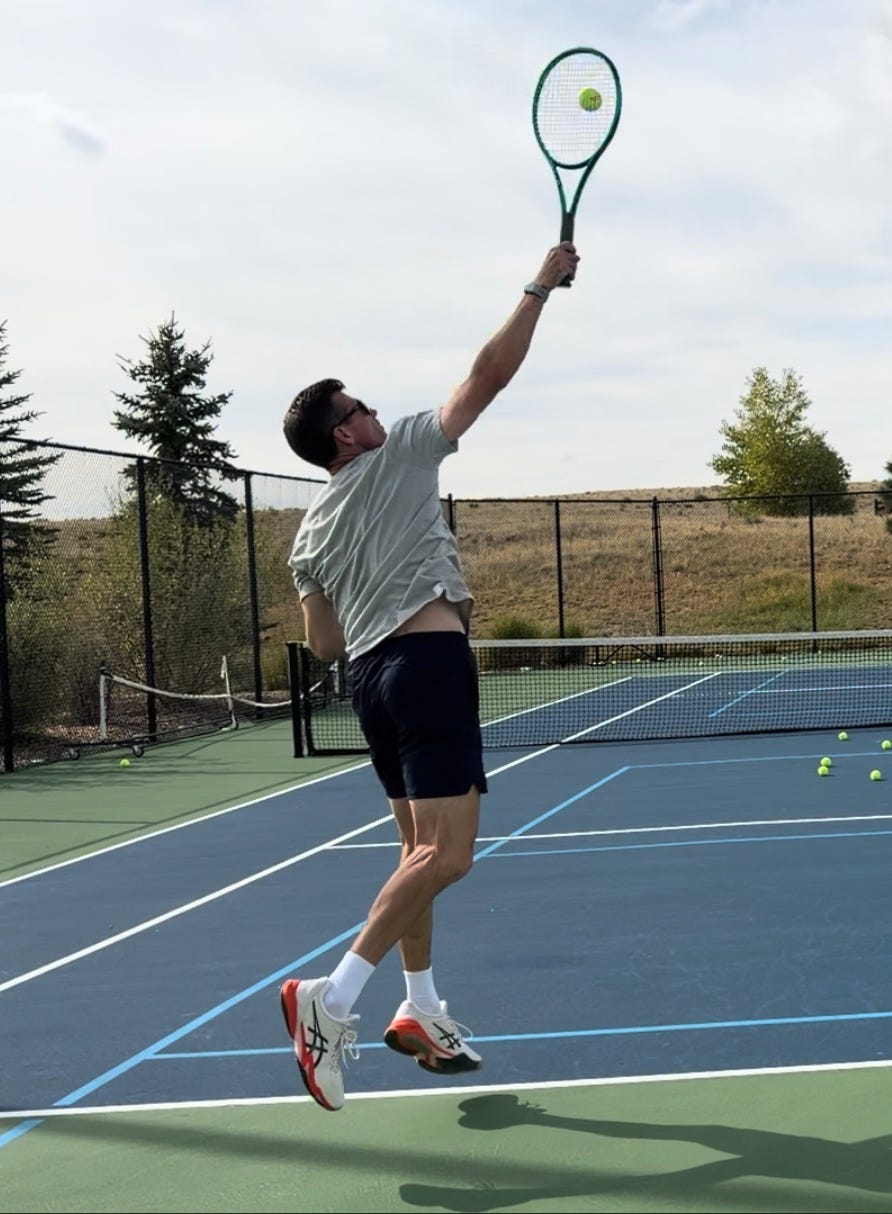
I’d play tennis. I want to be a beginner at something again and start from nothing. Tennis asks for all of me at once: body and brain, practice and study, physical effort and strategy. And I’d film myself. I’d sit with the embarrassment of watching how I actually move, which I expect will look different from how it feels.
Timothy Gallwey was a tennis coach when he wrote The Inner Game of Tennis, a book whose real subject is attention. In one story, a business executive named Jack comes to him with a backhand problem. His racket goes back too high. Five pros have told him so, and he hasn’t been able to fix it. Gallwey doesn’t tell him a sixth time. He walks Jack over to a large windowpane and has him swing while watching his reflection.
Two and a half years of that pressure is a long time spent in the narrow beam.
Jack is astounded. “Hey, I really do take my racket back high!”
Gallwey was surprised by the surprise. Jack had heard the correction five times. Gallwey’s explanation is that “no one is ever surprised at seeing something they already know.” Jack had been told. He had never seen. Once he did, the fix took almost no effort. In Gallwey’s account, the change came “in the instant he stopped trying to change his backhand, he saw it as it was.”
That is what I want from the court and the camera. I want the practice of seeing a thing as it is, starting with my own body, whose feel I trust and shouldn’t. It’s the same skill I need for the business, which, like a backhand, feels one way from inside a seventy-hour week and looks another way on film. Running on only one side of McGilchrist’s divided brain holds my business back too.
The route
For me, going permissionless has turned out to be slower than booking a day off. If I blocked out next Monday with nothing behind it, the work would flood back in by lunch. Taking the day means building the road to it. Can I delegate more? Can I get the people around me better prepared and better equipped, so the things that stand between me and that day can run without me? Those are process questions, and process questions have answers.
Open time with a purpose, left untaken, looks like waste.
The strategy day used to be a reward I’d get once life settled down. Now it’s a place I’m trying to reach, and I can see the route. I believe more time in that open kind of attention will compound as hard as anything in my life. Tennis is an imperfect fit, I know. It will be a narrow and wide beam activity. I think the switching is one of the useful points here; much like meditation, I need not only the counter-balance, but the practice of switching.
Everything about your body and mind is a use-it-or-lose-it proposition.
I thought I understood my uncle at that table. I did, the way Jack understood his five pros. What I didn’t have was the version that fit me: this house, these kids, this work, this particular squeeze. That took two and a half years to grow, and most of the growing happened while I wasn’t tending it, which is what he told me would happen.
My kids hear plenty of advice from me. Most of it won’t land for years. I hope some of it lies fallow in them the way his did in me, and comes up when it fits.
In the meantime, I’m working on the route. At the end of it is a tennis court and some real match play.
Proof of Work.
I am taking some time off from publishing.
After 61 essays, this field needs some fallow time.
I’ll be back sometime in November or December.
Sources and Inspiration
The Inner Game of Tennis - Timothy Gallwey
The Master and His Emissary - Iain McGilchrist