

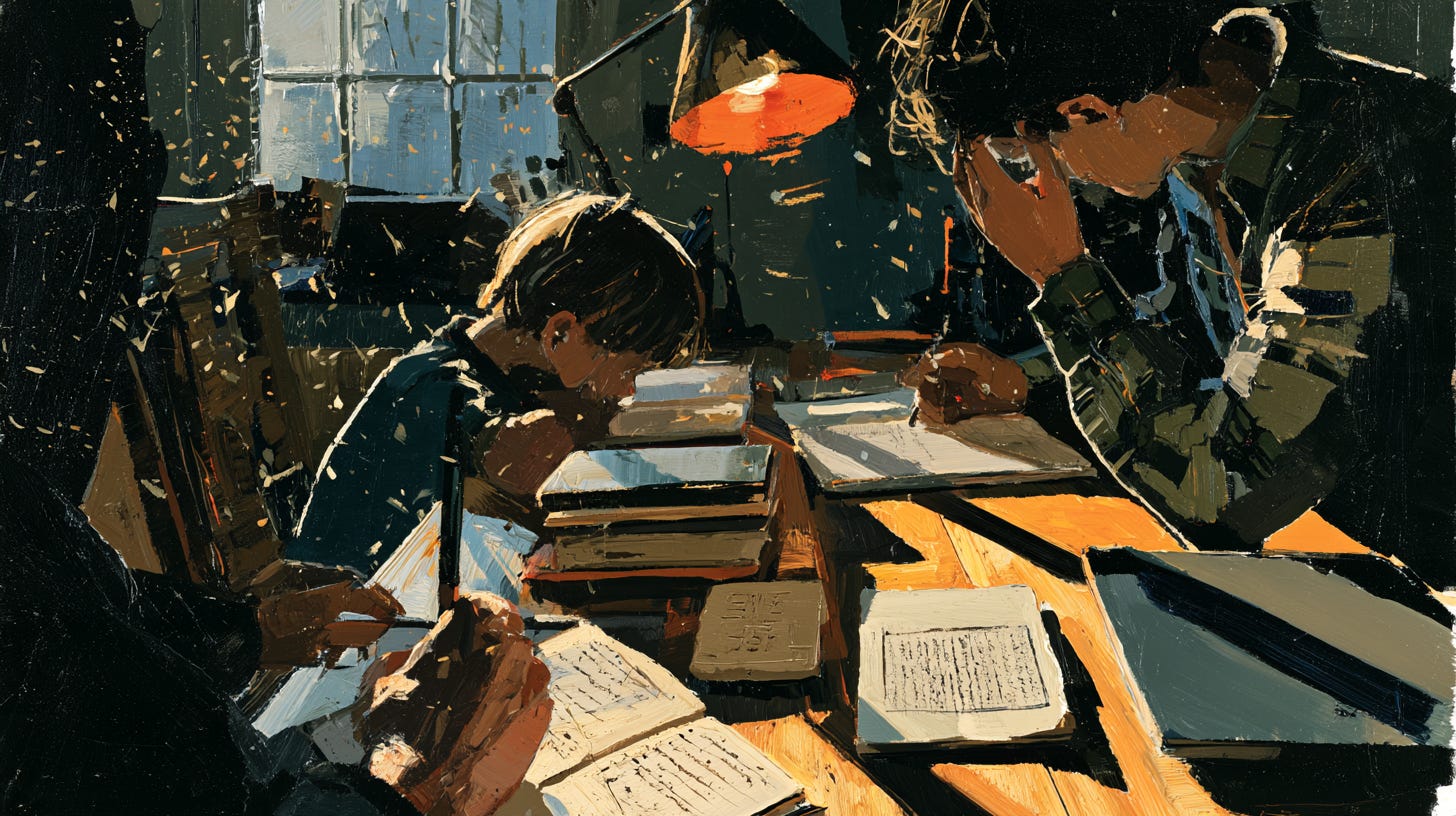
Every morning I open a fresh conversation with a mind that has read more than any human who ever lived, and every morning it has forgotten the work we were doing.
It holds the compression of a thousand libraries. It can quote the Federalist and the Analects and the service manual for a diesel injector. No sweat. But it does not know what we decided yesterday, or what this project is, or my occupation. Well, I don’t know my occupation either.
Each session it wakes into a blank room. So I keep a file it reads first, naming who I am, what we are building, and the decisions already made. I feed it notes. We bolt on a memory. The whole apparatus exists for one purpose: be useful, do not make the mistakes of the past, and know where we are driving towards. Skip the file and the genius can invert into ignorant and baffling vectors. Brilliant, yet waiting to be told what it already helped decide.
The strangeness of that wears off fast into frustration. Or, for many, into a malaise of not understanding what this hype is all about.
Underneath the frustration sits a problem we already know how to solve. We have been solving it in each other for as long as there have been people.
No one is born a citizen
Because that is us. We run about eighty years and we cannot save our state. Whatever a person comes to understand — how a market clears, why the man who promises to fix everything is the one to fear, what it cost the last time a country tried to abolish disagreement — dies in the skull that learned it. None of it rides in the genes. A child is not born a citizen the way she is born with lungs. She arrives in the blank room knowing nothing, and everything a free society knows has to be loaded into her from scratch, and then again into the next child, and the next, without end.
We have a name for that reload. Most of it we call education. The civic part, the part that carries why we live the way we do, we used to call civics, back when we still taught it.
We kept a Congress with two chambers and courts that can tell a president no. Ask a room why, and you get the word “balance.” The reason is Madison’s: ambition must be made to counteract ambition. Without the reason, the friction reads as failure. Unnecessary stoppage.
The market is the same story told again. We kept it and stopped teaching why it works. Ask why market-based exchange out-produces command and you get a slogan about freedom, or a slogan against greed, and underneath both sits a mechanism almost nobody is handed anymore. The knowledge a modern economy runs on lives nowhere in particular. It is scattered across millions of heads, and the price is how it talks to itself. No one alive knows how to make a pencil start to finish, and the pencil exists anyway; that is the whole argument. Deliver the pencil and skip the argument, and the next generation cannot tell a market from a racket.
We keep the machine and stop teaching the manual, and a machine whose manual is lost stops being maintained and starts being merely inherited, waited on until the day it breaks.
Write it down
For most of our history we did the loading out loud. We were an oral species, and we carried what we knew in myth, story, and song. Everyone has played the kindergarten version of what that costs. One child whispers a sentence to the next, who passes it on, and by the end of the line the words have almost nothing to do with where they started. Telephone is a parlor trick, but an honest one. A people that can only say things out loud loses a little of everything it knows each time it hands it over. Progress is lumpy to non-existent.
Then, about five thousand years ago, we started writing things down. A sentence pressed into clay drifts far less than one passed mouth to mouth. Libraries let one generation hand the next something close to what it actually meant, and when the printing press arrived more than five centuries ago, writing turned cheap and abundant and the amount a society could carry forward exploded. Each step raised the ceiling on how much complexity a people could hold at once. The Constitution and the supply chain behind a pencil both sit on top of that stack.
We are in the middle of the next step, and it may be the biggest one yet. The machine that forgets our work every morning is built out of everything humanity ever wrote down, and its grip on complexity is an inheritance from that record. And what makes it useful to me is what made writing useful to us: I write things down for it. The file it reads first is a library of one. Work with it without one, every session starting from nothing, and you are running an oral culture with a genius in it, playing telephone against yourself. Any AI use that does not grow alongside you leaves most of its value on the table.
A civilization is only what it transmits
The parallel holds up better than a trick of language, and the people who thought hardest about where knowledge comes from drew it long before there were machines to draw it for them.
Karl Popper took on the question “what is the ultimate source of our knowledge?” There are no ultimate sources, he answered, and the demand for one is an authoritarian demand for a pedigree. There is tradition, which apart from what little is inborn is the most important source of knowledge we have, and every scrap of it stands open to challenge. What we know, we were handed; what keeps us free rather than credulous is that we are allowed to argue with it. And beneath all of it sits the floor Popper never let his reader climb off:
While differing widely in the various little bits we know, in our infinite ignorance we are all equal.
We are all born knowing nothing. The genius and the fool arrive in the same blank room.
So where does knowledge live, if no single person holds it? In the space between people. Take the fallible scraps each of us carries, put them in a room, let them argue, and the room comes to know what no one in it knows alone. It is the intelligence we keep straining to build out of silicon and have possessed the whole time. Alone, not one of us is superintelligent; together, pooling what we each half-understand and correcting each other’s errors, we are the nearest thing to it the world has made. And the room is larger than the living. We still think with Madison and Smith and Popper, because someone wrote them down and someone else read them. Break that chain and the shared mind shrinks to whoever happens to be alive and paying attention this decade.
David Deutsch took the same point and made it civilizational. It is why he can hold, without flinching, that our problems are inevitable and every one of them soluble: a mind that keeps combining and criticizing keeps making knowledge that did not exist before. Whether a society keeps growing or ossifies turns entirely on what it transmits and how, rather than on its wealth or its cleverness in any given decade. A static society, the normal condition of humanity for most of its existence, survives by controlling the reload:
Static societies always have traditions of bringing up children in ways that disable their creativity and critical faculties. That ensures that most of the new ideas that would have been capable of changing the society are never thought of in the first place.
It transmits conclusions and forbids the questions. A dynamic society hands down the tradition of criticism itself: the standing permission to take no one’s word for it, its own word included.
Which tells you what actually has to be written down and handed over. It is not the answer. It is the argument. A file of pure conclusions produces an agent that fails the first time the situation slips off its script. A citizen given verdicts without the reasoning that made them keeps those verdicts only until someone offers better-sounding ones, and then the whole inheritance flips. The patriot who wants the founding taught as a catechism, the critic who wants it taught as an indictment, the builder who is certain the next tool will carry it for us: three costumes, one mistake. Each ships the verdict and keeps the reasoning for itself.
The oldest objection is pointed straight at me. Isn’t this the complaint every graying generation files against the young? Stephanie Coontz showed that the golden age we reach back for is a composite that never existed: name the year and you have to take the whole of it, the exclusions and the myths included. Josef Joffe has counted the waves of American declinism, five in five decades, each one certain and each one wrong. America keeps outliving its obituaries, probably because it is an idea, and an idea lives exactly as long as someone keeps teaching it.
They are right. There was no golden age of civic understanding; it was never widespread. What there was, for a while, was a habit of teaching it on purpose, and a habit is a practice we can stop. We already know how to load the next mind. We wrote the manuals. We built the libraries and the schools. When we stop using them, a society gets worse in ways it cannot quite explain, and it reaches for someone who promises the friction will go away. I believe this is one of the diagnoses of our current time.
Which is where the old story has been waiting the whole time. Prometheus stole fire and gave it to us, and fire in the myth was never only warmth. It was technē: the crafts, the arts, the knowing-how of civilization itself. Fire is a process, not a possession. It goes out when it is not tended, and it does not copy itself into the next hearth. Someone has to carry it, cupped against the wind, and light the next one.
We are all born knowing nothing, and so is every machine we build. The fix is the one we already have. Write it down. Load the why along with the what. Give the next mind the argument, not just the answer. The agent on your desk is no different from the child at your table: skip its context, never tend what it has been handed, and it will be as lost as a citizen who was never told why the Congress has two chambers. Light the next fire by hand. That is the whole of the work, and it has never once been finished.
Sources and Inspiration
Conjectures and Refutations - Karl Popper
The Beginning of Infinity - David Deutsch
The Federalist Papers - Alexander Hamilton, James Madison, John Jay
The Way We Never Were - Stephanie Coontz
The Myth of America’s Decline - Josef Joffe