

Yuval Noah Harari on meaning:
“Human life has absolutely no meaning. Humans are the outcome of blind evolutionary processes that operate without goal or purpose... any meaning that people inscribe to their lives is just a delusion.”
On human rights:
“There are no gods in the universe, no nations, no money, no human rights, no laws, and no justice outside the common imagination of human beings.”
On free will:
“Humans are now hackable animals. The idea that humans have this soul or spirit and they have free will, that’s over.”
On progress:
“We thought we were saving time; instead we revved up the treadmill of life to ten times its former speed.” The Agricultural Revolution? “History’s biggest fraud.” We didn’t domesticate wheat. “It domesticated us.”
On our cosmic significance:
“If planet Earth were to blow up tomorrow morning, the universe would probably keep going about its business as usual. Human subjectivity would not be missed.”
On the future:
“Those who fail in the struggle against irrelevance would constitute a new ‘useless class.’” Homo sapiens will likely “disappear in a century or two.”
These are not marginal observations. These are the central claims of one of the most widely read thinkers of the past decade. Tens of millions of copies sold. Translated into dozens of languages. Assigned in universities, discussed in boardrooms, cited by world leaders.
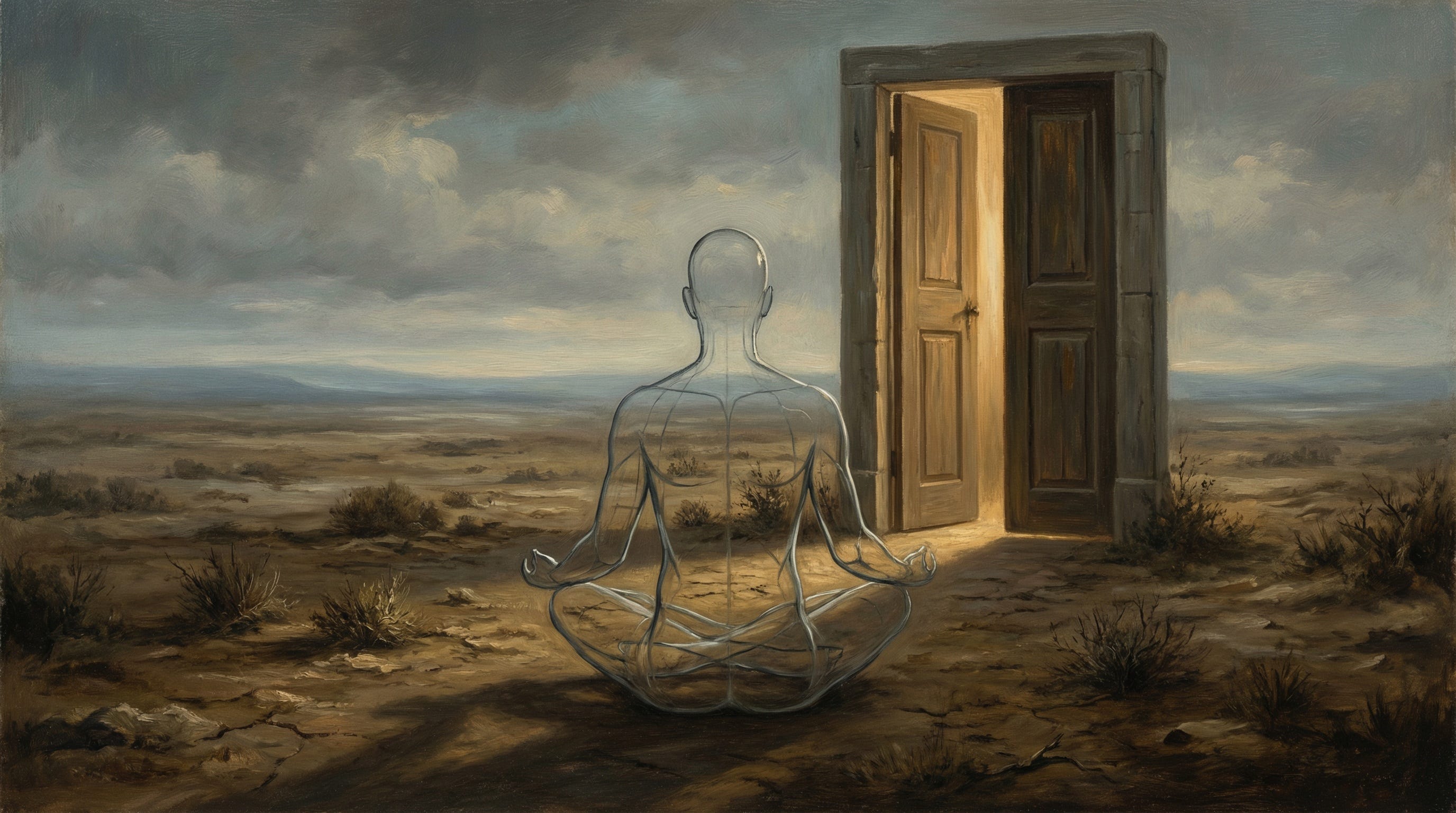
And something about them closes doors.
I must admit, I was a Harari disciple upon my first reading. It spoke to me in ways that I can only assume was a shared experience by many others. However, after reading David Deutsch’s The Beginning of Infinity. Deutsch has a concept he calls “bad philosophy.” Not philosophy that’s merely false (Aristotle was wrong about physics, but his philosophy opened inquiry). Bad philosophy is something more corrosive: ideas that actively prevent the growth of knowledge. Frameworks that make problems seem unsolvable by design. Conclusions that foreclose rather than open.
After absorbing Deutsch’s framework, Harari’s work reads differently. The quotes above aren’t just provocations. They’re door-closers. “You’re hackable” isn’t an invitation to investigate consciousness. It’s a terminus. “Meaning is delusion” doesn’t open inquiry into what makes life worth living. It shuts it down.
Bad philosophy doesn’t give wrong answers. It prevents better questions.
But here’s what puzzled me: Harari meditates two hours a day. He’s done months of silent Vipassana retreat. When Buddhist masters say “no self,” they’re pointing toward liberation. When they say form is emptiness, they’re opening a gate. Harari uses similar language and arrives somewhere else entirely. Same starting territory, radically different destination.
What happened?
Harari and Sam Harris are often grouped together because both speak favorably about meditation and draw from Buddhist traditions. The similarity is superficial. Their relationships to Buddhism differ in orientation, depth, and philosophical ambition.
I’ve listened to the two of them speak with each other for hours. Unfortunately, current events nearly always take the show rather than the two of them sparring on Buddhism and meditation. Sam, if you’re reading, let’s do it. I’d love to hear you wander around with Harari on the topic.
Harari’s connection is primarily disciplinary and experiential. He practices Vipassana in a traditional, intensive form. He treats meditation as a tool for epistemic hygiene: a way to observe mental phenomena directly and reduce self-deception. Buddhism, for him, is not a truth-claim about reality but a technology for seeing how minds generate suffering, narratives, and illusions. This perspective underwrites his historical work. His skepticism toward stories, identities, and humanist myths is consistent with Buddhist insights about impermanence and non-self. But he does not argue for those insights philosophically. He treats them as observations revealed through practice.
Harris’s connection is philosophical and normative. He engages Buddhism selectively, abstracting key insights (especially non-duality and the illusion of self) and then argues for their truth using analytic philosophy, neuroscience, and introspection. Meditation, for Harris, is not merely a practice but evidence in a broader claim: that certain Buddhist insights are objectively true descriptions of consciousness and can be integrated into a rational, secular worldview. He rejects much of traditional Buddhism while preserving what he sees as its core metaphysical insight.
The contrast can be stated cleanly. Harari uses Buddhist practice to undermine confidence in meaning-making systems. Harris uses Buddhist insight to establish a positive account of mind and well-being. Harari is descriptive and deflationary. Harris is prescriptive and reconstructive.
Harari treats Buddhism as a method that dissolves illusions. Harris treats it as a source of truths worth defending.
This matters because it reveals what Harari took from the contemplative tradition and what he left behind.
The Buddhist insight that “self is constructed” is not meant to terminate in despair. It opens into something. The dissolution of the grasping ego reveals interconnection, compassion, presence. The emptiness points toward śūnyatā: the ground from which meaning arises fresh, unburdened by clinging.
When a Buddhist master says “no self,” the next movement is toward all beings. The deconstruction is preparatory, not final. You dissolve the illusion of separateness and discover you were never alone.
Harari took the deconstructive move and stopped. He accessed the insight that narratives are constructed, selves are assembled, meaning is not given by the universe. True enough, in a sense. But then he stayed in the rubble.
His conclusions follow: if meaning is constructed, it’s “just a delusion.” If selves are assembled, humans are “hackable animals.” If stories are fictions, we can be reprogrammed by whoever writes better code.
This is left-hemisphere Buddhism: analysis that stops before integration, taking-apart that never returns.
The psychiatrist and philosopher Iain McGilchrist argues that the brain’s hemispheres don’t do different things so much as attend to the world in fundamentally different ways. The left hemisphere narrows, focuses, grasps. It excels at analysis, categorization, taking things apart. The right hemisphere opens, contextualizes, integrates. It holds the whole, the meaning, the way parts fit together.
Both modes are necessary. The pathology is when one dominates without the other’s correction. McGilchrist’s central image: the right hemisphere is the master, the left its emissary. The emissary goes out, gathers information, executes tasks. The master retains the broader view, the sense of purpose. Problems arise when the emissary forgets its role and begins to believe it is sufficient unto itself.
Harari’s Buddhism is the emissary without the master. He can dissolve the illusion of self but cannot complete the movement into what that dissolution opens. He visited the master’s house, took notes on the emptiness, and returned to report there was nothing there.
But the emptiness was the doorway, not the destination.
Why does this sell?
Erich Fromm understood. Freedom is a burden. The weight of choosing, of being responsible for your own meaning, of facing a universe that doesn’t hand you significance on a platter: this is difficult.
Harari offers relief. You don’t have to figure out what your life is for. It’s not for anything. Meaning is a delusion, so stop grasping. The algorithms will sort it out.
This is an escape mechanism dressed as sophistication. “I’m too intellectually honest for meaning.” But the exhausted reach for certainty, and nihilism is a form of certainty. It closes the question. You can stop searching.
The true believer, Eric Hoffer observed, doesn’t primarily seek truth. He seeks relief from the burden of selfhood. Harari’s readers aren’t necessarily true believers in the cult sense. But the appeal has the same structure: here is permission to stop struggling with the hard questions. The universe is meaningless. Your intuitions about significance are just evolutionary residue. Relax into hackability.
The alternative is harder. It requires holding the insight that meaning is not given while still constructing meaning worth living for. It requires dissolving the grasping ego without collapsing into passivity. It requires the return.
There’s a reflexivity problem in Harari’s position that he never addresses.
The insight that dissolves meaning should dissolve the speaker’s authority too. If narratives are fictions, Harari’s narrative is fiction. If humans are hackable, his predictions are outputs of a hacked system. If “any meaning that people inscribe to their lives is just a delusion,” then the meaning Harari inscribes to his project of enlightening millions is also delusion.
But he doesn’t write that way. He writes with the confidence of someone who has seen through the illusions and now reports from outside them. The deconstruction is applied to everyone except the one doing the deconstructing.
This is the tell. A genuine “no self” position would dissolve the narrator along with everything else. What remains is humility, or silence, or compassion.
Harari retains the authority of the one who knows while denying that knowing is possible. He stands outside the system he’s describing, which is precisely what his system says can’t be done.
What’s actually at stake?
David Deutsch offers a counter: problems are soluble. The future is not determined. Humans are not algorithms because humans generate explanations that change everything. The growth of knowledge is unbounded. We are not hackable because we can always conjecture something new, criticize what exists, and create what didn’t exist before.
This is not naive optimism. Deutsch is clear-eyed about how things can go wrong. But his framework opens doors. “We don’t yet know” is an invitation to inquiry. “You’re hackable” is a full stop.
Jung offers another counter. Human consciousness doesn’t seem to operate in isolation. The same symbols, the same myths, the same archetypal patterns appear in cultures that never touched each other. Calculus emerged simultaneously from Newton and Leibniz. Natural selection from Darwin and Wallace. Jung called this the collective unconscious: something shared beneath individual minds that shapes what we dream, what we create, what we discover.
Harari would likely dismiss this as pattern-matching on randomness, or convergent evolution of cognitive modules. But notice what that dismissal does. It takes a phenomenon that feels meaningful (the sense of participating in something larger than the individual self) and declares it epiphenomenal. The left hemisphere can’t grasp it, so it must be illusion.
This is the emissary’s confidence again. What it can’t measure, it dismisses. What it can’t analyze, it denies.
The Buddhist return offers the deepest counter. Emptiness isn’t the destination. It’s the clearing that allows compassion and meaning to arise without grasping. You dissolve the fixed self and discover something larger. The insight is preparatory to engagement, not withdrawal.
Harari foreclosed all three.
I don’t think Harari is malicious. I think he’s incomplete.
He accessed something real through practice. The constructed nature of experience. The way minds generate narratives. The absence of meaning written into the fabric of the universe. These are insights, and they can shatter comfortable illusions.
But shattering is not the end. What matters is what you do with the pieces.
Harris tries to rebuild: a secular ethics, a science of well-being, a meaning grounded in the facts of consciousness. You can argue with his reconstruction, but he’s attempting the return.
Harari stays in the rubble and describes it. Worse, he predicts that the rubble is all there will ever be. The stories are fictions. The selves are hackable. The useless class awaits. This is what you see when you stop halfway.
Bad philosophy doesn’t just give wrong answers. It prevents better questions. It forecloses the inquiry that would reveal its incompleteness. Harari’s millions of readers don’t just absorb false claims. They absorb a frame that makes certain thoughts harder to think.
What would it mean to hold the same insights Harari accessed and complete the movement he abandoned?
The self is constructed. We can construct selves capable of bearing freedom.
Meaning is not given. And we can create meaning worth living for.
Narratives are fictions. Some fictions are more true than others.
The door Harari closed was never locked. It just requires walking through.
Now go.
Sources and Inspiration
The Beginning of Infinity - David Deutsch
The Master and His Emissary - Iain McGilchrist
Escape from Freedom - Erich Fromm
The True Believer - Eric Hoffer