

America, Our Dare — a series on the American experiment, for the 250th
Founding Fragility · A Government Designed to Be Wrong · We Keep Building · Selection Bias on the 250th
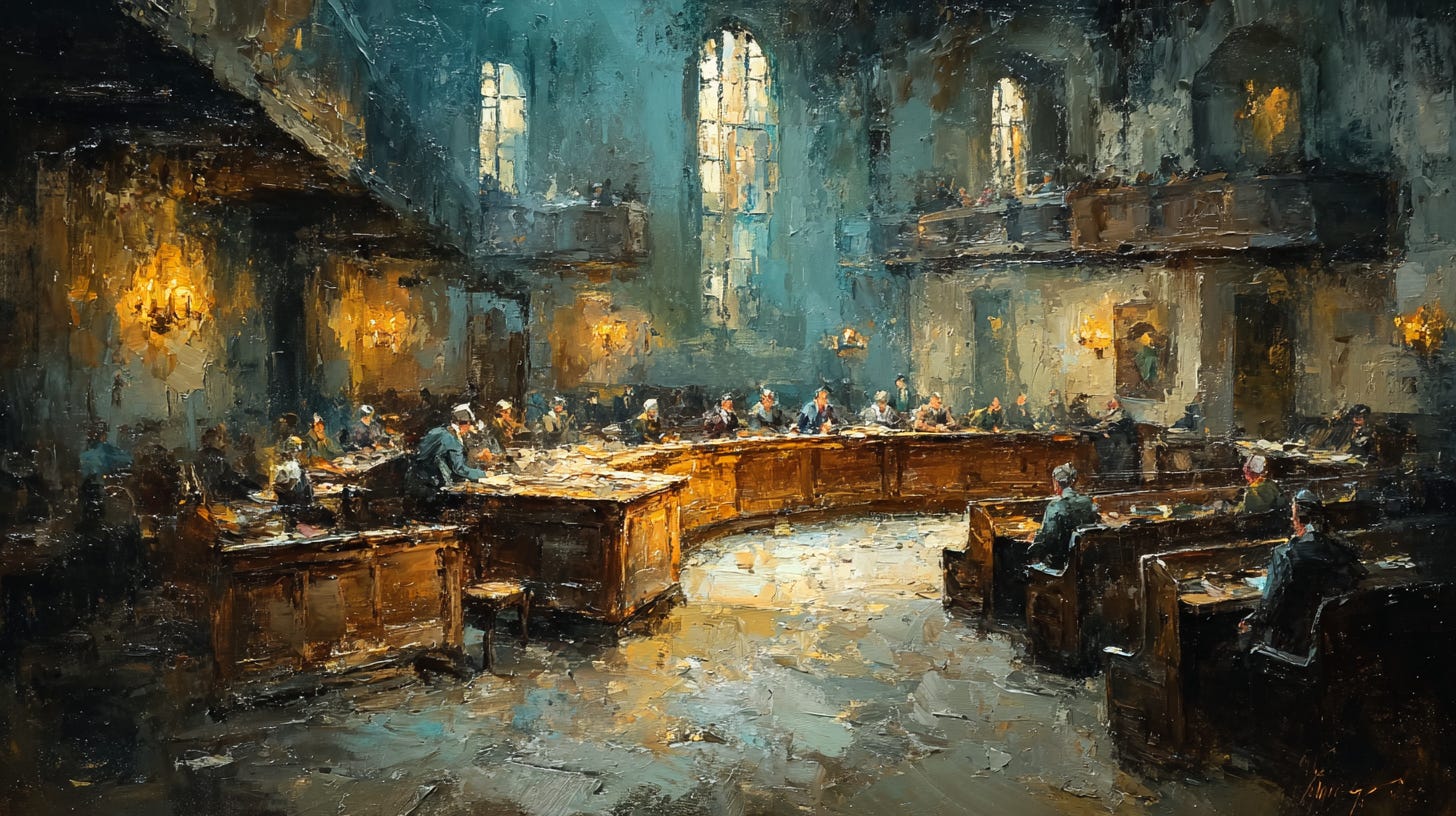
The windows of the State House were shut against the Philadelphia summer, which also meant shut against anyone listening. Fifty-five men in a sweltering room, sentries at the doors, a secrecy rule so strict that nothing said inside would reach the public until the work was finished. James Madison sat near the front and took notes he wouldn’t allow published until every delegate in the room was dead.
For roughly five thousand years of recorded civilization, the answer to “who governs?” had been the same: somebody born to it. Pharaoh, emperor, king, chief, divine right, bloodline, conquest sanctified by time. The structure never changed. One person or one family ruled, and everybody else was ruled. It worked well enough, often enough, for long enough that attempting to change it was deadly.
The men in that room were there to try.
They weren’t starting from scratch. The Articles of Confederation had already failed. The Revolution had been won (barely, by fog and desperate gambles), and the country it created was falling apart. States printed their own money, ignored their debts, quarreled over borders. The Continental Congress couldn’t raise taxes or enforce its own decisions. European observers gave the experiment a few more years before it collapsed into either monarchy or anarchy.
The men in that room knew this. Many of them had fought for independence. Some had signed the Declaration. They were lawyers, merchants, plantation owners, speculators, war veterans. They were also slaveholders, land grabbers, and creditors protecting their interests. They were not demigods arriving with a blueprint. They were politicians arriving with agendas, arguing for four months about a form of government that had never existed at this scale.
What they produced was something stranger than perfect. It was a system designed by men who assumed they’d get things wrong.
The genius of anticipated failure
Monarchy doesn’t need an amendment process. If the king is sovereign by divine right, the system is correct by definition. Error belongs to the subjects, not the structure.
Karl Popper, writing from exile during the Second World War, identified this assumption as the most dangerous idea in Western political thought. He called it historicism: the belief that someone, somewhere, has access to the correct answer. Plato’s philosopher-kings. Hegel’s unfolding Spirit. Marx’s inevitable revolution. The content changes. The structure remains: if you know the destination, everyone who disagrees is an obstacle.
What happened in Philadelphia was the opposite of this. The framers designed a system premised on the idea that no one has access to the correct answer. Not the president. Not the Congress. Not the courts. Not the framers themselves. Article V of the Constitution is the most radical sentence in the document: it provides the mechanism for the people to change anything in it, including, in theory, Article V.
These men had egos that could fill the room. Hamilton wanted a president for life. Madison arrived with a plan to override state legislatures entirely. The Virginia delegation wanted representation by population; the New Jersey delegation wanted equal votes regardless of size. They fought bitterly about every clause.
Madison’s plan to extend Congress’s veto over all state laws was defeated, 7-3-1. Even Madison didn’t get the centralization he wanted. The compromise that survived left more room for state-level wrongness than he thought wise.
But the system they built encoded a specific epistemological commitment: we might be wrong. Madison made the commitment explicit in Federalist 51. If men were angels, no government would be necessary. The whole architecture turned on the assumption that men are not angels: ambition would have to counteract ambition, and flawed creatures would need machinery to constrain themselves. Joseph Ellis would later document how the post-ratification decade nearly tore the republic apart. The pattern was there in Philadelphia. The Constitution wasn’t consensus. It was negotiated truce. The three-fifths compromise on slavery was morally catastrophic. The electoral college was a jury-rigged solution to a problem no one could solve cleanly. The Bill of Rights had to be added later because the original document didn’t protect individual liberties explicitly enough.
Every one of these flaws was real. And the framework included the mechanism for addressing them. That mechanism is the point.
The framers’ question wasn’t who should rule. It was how to design institutions so the wrong ruler does limited damage. Elections, separation of powers, impeachment, amendment: every mechanism assumes the next person in the chair might be wrong.
The slaveholders wrote a framework through which slavery was abolished. The men who excluded women from voting built a system that eventually extended the franchise to everyone. The elitists who feared mob rule created institutions that, over two centuries, became more democratic than anything they imagined or intended. The correction happened through the framework. Dismissing the mechanism because its creators were flawed is dismissing the very process through which those flaws got corrected.
I’ve done both versions of the dismissal: gold-leaf reverence and tainted-origin contempt. Most of us lean one direction. They’re the same error, treating the founders as the point, when the founders built something designed to outlast and outgrow them.
A system for people who don’t know the future
Hannah Arendt called the ability to begin something new “natality.” Every human being arrives as a fresh start, capable of doing what has never been done. The founding was an act of natality at civilizational scale: a beginning, not the application of a theory. The framers were starting something they couldn’t predict.
Arendt’s insight matters here because it rescues the founding from two traps. The first is inevitability (it was always going to happen this way, manifest destiny, God’s plan for America). The second is cynicism (they were just protecting their property, the ideals were cover for self-interest). Both flatten the genuine uncertainty of the moment. These were people acting into a future they couldn’t see, making commitments they couldn’t guarantee, and building in the assumption that the people who came after them would need to fix what they got wrong.
The amendment process has been used twenty-seven times. The thirteenth abolished slavery. The nineteenth gave women the vote. The twenty-sixth lowered the voting age to eighteen. Each amendment was a correction, an admission that the previous version was incomplete. This is constitutional piecemeal repair: test, discover the error, correct. The slow, grinding, imperfect work of making a flawed system less flawed.
Alexis de Tocqueville, arriving from France in the 1830s, saw something in American life that had no equivalent in Europe. Americans governed themselves daily. They formed associations to build schools, maintain roads, organize churches, solve problems. They didn’t wait for a king or a ministry. The township, Tocqueville thought, was to freedom what primary schools are to science: the place where citizens first learn the habit of governing themselves. Self-governance practiced in small rooms, over questions that affected their actual lives.
This is the other half of the bet. The Constitution provided the structure. But the structure only works if citizens fill it with the habit of governing themselves. Tocqueville’s warning was that democracy could hollow itself out, citizens gradually surrendering self-determination for the comfort of being managed. The framework holds only as long as enough people keep choosing to use it.
We inherited this. The founding was fragile. The framework that survived is fragile too, in a different way. Its fragility is civic rather than military: whether the people living inside the system still understand what it asks of them.
The bet the framers made was that ordinary citizens, given the tools of self-correction, would keep improving an imperfect government. That future generations would use Article V instead of abandoning the project. That people who inherited freedom’s burden would choose to carry it rather than hand it to someone who promises to carry it for them.
I think about this when I watch people on both sides talk about the founders. The reverence and the contempt share something: both treat the founding as settled. One side says it was great and needs restoring. The other says it was rotten and needs replacing. Neither reckons with the possibility that the founders’ actual genius was building a system that asks to be used. Argued over, amended, extended, corrected. Worked.
The radical bet was that we would keep fixing it.
Two hundred and fifty years in, the question is whether we’re still making that bet. Whether we still believe the slow, exhausting, imperfect work of self-governance is worth the trouble. Whether we’re still the kind of people who would rather argue about how to fix a flawed system than surrender the argument to someone who claims to have the answer.
I think we are. But believing it isn’t enough. The founders didn’t just believe in self-governance. They practiced it, daily, in rooms that were too hot, with people they couldn’t stand, over problems they couldn’t solve. The bet renews itself only in the practice.
The system is still here. The mechanism still works. The bet, as always, is on the people who fill it.
America, Our Dare — a series on the American experiment, for the 250th
Founding Fragility · A Government Designed to Be Wrong · We Keep Building · Selection Bias on the 250th
Sources and Inspiration
The Open Society and Its Enemies - Karl Popper
The Federalist Papers - Alexander Hamilton, James Madison, John Jay
Founding Brothers: The Revolutionary Generation - Joseph J. Ellis
Democracy in America - Alexis de Tocqueville
The Human Condition - Hannah Arendt